Table of Contents
The oldest and strongest emotion of mankind is fear. And the oldest and strongest kind of fear is fear of the unknown. – H P Lovecraft
Despite labouring in obscurity and genteel poverty for all his adult life, H P Lovecraft posthumously became a titan of modern literature. Beginning with a series of reprints in the 1970s, his relatively modest oeuvre of short stories, novellas and one short novel rose to iconic cultural status. Yet, for all his pop culture celebrity, Lovecraft’s coherent literary and personal ethical philosophy remain largely ignored and wildly misunderstood.
Lovecraft’s literary universe is most popularly known for his ‘Cthulhu mythos’ (10 bucks says you’re not pronouncing it properly), which seems, on the surface, a pretty bleak one: a vast, indifferent universe where humanity lives “on a placid island of ignorance in the midst of black seas of infinity, and it was not meant that we should voyage far”. Where, indeed, we are less than flies to wanton schoolboys, so far as the cosmic ‘gods’ of Lovecraft’s pantheon: they kill us, not so much for sport, but because they notice us less than we notice the ants under our own feet.
But Lovecraft’s fiction wasn’t restricted to cosmic horror: he wrote many stories of Dunsanian fantasy where humans explored a rich dream-world of beautiful cities and jewelled oceans, where even ghouls can be (moderately) friendly companions.
So, what was Lovecraft’s philosophy? He dubbed it ‘cosmicism’, an atheistic philosophy of coming to terms with a universe that neither knows nor cares that we exist.
For Lovecraft, the cosmos and human centric views of the universe are completely incompatible. But unlike nihilism, cosmicism emphasizes the complete uselessness and insignificance of humanity to the all powerful universe over which humans have no control. Each of Lovecraft's creations and monsters horrify because they emphasize how humanity’s existence is utterly meaningless in the vast and caring universe. There is no evil to be feared, only indifference.
Lovecraft believed that humanity’s greatest terror is realizing how small we are in the face of the cosmos. How the universe is vast, uncaring, and fundamentally unknowable.
That might sound like a recipe for despair, such as Albert Camus imagined, where “there is but one truly serious philosophical problem and that is suicide”. But, just as Camus concluded that life in an indifferent universe really is worth living, so did Lovecraft.
It is perhaps unsurprising that Lovecraft saw the universe as one of enduring vast indifference.
Born in 1890, Lovecraft was an anxious child who suffered from loneliness and frequent illnesses, many of which are speculated to have been psychological. When he was just 3 years of age, his father had a nervous breakdown in a hotel room and was taken to a hospital where he remained for the next 5 years until his death in 1898.
Lovecraft was raised primarily by women: his mother, two aunts and his grandfather, who naturally became his dominant male role model. Young Lovecraft was a prodigy, able to recite poetry from the age of just two and reading The Arabian Nights by age five. His love of the book inspired him to adopt a pseudonym, Abdul Alhazred, later to become famous as the supposed ‘mad Arab’ author of the forbidden Necronomicon.
Lovecraft also devoured the classic compendium of Greek, Latin, Norse and Romance legend and mythology, Bulfinch’s Mythology. His earliest known literary work is a poem of Ulysses, written when he was just seven.
But with his beloved grandfather’s death, Lovecraft’s world fell apart, in many ways. Besides the emotional devastation, subsequent mismanagement of his grandfather’s estate forced the family to abandon their lavish Victorian home. A nervous breakdown forced Lovecraft to quit high school without finishing his diploma. That this later barred him from university studies further disillusioned the highly intelligent young man, widely read in science and literature, but with no formal qualifications to even land a job that suited his ‘station’ (if nothing else, Lovecraft inherited a wealthy New Englander’s sense of class status).
After a five year stint as a virtual hermit in his room, not unlike a modern-day Japanese hikikomori, Lovecraft eked out a bare living as an editor, ghost-writer, champion of amateur literature, voluminous correspondent and short story writer. Most of his work appeared in the then-obscure magazine Weird Tales. At Weird Tales, Lovecraft became part of a circle of friends and correspondents, including such famous names as Robert Bloch (Psycho) and Robert E Howard (Conan the Barbarian). Lovecraft married Sonia Greene in 1924, with the marriage ending in 1933.
In 1937, Lovecraft died of cancer, aged just 46. His first book collection, The Outsider and Other Stories, wasn’t published until two years after his death.
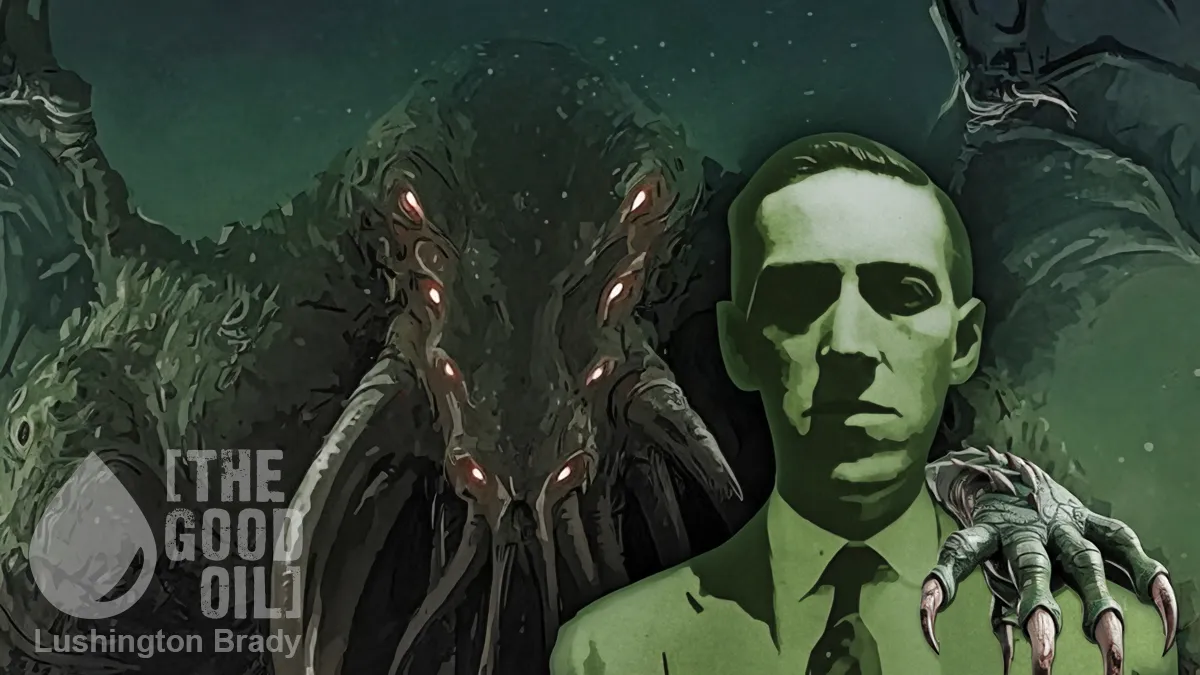
The popular view of Lovecraft’s philosophy is best summed up by his best-known creation, Cthulhu. The very sight of Cthulhu is said to be so incomprehensible to the human mind that upon sight a human would immediately descend into madness. Other ‘deities’ of his cosmic pantheon include Azathoth, the “blind idiot god… encircled by his flopping horde of mindless and amorphous dancers, and lulled by the thin monotonous piping of a demoniac flute held in nameless paws”, and Nyarlathotep, “the crawling chaos”.
Such a universe might seem a recipe for despair and horror but, in real life, Lovecraft asserted it was a constant source of comfort. When the vicissitudes of life drove him to the edge of suicide, he said that remembering he was merely the smallest speck in an infinite universe put his own troubles in perspective.
“Contrary to what you may assume,” he wrote in one of his thousands of letters, “I am not a pessimist but an indifferentist.” The pessimist, he said, is as illogical as the optimist. “Of course, real happiness is only a rare and transient phenomenon; but… we usually find a very tolerable fund of mild contentment at our disposal.”
He needed all he could get. The last month of Lovecraft’s life, documented in a ‘death diary’ he kept up until his final three days when he was unable to even hold a pen, was spent in incredible and unrelievable pain. In his own words, “pain–drowse–intense pain–rest–great pain”. Yet, he retained his sense of equanimity.
The day before his death, a final visitor said, on parting, “to remember the ancient philosophers”. Lovecraft’s only response was a smile.