An expensive ratepayer-funded climate change report has predicted future “extreme heatwaves” for Auckland which, perhaps embarrassingly, turn out to be colder and shorter duration than heatwaves a century ago.
The “Auckland Urban Heat Assessment report 2026” is 44 pages, produced by a private sector climate change consultancy and ultimately published by Auckland Council’s climate unit.
The Newsroom website was helping the Council talk up their findings this week:
“Auckland Council’s Lead Climate Resilience Advisor, Petra Pearce, says even under a moderate climate warming scenario for the city we are looking at a jump from about 16 hot days in a summer (that’s above 25 degrees) to 31 in 2050. In terms of heatwaves, at the moment the longest run of hot days we get is around 3.7 days per season, and that could roughly double. That’s a regional average, so there are places that will be hotter.”
It follows an earlier 2024 report, but this time acknowledges that much of Auckland’s future heatwaves will be driven by “urban heat island effect” (UHIE), where buildings and roads absorb heat during the day and release it at night, driving up the overnight minimum temperatures and therefore the daily mean temps used to track climate change.
Strangely, the 2026 report doesn’t use an actual temperature database from a century ago in the pre industrial era. Instead, the report’s authors chose a modelled urban-heat dataset covering just one extended summer—November 2021 to March 2022—as their “baseline”, a striking choice given that it straddled New Zealand’s two successive record-warm calendar years: 2021 was then the warmest recorded and 2022 subsequently displaced it. Whether that unusually warm interval was deliberately selected to bake additional heat into the urban-heat modelling so they could trumpet that the future could be “five times worse” than the hottest year on record, or merely reflected data availability and the timing of the original 2024 commission, is not disclosed; the report simply inherits the period without offering a climatological justification for its selection.
The authors then chose 2003–2022 as their 20-year “reference period”, partly because it ended alongside the baseline and produced the lowest modelling error against it—in effect selecting the reference period that best fitted an already unusually warm single summer. They nevertheless acknowledge that the baseline was “not necessarily typical”, was not fully representative of longer periods, and was not directly comparable with the 20-year periods used for the projections. That methodological shortcut has now come back to bite them on the derrière.
The Auckland summer straddling allegedly NZ’s hottest years on record, November 2021 to March 2022, delivered 16 days where temperatures exceeded 25C. By 2050, warns the Auckland Council report, the current trajectory of emissions cuts would still see nearly double the number of >25C days, to 31, whereas a more pessimistic “unlikely” scenario, SSP3-7.0, based on higher emissions, sees Auckland’s hot days balloon from 16 to 40 by 2050.
By 2090 under those scenarios, the Auckland Council report is predicting an increase from 16 hot days to 55.9 or 87.8 days on average, depending on which of the emissions pathways you choose.
We are told climate change “is already here” and that eight of NZ’s ten hottest years have occurred in the past decade. We’ve been told that climate change has brought more intense heatwaves, more frequently. But here’s where those claims, and the Council report, get embarrassing.
By not using actual historical data from the early 20th century, the Council’s climate report makes a series of dramatic future predictions without knowing what it doesn’t know. And it turns out Auckland’s past has been hotter than much of what they are predicting for the future.
Of 55 complete historical summers on record at Auckland’s Albert Park between 1931 and 1990, that central city weather station recorded an average of 17.4 days each summer above 25C. That’s higher than modern summers on 16 days.
The 1934/35 summer clocked 35 days above 25C. The 1974/75 summer had a blistering 47 days above 25C. At the risk of labouring the point, Auckland during NZ’s “hottest year”, 2022, had 16 days.
Reporting on the Council study, RNZ claimed: “In terms of heatwaves, at the moment the longest run of hot days we get is around 3.7 days a season, and that could roughly double.”
It sounds scary. Imagine Auckland by 2050, sweltering under an eight day heatwave. However will we cope? By looking at the historical data and taking a long cold drink of reality:
Auckland has experienced heatwaves five or more days in a row 41 times in 55 historical summers. It has experienced heatwaves 10 days or longer 12 times over the same period, some up to 17 days in a row.
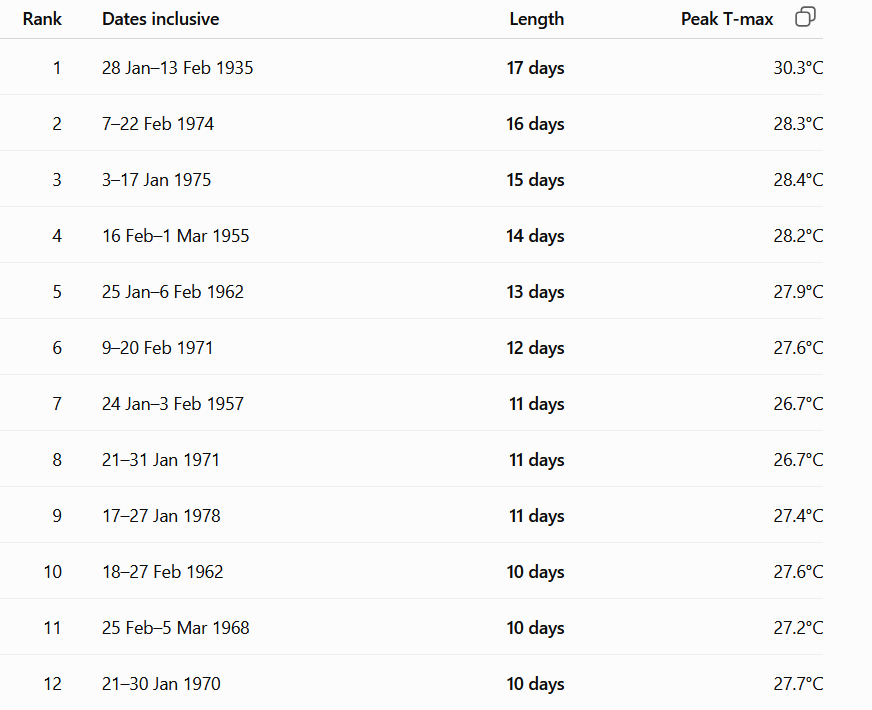
It doesn’t matter how you slice and dice it, we’re being conditioned to fear a future where Auckland in 2050 is expected to endure 39.8 days a year above 25C by 2050 (SSP3-7.0 high emissions scenario), and the scientists aren’t telling you we’ve already been there, done that, many times in the past.
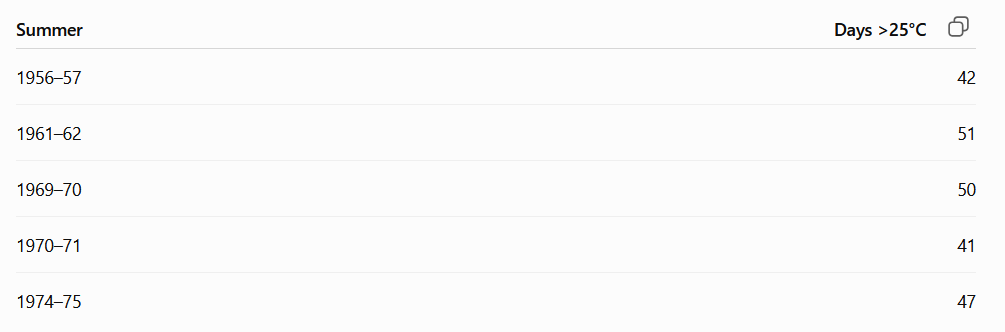
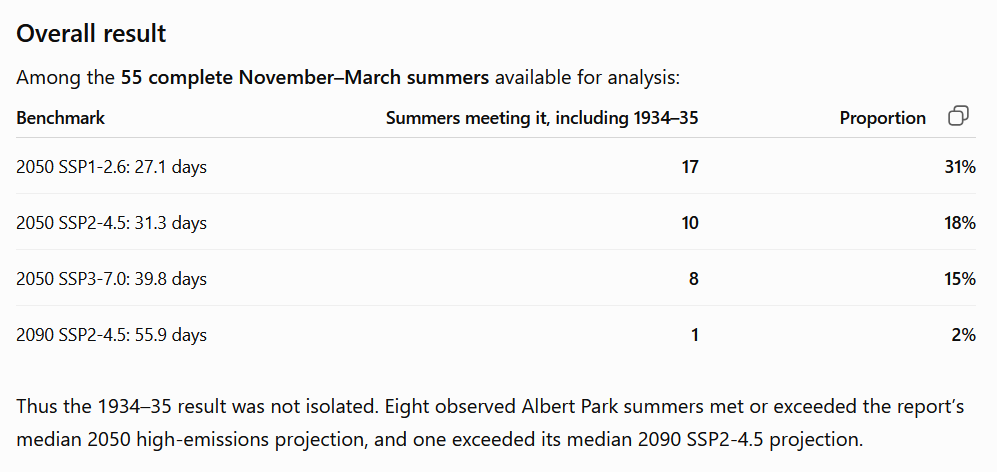
When you look at the actual historical data from last century, 1931 to 1990, and leave out the summers where data is missing, the temperature station at Albert Park’s long observational record shows that 17 of 55 complete historical summers equalled or exceeded their median 2050 low-emissions hot-day projection, eight equalled or exceeded their 2050 high-emissions projection, and 1974–75 even exceeded their median 2090 SSP2-4.5 projection.
Questions put to Auckland Council’s Petra Pearce, a former NIWA climate scientist, have gone unanswered to date.
Re-published from the Centrist with permission