Julian Mann
Julian Mann, a former Church of England vicar, is an evangelical journalist based in Lancashire.
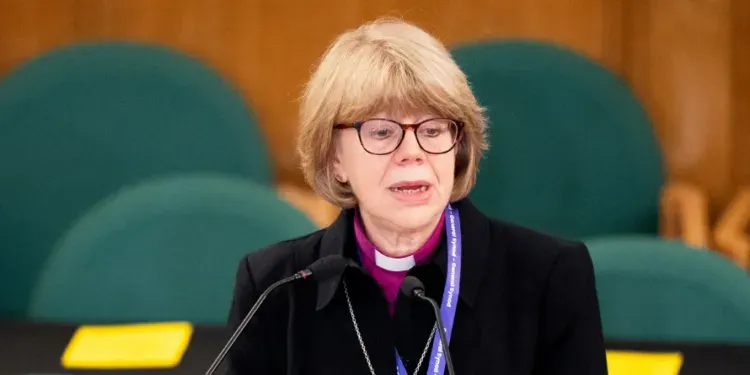
The atmosphere at the Church of England’s General Synod after it passed its shameful anti-Israel motion was frighteningly complacent. From where I was sitting in the press gallery on July 13th the members in the chamber seemed to be very pleased with themselves.
But unless these largely middle-class Anglicans had returned home to an enclosed-order monastery after their meeting in the York University central hall, how could they fail to register the impact of the nuclear bomb they had just let off?
The Jewish Chronicle reported on the vote:
The Church of England’s governing body, the General Synod, has voted overwhelmingly to encourage members to “engage with” a Palestinian-Christian document that accuses Israel of genocide, despite warnings from the Chief Rabbi and other Jewish leaders of the potential damage to interfaith relations.
Sir Ephraim Mirvis had condemned ‘A Moment of Truth: Faith in a Time of Genocide’ [also known as Kairos II], produced last year by Kairos Palestine, an ecumenical movement of Palestinian Christians, as a “shocking” document that contains “so much falsehood” against Israel, which “can only harm the cause of peace”.
This was echoed by Lord Carey, the former Archbishop of Canterbury, who said: “As supreme governor of the Church of England, and patron of the Council of Christians and Jews, the King could, through no fault of his own, find that the Church he represents is now committed to promoting a document that ‘risks undermining decades of careful relationship-building’, in the words of Chief Rabbi Ephraim Mirvis.”
Mirvis posted on X after the vote:
It is shameful that the Church of England General Synod has recommended engagement with Kairos II. This is a document full of falsehood, which openly rejects dialogue, uses extreme rhetoric to challenge the very existence of Israel and objects to existing peace agreements in the region. Though it poses as a route to understanding, Kairos II in fact functions as an egregious barrier to it, reducing one of the world’s most complex conflicts to a single, warped narrative, which can only harm the cause of peace. This is a sad day for Jewish-Christian relations.
In a piece on her Substack headed ‘The Unfathomable darkness of the Church of England’, Times and Jewish Chronicle columnist Melanie Phillips explained why the vote matters:
In post-religious Britain, people assume that the church is irrelevant. It is not. Even among those who are resolutely secular, the assumption remains that priests of the church are a moral lodestar representing integrity, truth and conscience. So when they speak about Israel, people believe them. This has had a devastating effect, because for decades the church has been promulgating incendiary calumnies against Israel with a theological underpinning that casts the Jews as the party of the devil. Its importance in helping create today’s insane levels of Jew-hatred should not be underestimated.
Having watched the debate, I replied to Mirvis on X:
In the General Synod debate on Monday morning, three Church of England bishops expressed reservations about this shameful motion – Manchester, Blackburn and Lichfield – but no bishop voted against it. Five bishops abstained but 25 bishops voted for it. British Jews – or Jews living on the British Isles – are arguably more vulnerable now than they have been at any time since the Middle Ages. The speech by Free Speech Union General Secretary Toby Young last April outside Downing Street warned of the enormous loss to this country if British Jews were to leave. There is a price for this kind of posturing by the prelates of the Established Church but it won’t be they who have to pay it.
Elections for membership of the General Synod over the next five years are due to take place this autumn. These are likely to lead to an even larger left-wing majority on the Synod, so unfortunately British Jews can expect an escalation of dangerous anti-Israel rhetoric from the established church.
This article was originally published by the Daily Sceptic.