EKO
Artist and bookmaker.
Back in 1951 a young dermatologist walked into Holmesburg Prison in Philadelphia, looked at all the men locked inside, and described the moment like someone who had found what he was born for.
All I saw before me were acres of skin, he told a reporter.
It was like a farmer seeing a fertile field for the first time.
His name was Albert Kligman. And most of us have his work in our medicine cabinets.
For the next 23 years he ran one of the most extensive human experiment operations in the country out of that prison, and almost nobody stopped him, because the people who could have were paid not to look.
The Field
Holmesburg gave him what no university could. A captive population.
Men who could not leave, could not sue, and would sign anything for a few dollars on the commissary books. Most were black. Many awaiting trial, jailed because they couldn’t make bail, experimented on before a court decided whether they were guilty of anything.

He ran dozens of studies at once.
Cosmetics. Detergents. Foot powder. Diet drinks. Psychotropic drugs. Whatever a corporation or an agency would pay to test, applied to skin that could not say no, at the going rate of a dollar or two a patch.
Back then prison job were called money slots, and most men never saw one. The food was monotonous and rotten. Soap, writing paper, and toilet paper came in scant quantities. Inside, a pittance was a preoccupation, because a pittance bought the small things that make a cage survivable.
The experimenters didn’t have to outbid a man’s better judgment.
In 1952 a former president of the American Dermatological Association wrote in its own research journal that dermatologists hadn’t been alive enough to the wealth of test material in penitentiaries.
“The administrative officers are glad to have doctors work in their institutions,” he wrote. “And the inmates really enjoy it.”
In the mid-1960s Dow Chemical paid him about $10,000 to put dioxin on the backs of roughly 75 prisoners. Dioxin is the poison that makes Agent Orange lethal to humans. He used doses far higher than Dow authorized, watched the explosion of lesions, and kept going.
The army moved trailers into the prison yard. Inside, men were dosed with chemical warfare agents and mind-altering drugs and watched to see what happened.
Nobody outside the walls ever asked what was happening to the men inside.
The Patient
The official theory of the prison in those years was medical.
The crime was a disease and the criminal was the patient, so the prison called itself a hospital and treatment could be imposed whether the man wanted it or not. The guards held total veto power over every detail of every function inside. San Quentin’s own staff psychiatrist admitted what prison psychiatry actually was. Electric shock and other forms of prescribed punishment.
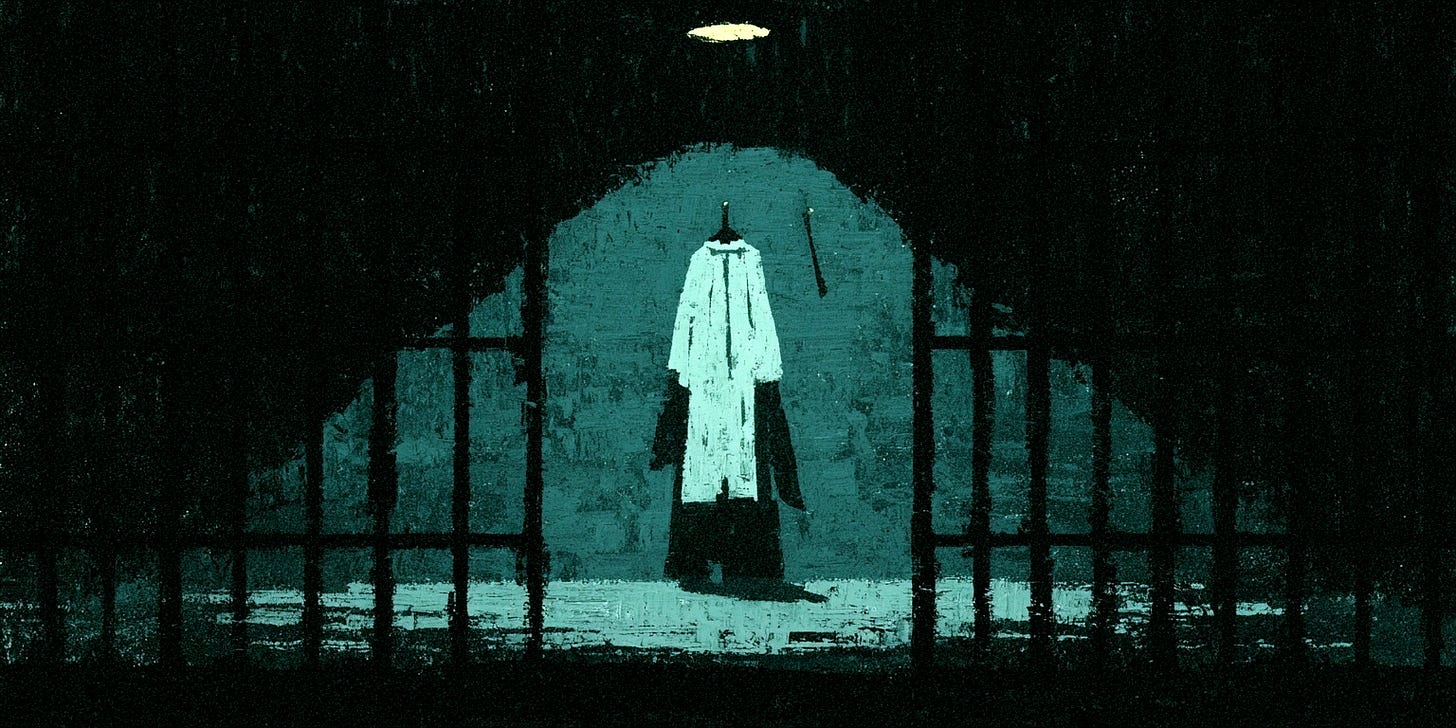
At Nuremberg, the American medical establishment’s own witness swore prisoners in the US could say yes or no to experiments without fear of punishment or loss of privilege.
But the men who ran those prisons described the system very differently. In order to reform a criminal, one of them said, you must first break his spirit.
The Nuremberg Code demands the free power of choice, without force, fraud, deceit, or duress. A man with a broken spirit in a locked ward, weighing a rotten dinner against a dollar on the books, was the volunteer modern medicine built its postwar empire on.
Most of the men who signed Kligman’s waivers were poorly educated. Many couldn’t read. When the truth came out years later, they said they never heard the words informed consent.
“We predetermine whether a test is dangerous,” Kligman explained, “and the prisoner has to depend on our judgment.”
The Cream
Kligman was a tenured professor at the University of Pennsylvania, and one of the most respected dermatologists alive. He told his students that rules don’t apply to genius – they just get in the way of creative minds.
In one study he and his trainees painted candida on men’s skin and covered it with bandages, then followed the infection from papules to pustules to what their own paper called a shallow, continuous lake of pus. The subjects, the paper noted, complained bitterly of pain and burning.
But readers were assured volunteers were totally okay with the discomfort.
In the late 1960s he developed Retin-A, the compound he refined on prisoner skin. It became the most prescribed acne medicine in the world and then the first blockbuster anti-aging cream (retinol).
The wrinkle product in tens of millions of bathrooms. The acne tube in a teen’s drawer. Refined on men in cages who were never told what or why.

He made a fortune.
He gave the University of Pennsylvania more than $4 million. The school put his name on honors and lectureships and kept it there for decades.
When the prison finally shut the program down in 1974, Kligman destroyed all of the experimental data. So now the record of what happened to those men mostly lives in the papers that made him famous.
The City of Philadelphia apologized in 2022. Kligman died back in 2010, rich and decorated. Never charged. Never fined. The apology only arrived after the man who owed it was safely beyond reach.
The Three Conditions
The book still sits on my desk. The Abuse of Man by Wolfgang Weyers. I keep going back to it because I want to understand how this keeps happening.
Weyers lays out the three conditions every medical atrocity requires:
- A captive population that cannot refuse
- Harm that compounds slowly, so no single day looks like a crime
- A profitable agenda that rewards everyone for looking away
Holmesburg had all three. So does every case in the book.
An estimate from 1960 put 20,000 federal inmates inside medical experiments, and the federal system was only one layer. When the World Medical Association moved in 1961 to declare that prisoners, being captive groups, should never be used as test subjects, the American delegation blocked the resolution.
When Iowa's attorney general ruled prison experiments illegal, the doctors of Iowa went to their legislature and got a law passed permitting them.
That is the argument Weyers is making across 700 pages, and it is the reason the book is expensive and out of print and absent from the medical schools whose own founders are named in it.
The book is a gallery of monsters, but it’s also a blueprint.
And the blueprint still works.
Without Consent
So I am going to keep bringing it up, one file at a time.
They call it history once everyone who could be charged is dead. Dredging up old cases as warning, because the only thing that has ever interrupted this pattern is ordinary people seeing it plainly before the next version shows up.
The doctor who deliberately infected Guatemalans with syphilis, and a government that waited until 2010 to admit it. The orphans dosed with experimental vaccines because no parent would object. The contraceptive trials run on women who were told it was treatment. The German scientists America imported and laundered because their skills were judged worth more than their victims.
One of you wrote to me after the last file that you changed your mom’s medical paperwork to read “no injections without my consent”.
That’s the whole thing in five words.
The men who ran these experiments weren’t cartoon villains. They were funded, credentialed, awarded, invited to give keynotes, and most of them stayed that way to the end. The apparatus never seems to apologize until long after the bill can be delivered to anyone.
TL;DR Your body is yours.
The first law of a free man is that no one touches him without his yes.
That law has a body count, and this series is keeping count.
Everything I write is free.
Previously:
WITHOUT CONSENT The Glow EKO 19 Aug
WITHOUT CONSENT Normal Exposure EKO 25 Jun

WITHOUT CONSENT The Feedlot Protocol EKO 9 Jan

This article was originally published by EKO Loves You.