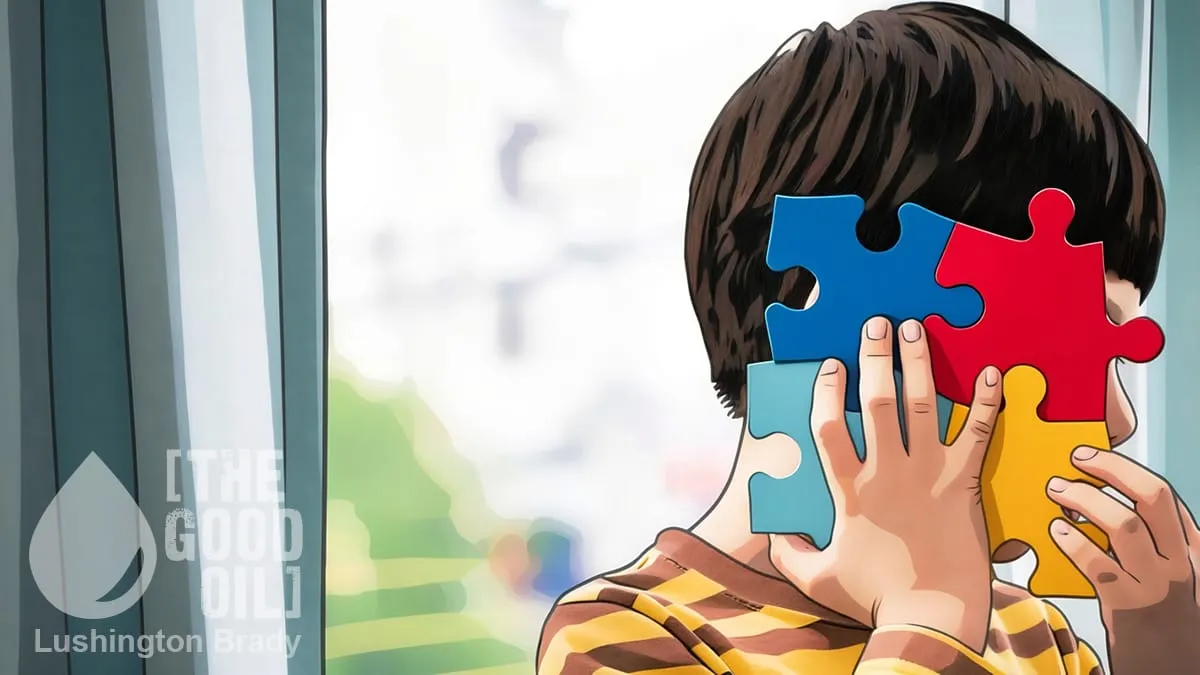
It must be especially galling for people with actual autism to have to endure some clickbait-farming TikTok prattle that ‘autism is my super-power!’ No it isn’t and you’re not, you fatuous bint. In reality, full-blown autism is an often crippling condition necessitating lifelong support. Even at the milder end of the spectrum, such as Asperger’s, sufferers can find even everyday life a minefield of difficult situations.
One question that few of us even consider, though, is: why is there autism at all? We know that it’s very strongly genetically linked. We also now know that it’s a very ancient condition, which begs the question of why hasn’t evolution weeded it out? Recent research suggests that, while not the ‘superpower’ of idiotic internet mythology, autism carries traits that made it valuable enough to at least some of our ancestors to keep it rattling around in the genetic toolbox – and modern humans perhaps even more so.
The textbook logic seems plain. Twin studies put heritability at roughly 80 per cent. Large population studies show autistic adults have fewer children on average. Run that forward for a few thousand years and the trait should thin out and vanish. It hasn’t. It appears in every population anyone has checked. Geneticists went looking for the usual story of a harmful leftover that selection had failed to sweep away. They found the opposite.
These variants carried the fingerprint of positive selection. In plain terms, they were not being purged. Many were being kept and some were spreading.
To understand what that means ignoring the conspiracy theories, and sweeping away some common misconceptions about how genes work. A 2017 Yale analysis by Renato Polimanti and Joel Gelernter examined common DNA variants linked to autism. Many are ancient enough to predate the split with Neanderthals: hundreds of thousands of years.
Autism, like many genetic traits, is not a single switch. Most genetic traits are polygenic: involving hundreds of common variants, each nudging the odds by a tiny amount. Millions of people carry a handful of the traits that contribute to autism and never know it. In the Yale data, a moderate load lined up with higher childhood cognitive scores, more years of education and faster growth of new neurons. Turn the dial up a little and the engine runs hotter and spots patterns sooner. Turn it all the way up and, in some people, sensory input and social wiring overload. That is one plausible picture of what happens when a child inherits a heavy dose from both parents.
So, why don’t other animals, including our genetic cousins the apes, seem to get autism like humans do? A Stanford study compared gene activity in humans, chimpanzees and gorillas. Across mammals, abundant cell types evolve slowly: a sensible safety rule. Humans broke it. Neurons that link distant brain regions and sit at the heart of language, planning and abstract thought, changed unusually fast after we split from the other apes. Evolution sped them up by dialling down the activity of many genes that normally keep neural wiring steady. A number of those same genes are the ones associated with autism today.
Autism isn’t a random mistake that happened to appear next to human intelligence. It may be part of the price evolution paid to get it.
So what use were such minds 70,000 years ago, when your band of 50 was staring at an empty valley and the temperature had dropped below freezing?
Cambridge psychologist Simon Baron-Cohen calls the cognitive style hyper-systemizing. The systemizing mind treats nature as a collection of rules: strike the stone here and it flakes into a blade – there and it shatters. Someone had to repeat a small motion thousands of times and notice differences that would bore most brains to tears. In a clinic that is a restricted interest. Around an ancient fire it looks a lot like a research and development department.
Sensory sensitivity works the same way. What is an assault in a modern supermarket – fluorescent hum, overlapping voices, perfume – was an asset in a dark forest. The person whose senses never fully switch off hears the twig snap 80 metres away, smells distant smoke and notices meat that has turned. Detail-focused vision finds the antler tip behind a branch or the edible roots under dead leaves.
Like Julian Jaynes finding the dawn of consciousness between The Iliad and The Odyssey, some researchers even point to Ice Age cave art. The horses, bison and lions of Chauvet and Lascaux show depth, overlapping herds in motion and muscle detail painted from memory by the flicker of fat lamps. Nicholas Humphrey and Penny Spikins have suggested that the burst of such lifelike work and precise bone tools may reflect groups beginning to value members with an extreme eye for detail: a pattern most famously seen in some autistic savants. It remains a hypothesis, but it turns a cave wall into a possible clue about whose minds shaped the Stone Age.
Independence from social pressure may have been equally useful. Most of us carry a strong conformity bias: better wrong together than right alone. Experiments show autistic children and adults are far less likely to go along with a deliberately wrong group answer. When the 10 loudest voices around the fire declare toxic berries safe, the person who does not care about approval may be the only one who refuses to eat them.
Evolutionary researcher Jared Edward Reser has proposed a solitary forager hypothesis. During the harshest glacial peaks, a band of 50 would starve if it stayed together. Scattering into tiny groups or lone individuals favoured people who needed little social approval, felt comfortable alone and stuck to strict routines. What looks like a deficit in a modern classroom was survival kit on the empty tundra.
Evolution was not trying to build one perfect person. It was building a team, balancing selection, a division of cognitive labour. Plenty of social glue, plus a smaller share of specialists who saw the world differently.
This brings us to the modern problem. Our genes were shaped for wind, water, firelight and the same few dozen faces. We packed millions into concrete cities, sat sensitive six-year-olds under buzzing lights in classrooms of 30, and built an economy that begins with eye contact and small talk in open-plan offices. We constructed an obstacle course that punishes the very traits that once earned supper.
But there is a further modern twist. A mother whose son finally got a job with a tech company quietly let the boss know that he was on the spectrum. The boss smiled and said, ‘So are half our techs’. Baron-Cohen has suggested that universities, engineering firms and tech hubs concentrate highly systemizing minds. They meet, pair up and the odds of a child receiving a heavy concentration rise. A study of the Eindhoven region found autism rates nearly three times higher than in comparison towns.
None of this, to forestall the bandwagon-jumpers, makes autism a superpower, nor does it erase the real challenges and the need for support. It does mean the old story, that autism is merely a mistake nature forgot to fix, is far too simple. The quiet mind at the edge of the fire, watching the flint, counting the stars and refusing the comfortable lie is part of how we got here. The world we built with those minds is now the one that struggles to make room for them.