Table of Contents
Pee Kay
No Minister

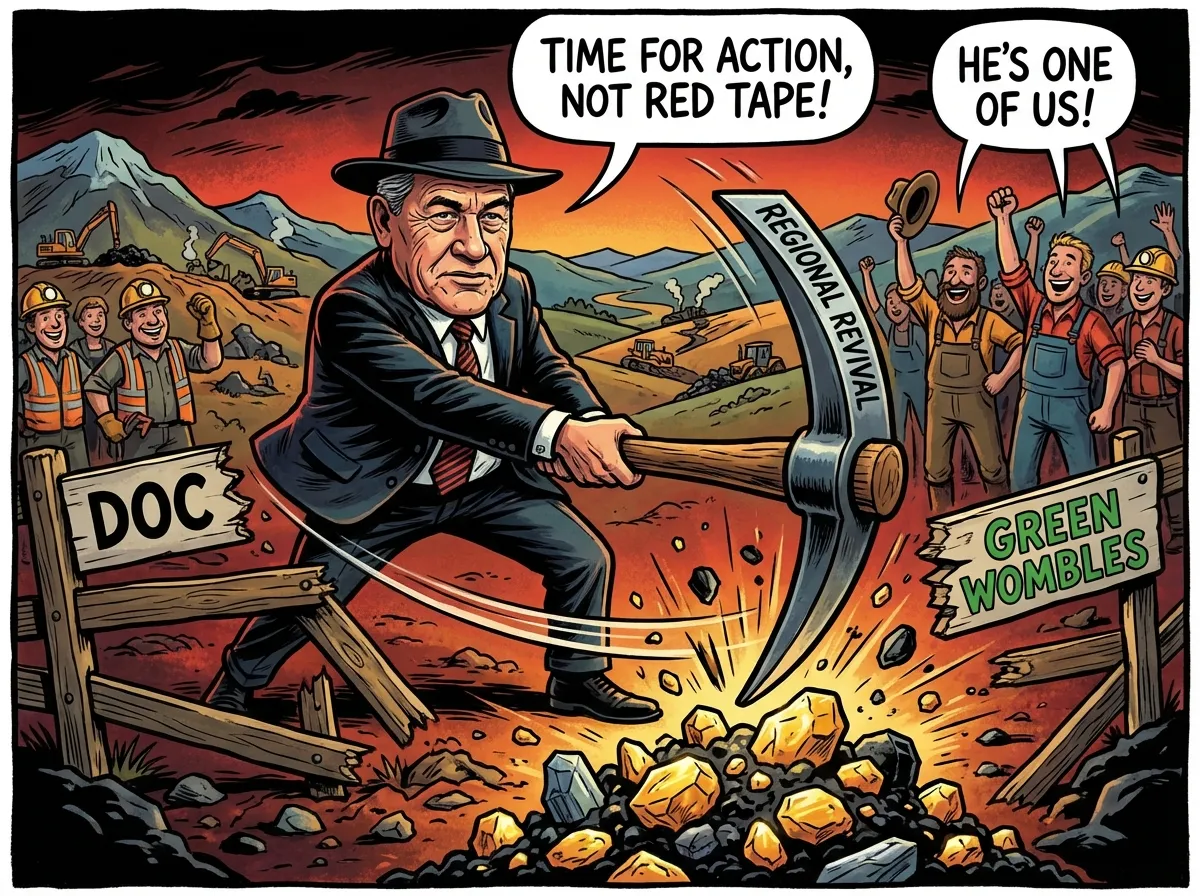
Despite plummeting to historic lows in both personal and party polling, and facing a relentless media firestorm questioning his grip on the National Party leadership, Christopher Luxon has remained curiously paralysed.
He has conspicuously failed to wield the most potent political weapon available to him since mid-2022 – the mandated voice of the New Zealand majority.
This weapon is the collective voice of New Zealanders who have long demanded the era of “grace and favour” of race-based preference extended to Māori must come to an end.
It is the very same rhetoric Luxon exploited with strategic, but very judicious, precision during the 2023 campaign to galvanise voters and to secure his seat at the top table. Back then, his posture was one of principled defiance and his stance appeared unwavering :
- “National’s position on co-governance is clear and will be applied by us in government.”(1)
- “We do not support co-governance of public services.” (1)
- “If it is genuinely about co-governance of the delivery of public services, that’s something that I feel uncomfortable with.”(2)
- “I think there is a real need for us to have a genuine, high-quality conversation around co-governance… when you don’t take the people with you… you leave people behind and it drives more division.” (2)
- “We are one country; we deliver our public services to people on the basis of need, not ethnicity.”
However, since taking office, that promised “high-quality conversation” has been non-existent. Instead of the transparency and national dialogue he once championed, we are witnessing the steady implementation of co-governance frameworks, by stealth.
These are often masked by bureaucratic rebranding or subtle administrative tweaks. We are being subjected to a disturbing trend of policy backsliding. Yes, the underlying policy remains the same but the erosion of democratic equality continues and voters are left to wonder why the firm promises of the campaign trail have vanished in the halls of power.
To describe the mood of many National voters as disillusioned or deceived is a profound understatement. It is a sense of fundamental betrayal.
In hindsight, however, I think the signs were always there.
Luxon’s ‘co conspirator’ and key player in all the political backsliding is Tama Potaka.
The hand-picking and rapid elevation of Tama Potaka following the 2022 Hamilton West by-election should have served as a clear harbinger of Christopher Luxon’s true trajectory regarding the “Māorification” of New Zealand.
Tama Potaka serves as the essential pivot point in Luxon’s political swivel. As Luxon’s hand-picked conduit to the Māori elite, Potaka is the key operative tasked with sanitising the very co-governance frameworks that Luxon and National once vowed to dismantle.
Potaka was not merely a candidate, he was a strategic acquisition. Bypassing local options, Luxon headhunted Potaka to spearhead a “diversity” drive that many now interpret as a concerted effort to cement Māori-centric policy into the National Party’s DNA. Luxon’s public critiques of his own party’s lack of diversity were the opening salvos in a campaign to install a loyalist who could confidently bridge the gap between the National front bench and Māori elite.
As the minister for Māori development, he is more than just a minister. He is a sophisticated mouthpiece, the one who expertly navigated the hurdles and complexities that allowed the integration of tikanga into the halls of parliament.
Potaka is the man Luxon has tasked with smoothing the way for race-based policies while sheltering the prime minister from any resultant political heat. Potaka acts as the primary protector of Luxon’s complex Māori agenda. Potaka has become Luxon’s indispensable emissary.
The political cost of this Luxon/National betrayal can no longer be treated as theoretical. The polls very graphically portray public sentiment. The National Party support has stumbled to such a precarious position the very survival of the coalition is threatened.
As the National Party’s support erodes, its coalition partners appear to be distancing themselves from Luxon. Both Seymour and Peters have remained uncharacteristically silent on the contentious issue of co-governance. And as we all well know, co-governance is bread and butter to these two!
This raises a critical question: How do you explain this restraint from two politicians typically known for their outspokenness? With an election on the horizon, it seems likely they are distancing themselves from Luxon’s agenda to protect their own political territory.
By staying quiet Seymour and Peters avoid accountability for the government’s failure to deliver on core campaign pledges. This silence acts as a very convenient shield (and indicator?), allowing them to ignore the uncomfortable reality that ‘business as usual’ (Māorification) continues.
Race-based politics, that many argue are furnished in the form of thinly disguised co-governance linked to the government’s ongoing appeasement of Māori, is alive and well under National. While the coalition pledged to uphold the ‘equality of citizenship’ outlined in the Treaty of Waitangi, current policies suggest a continued appeasement that prevents a truly level playing field.
National backbenchers in provincial seats are reportedly sounding the alarm, as they are going to bear the brunt of voters disenchantment. They see Luxon’s preference for “behind closed doors” appeasement (as noted by Wendy Geus in the link below) as a direct threat to their own political survival.
A recent article by political commentator Wendy Geus, I think, sums up the feelings of many National voters very well.
https://breakingviewsnz.blogspot.com/2026/03/wendy-geus-seymour-must-demand-luxon.html
As Wendy Geus aptly noted, Luxon appears to find “appeasement (preferably behind closed doors at the Iwi Chairs Forum) easier than acting in the public’s best interest.” Enter Potaka, the architect of that relationship, the key figure fashioning the very “grace and favour” extensions Luxon once promised to dismantle,
In her article Wendy talks about Peters promise “…to eliminate Māori Treaty clauses in public services…” which, she says, “…would have atoned somewhat for his opposing the Treaty Bill, has mysteriously petered out”.
The commitment to eliminate Māori Treaty clauses in public services was a cornerstone of the New Zealand First-National coalition agreement. The objective was to replace vague, all too flexible, principles with explicit language, thereby limiting the judiciary’s role in delivering ‘elastic’ interpretations of Treaty obligations.
Bizarrely, this high-stakes task that was certain to draw fierce opposition from the Waitangi Tribunal and Māori leadership, was delegated to Minister of Justice and Treaty of Waitangi Negotiations Paul Goldsmith to action.
That raises questions such as: Why was such a contentious portfolio assigned to him? Why would Peters allow the spotlight on an issue that has significant voter interest to be moved to Goldsmith?
Is this just Mr Machiavelli ‘doing his thing’?
By assigning the work to Goldsmith, the policy ceases to be viewed as a ‘rogue’ NZ First demand and thus becomes an official cabinet-led, government initiative. By having a National minister in charge, Peters gains significant political leverage while shielding his own party from the intense backlash from Māori elite.
Strategic positioning?
A friend enquired from ACT about the report’s progress. She was told the report is “stuck inside cabinet”.
No surprises there. Conveniently now too late for any legislative action before the election?
It is worth having a look at Democracy Action’s take on the panel Goldsmith has appointed to provide initial advice on the “Māori Treaty clauses in public services” review. https://www.democracyaction.org.nz/review_of_treaty_principles_in_legislation
My opinion is Mr Luxon will only understand just how disenfranchised National voters feel come late in the day of November 7th when polling booth results begin to show just how much the Luxon-led National has alienated its voter base!
Instead of the transparency Luxon once championed, we are witnessing the systematic, quiet implementation of co-governance frameworks, under the radar.
References:
- https://www.democracyaction.org.nz/where_the_parties_stand_on_co_governancehttps://www.democracyaction.org.nz/where_the_parties_stand_on_co_governance
- https://www.rnz.co.nz/news/political/464214/luxon-backs-co-governance-debate-shies-from-referendum
- https://www.1news.co.nz/2023/01/24/ratana-luxon-says-co-governance-debate-divisive-and-immature/
This article was originally published by No Minister.