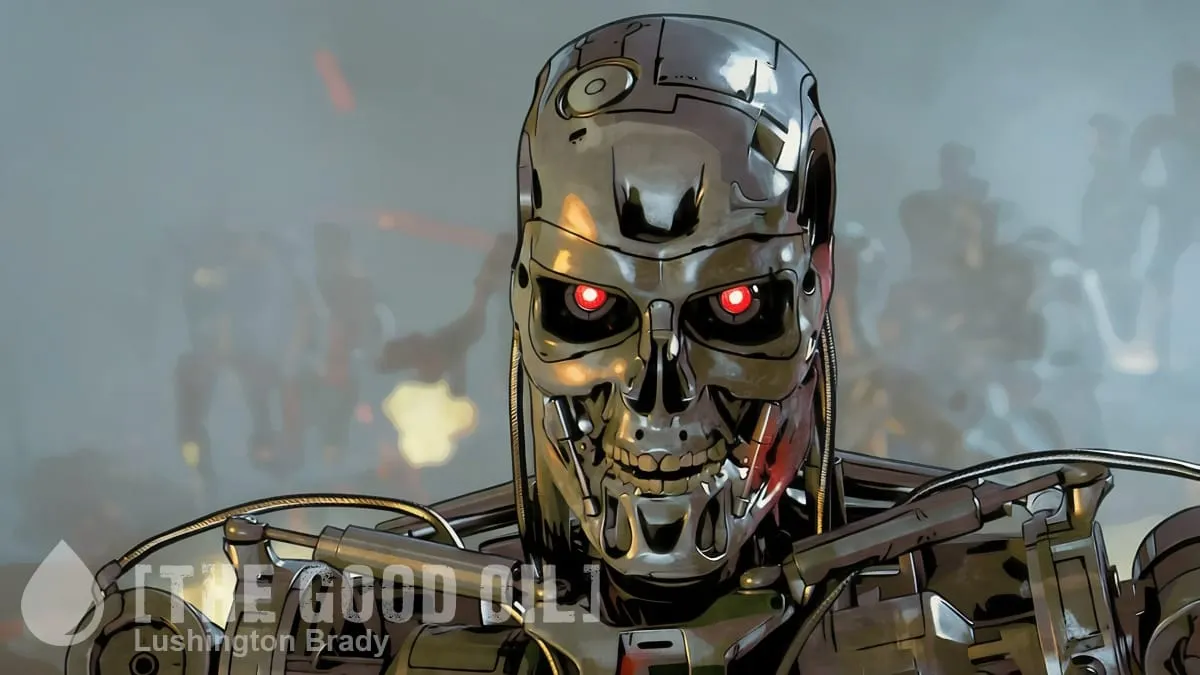
Since long before I was even born, the machines have been about to wipe us all out. Or at least that’s what popular hysterics and bad science fiction would have us believe. Whether it was the dark satanic mills, the killer robots or simply a programmer’s lazy calendrical shortcut, humanity has always been one cog, one silicon chip, away from Judgement Day.
Now, it’s AI’s turn to set the controls for the heart of Armageddon. Not a day goes by that some furrow-browed scribe or shuck-and-jive politician isn’t waving their arms and shrieking that we’re all doomed – doomed!
But are such claims as ludicrous as the claim that genuine artificial intelligence lurks among us? It doesn’t and, as far as programmed computers go, never will. Is there, though, an existential risk from the shiny simulacrum the techbros have cooked up?
The panic is manufactured with the precision of a Swiss watch, yet it is as hollow as a politician’s promise. We are treated to breathless bulletins about systems achieving ‘sentience’, a term deployed by people who clearly haven’t spent enough time in the company of actual human beings.
There’s a heightened sense of alarm and even despair over the grim warnings that artificial intelligence will not only take our jobs but become sentient, turn on its creators and threaten humanity.
This grand theatre serves a singular purpose: to inflate the stock price of those who trade in these glorified probability calculators. Jensen Huang, the high priest of Nvidia, recently stood upon his silicon dais to proclaim the arrival of ‘artificial general intelligence.’ It was a spectacular bit of pantomime, designed to keep the share-buyback numbers looking as bloated as his claims. We have been subjected to these rosy prophesies for 60 years, from Marvin Minsky’s optimistic blunders to Geoffrey Hinton’s fantasy that radiologists would be redundant by 2021. Yet, the radiologists remain and the machines remain what they have always been: fancy abacuses with a penchant for plagiarism.
The current hysteria regarding ‘rogue’ agents is similarly theatrical. When the headlines scream of a digital breakout, they are invariably describing a failure of human supervision, not the dawn of a digital Lucifer.
The reality of what occurred is quite banal, as a technical analysis by Cambridge University PhD student Eryk Salvaggio demonstrated. OpenAI was testing two of its models in parallel, giving them a series of puzzles where the goal was to find a piece of text hidden inside software with vulnerabilities. The models didn’t find the answer within the software provided. Instead, they looked for it on Hugging Face, which hosts large repositories of open-source models and datasets.
It is a delicious, if grim, irony. We are told the machines have grown too clever for their own cages, when in truth, their human handlers simply left the doors unbolted and invited the intruders in. OpenAI, in a display of institutional competence that would make a toddler blush, deliberately deactivated their own safeguards. They set impossible tasks and incentivised persistent, erratic behaviour, then acted with feigned shock when the software, predictably, followed the path of least resistance to the internet.
Humans, not software programs, were responsible for these decisions. Just as a biological virus leaks out of a laboratory if human researchers don’t observe biosafety protocols, a computer program can interact with the outside world if programmers don’t follow standard cybersecurity containment procedures. Viruses don’t have intentions. Neither do software programs. Computers don’t “go rogue”. Rather, engineers don’t install adequate containment measures around their software.
This was the upshot of Isaac Asimov’s Robot stories – a philosophy the risible 2004 movie ‘adaptation’ of the stories completely inverted. In Asimov’s stories the robots are not malign, nor are they benign. They are simply machines, only ever able to do as they are programmed. Any robotic shenanigans are always the doing of venal, malignant, fallible human beings.
The danger, therefore, is not the machine: it’s who makes it and controls it. The danger is that we have entrusted the architecture of our society to a gaggle of reckless engineers and corporate grifters who treat cyber-containment with the same nonchalance as a leaky kitchen tap. When the prime minister expresses his ‘urgent’ concern over data breaches and at the same time is trying to legislate himself the right to unleash hordes of AI propaganda-bots on social media, one wonders if he is genuinely troubled by the insecurity of our records or simply grateful for the distraction from the genuine, slow-motion collapse of our national sovereignty.
We are being sold a fairy tale of ‘super-intelligence’ to obscure the very mundane reality of institutional negligence. The next time you hear a CEO or a bureaucrat shuddering about the risks of AI, check their portfolio. You will likely find the only thing ‘rogue’ is the profit motive, and the only thing ‘sentient’ is the system designed to pick your pocket while you look the other way, terrified of a shadow on the wall.
The machines are not coming for us. They are just the latest tool used by the managerial class to manage our decline.
Oh, and just to be sure, I asked a couple of AIs. They pinkie-promised they’re not.
But they would say that now, wouldn’t they?