
Sometimes a simple graph can cut through 10 solid feet of weapons-grade bullshit. ‘Data visualisations’ that have changed the world include Ignaz Semmelweis’ Hand Hygiene Charts of 1847, which cut through surgeons’ arrogant denials and led to changes that slashed post-birth mortality rates. John Snow’s cholera scatterplot map of 1854 founded modern epidemiology. And so on.
One simple graph cuts through the Climate Cult’s bullshit, endlessly repeated by Australia’s ‘Climate Change and Energy Minister’ Boofhead Bowen, that “wind and solar are the cheapest form of electricity”. Here it is:
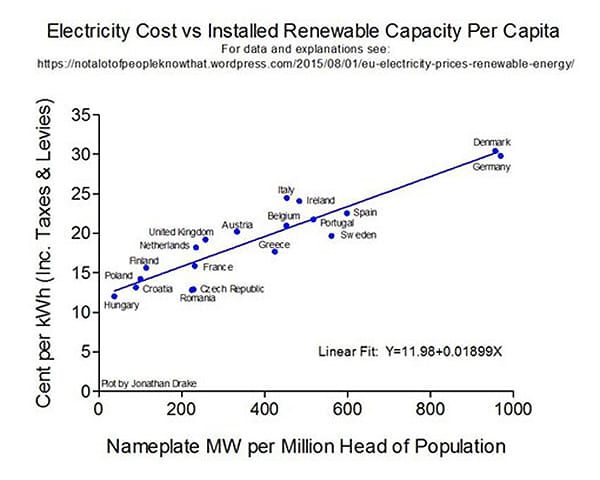
Bowen can bullshit till the cows come home, but the household electricity bills tell the true story. Ditto for the Australian Energy Market Operator’s breathless claims that wholesale electricity prices in Australia have plummeted. The household bills tell a very different story – and that’s including the Albanese government artificially distorting bills with taxpayer subsidies.
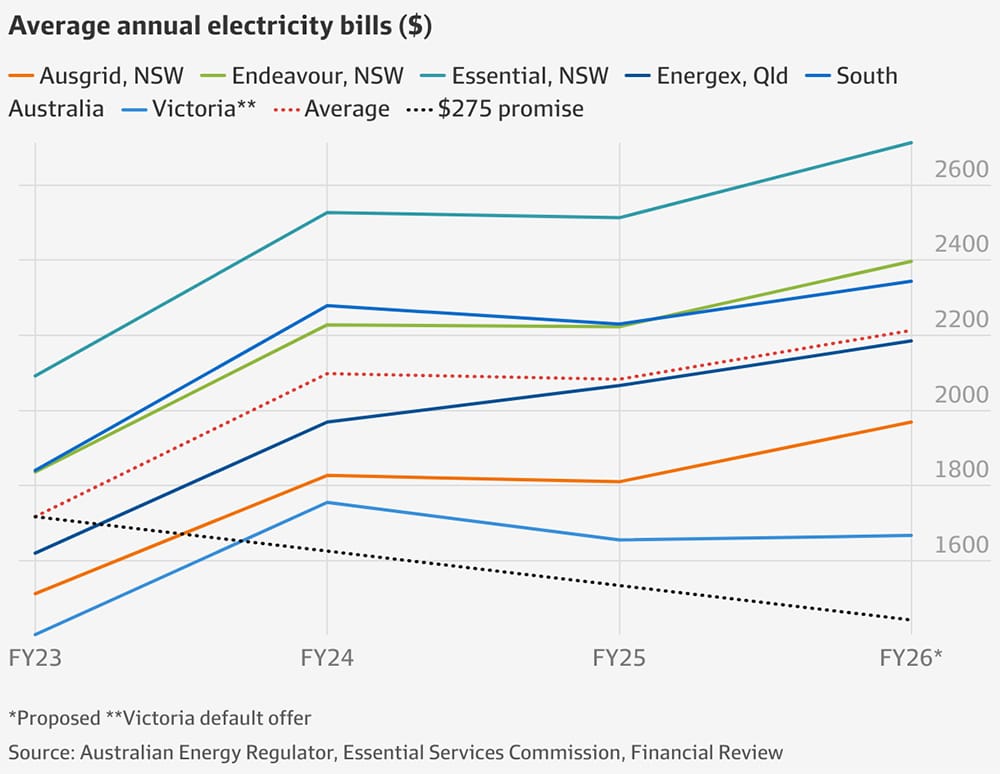
It’s all about to get a whole lot worse.
On any given day in Australia, from its west coast to its east, there is a fair chance spot power prices will plunge to remarkably low levels.
And then skyrocket even higher a few hours later.
It’s a confusing, and some might even say maddening, contradiction.
Only if you’re a Climate Cultist determined not to confront the single most damning fact about so-called ‘renewables’: their inescapable intermittency. Spot prices ‘plunge’ during the day, because that’s when the sun shines and the wind tends to blow strongest (thanks to thermal convection). The only problem is that that’s also the time when people are using the least electricity. At those times, spot prices can fall even into the negatives: as low as $1,000 per megawatt hour.
But a shocking (no pun intended) thing happens a few hours later. The sun sets, and the wind drops – and people get home from work, turn the lights on, and the heater in winter or aircon in summer, start cooking dinner, watching telly, playing games – the prices soars into the stratosphere. As high as $20,300/MWh.
By contrast, however, when demand for power from the grid is high – typically in the evening when the sun has set – prices almost invariably rise.
And sometimes they soar.
In short: during the day, there’s a massive surplus of energy no one needs. High supply, low demand: prices fall. But when people need electricity the most, the solar panels stop producing, the wind turbines stop spinning and energy availability evaporates. Low supply, high demand… you know your basic economics (probably better than our arts-degree treasurer).
Or, as AEMO so coyly puts it:
“Despite their greater frequency, negative prices have a relatively modest impact on average spot prices compared with high prices,” the regulator found.
“High prices apply to a greater proportion of the electricity that is dispatched and therefore have a larger impact.”
The numbers are dire. South Australia, the state that relies totally on ‘renewables’ (infamously leading to a complete state-wide blackout in 2016), is an abject lesson. In just one quarter, negative prices reduced average prices by just $7.79, but peak prices raised them by $23.68. So, South Australians are paying through the nose when they actually need electricity.
As Australia’s energy system enters a “once-in-a-century” transition, wild price volatility has become one of its most striking features.
And a permanent one.
[David Dixon, an analyst at global consultancy Rystad], said the benefits of negative prices were completely outweighed by extremely high ones.
“You do the maths in terms of an hour or 30 minutes at that market cap,” he says.
Ah, say the Cultists, but the batteries. Yeah, about that…
Firstly, even with all the batteries currently installed or currently scheduled, there’s still a shortfall of five to seven gigawatts. Sure, they can promise to install more batteries, but does anyone really think demand will drop, especially with turbocharged immigration showing no signs of relenting?
Even then, batteries are, in practice, only making a bad situation even worse.
In the wee hours of a cold night last month, as most West Australians slept in their beds, a strange thing happened in the state’s biggest and most important electricity system.
About 1am, prices on the spot market started to soar.
They had been hovering at an elevated level of roughly $120 per megawatt-hour (MWh) but suddenly began to climb to extreme highs of more than $350/MWh.
What could possibly have caused this? A catastrophic transmission failure? A coal-fired plant going offline?
Batteries.
The surge was coming from batteries, the very things supposedly designed to prevent just such a breakout in prices […]
Why it happened – in the middle of the night when there was seemingly no obvious reason – is still unclear.
Because, oh, I don’t know… batteries have to be charged…?
But what would I know? I’m not an expert, like Bowen.