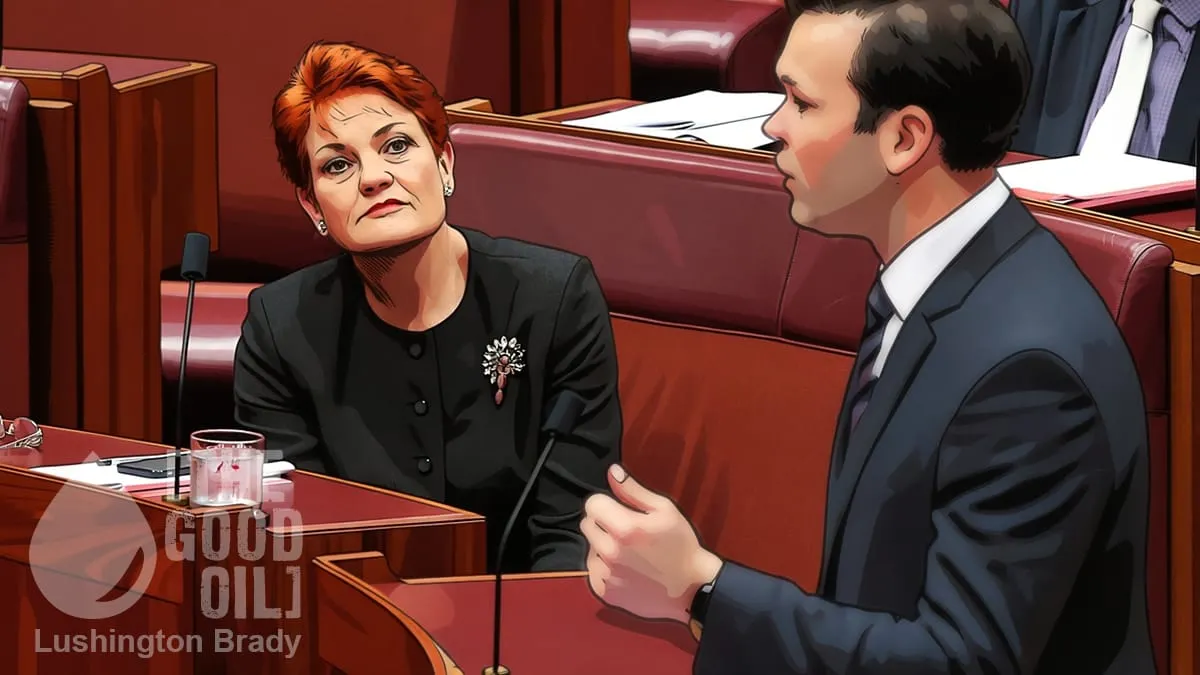
It is, as the saying goes, quite a turn-up for the books. After years of sneering attacks on One Nation from the uniparty over their economic credentials, Pauline Hanson has hit back. As she points out: one of them in Canberra has been at the coalface of economic activity, running a small business. And it’s not Jim Chalmers.
Hanson has some pretty heavy backing, too: Deloitte Access Economics have a brutally blunt assessment of the economic performance of the uniparty. In a word: we’re stuffed.
Addressing the assembled grandees and chief executives at the Australian Chamber of Commerce and Industry business leaders’ summit, the member for Oxley and leader of the peoples’ insurgence offered a scathing appraisal of Canberra’s ruling caste. The Canberra Bubble is an administrative construction populated entirely by apparatchiks and trade union hacks whose understanding of commerce begins and ends with looting someone else’s pay packet.
Senator Hanson laid bare the sheer absurdity of career politicians lecturing the wealth-creators of the nation on enterprise, profit margins and balancing a ledger. The chasm of experience between the tea-room socialists in Parliament House and the bloke operating an earthworks or local accountancy firm is widening by the day, much to the detriment of the Commonwealth.
Too many people in this government have never run a business. They’ve never put their own savings on the line. Never laid awake wondering if there’d be enough money in their account to make the week’s payroll.
By “too many”, of course, she means ‘none’. The collective non-government employment hours of the prime minister and treasurer add up to… zero. The closest Albanese has ever come to working a day in his life was a few months in the back-offices of a government-owned bank. Then it was straight on to politics.
“Dr” Chalmers, a man whose intimate acquaintance with the private sector is entirely theoretical, operates under the rather quaint delusion that every commercial friction can be smoothed over by inventing a fresh levy, drafting another stifling regulation or appointing yet another alphabet-soup regulator to hound the butcher, the baker and the candlestick maker. It is the classic playbook of managerial central planning: tax anything that moves, subsidise failure and pretend that expanding the public service headcount constitutes economic growth.
While the treasurer spends his afternoons assuring Bloomberg that all is splendid and that his doubleplusgood surplus budgets are the envy of the world, the bean-counters at Deloitte have rudely pulled back the curtain on our national decline. The “Lucky Country”?
“It was good while it lasted,” Deloitte partner Stephen Smith said. “The collective voice of economists has become hoarse from the persistent and consistent pleading for substantial reforms across tax, regulation, spending, skills, federal-state relations and the like. Those calls have largely been met with the white noise of political constraints.”
Deloitte Access Economics has pruned its growth forecasts down yet again, predicting that Australia is hurtling toward the longest stretch of sub-par economic performance since the recession we had to have in the early ’90s. Consumer confidence has cratered to depths not witnessed in over three decades, driven into the abyss by successive cash rate hikes and the crushing weight of cost-of-living pressures.
The golden era has been unceremoniously shown the door, replaced by a lingering hangover of anaemic growth, stubborn inflation and an RBA interest rate stick beating the living daylights out of households.
For decades, the political class has treated economic prosperity as an endless annuity paid out by population padding and fortunate property booms, rather than the hard graft of productivity and, y’know, actually working for a living. Instead of trimming the fat, Canberra has ballooned the public service, who wouldn’t know a day’s work if intruded on their flexitime, by a staggering 23 per cent in just a few short years while simultaneously pouring hundreds of millions into the bottomless pockets of management consultants. You’d have to laugh, if you weren’t footing the bill.
Senator Hanson’s diagnosis at the ACCI summit hits the nail squarely on the head.
An old great-uncle of mine used to say of Victorian Liberal Premier Henry Bolte, “He couldn’t run a grocery store, how is he expected to run a state?” The thing is, though: at least Bolte knew what it meant to fail and carry the cost. Today’s political class have never known any other world than one in which other people pay the price for their colossal cock-ups.