Bob Hawke once listed as one of his great achievements making Australian voters more educated on economic policy. He might not be so sure of that, if he was alive to see the Albo and Zippy Show in action.
As I wrote recently, too many Australian voters have discovered that they can apparently vote themselves money. A poll before the last election showed that 83 per cent of voters supported increased government spending. The handout mentality spanned the political spectrum.
In slightly better news, a new poll suggests that at least some voters are coming to their senses.
After combining the highest priority and second-highest priority for voters, lowering government spending (55 per cent) topped the list of actions followed by subsidising essentials such as energy and fuel (51 per cent), cutting income taxes (31 per cent), reducing regulation and costs for business (27 per cent), and offering one-off payments (11 per cent).
Observe the inherent contradiction: whilst a commendable majority yearn to put the brakes on the Treasury’s profligacy, half of those same citizens remain hopelessly addicted to the teat, demanding subsidies for the very energy and fuel prices that government intervention has rendered unaffordable in the first place. It’s the classic Australian delusion: wanting the state to stop spending money, provided it does not stop spending money on your own particular basket of ‘essentials’.
It is not all gloom, however. Nearly one-third of the electorate has grasped the fundamental truth that cutting taxes and slashing the suffocating tendrils of red tape is the only path to genuine prosperity. Yet, those sensible voters must look at the coalition’s current performance and wonder if they are attempting to win an election or merely auditioning for a role in a pantomime of incompetence.
Angus Taylor has ruled out backing an increase to the GST, in a move that sharpens the divide between himself and potential future Liberal leadership candidate Josh Frydenberg, as economists and some MPs raise concerns it signifies a lack of political will to embrace bold reform […]
Rebel Liberal senator Andrew McLachlan went public with his concerns, arguing Mr Frydenberg’s economic proposals should be taken seriously.
This latest internal squabble regarding the GST serves as a masterclass in missing the point. The only ray of hope is that at least some of the coalition MPs argue that a GST increase should be part of a package of slashing personal income tax and company taxes. But it still smacks of rearranging the taxation deckchairs on a Titanic that is sinking under the weight of its own spending.
At least some MPs get it:
“Talk about tax and spend, maybe Josh should talk to the Labor Party about being their leader,” one conservative MP said.
Australia doesn’t have a revenue problem, we have a spending problem, with the NDIS, other welfare and Net Zero being the biggest black holes of spending.
The NDIS, once sold as a compassionate necessity, has metastasised into a fiscal leviathan that swallows taxpayer funds with the voracity of a starving python. Meanwhile, the fanatical commitment to Net Zero acts as an anchor on the neck of our industry, ensuring that no amount of tax reform can possibly compensate for the destruction of our comparative advantages.
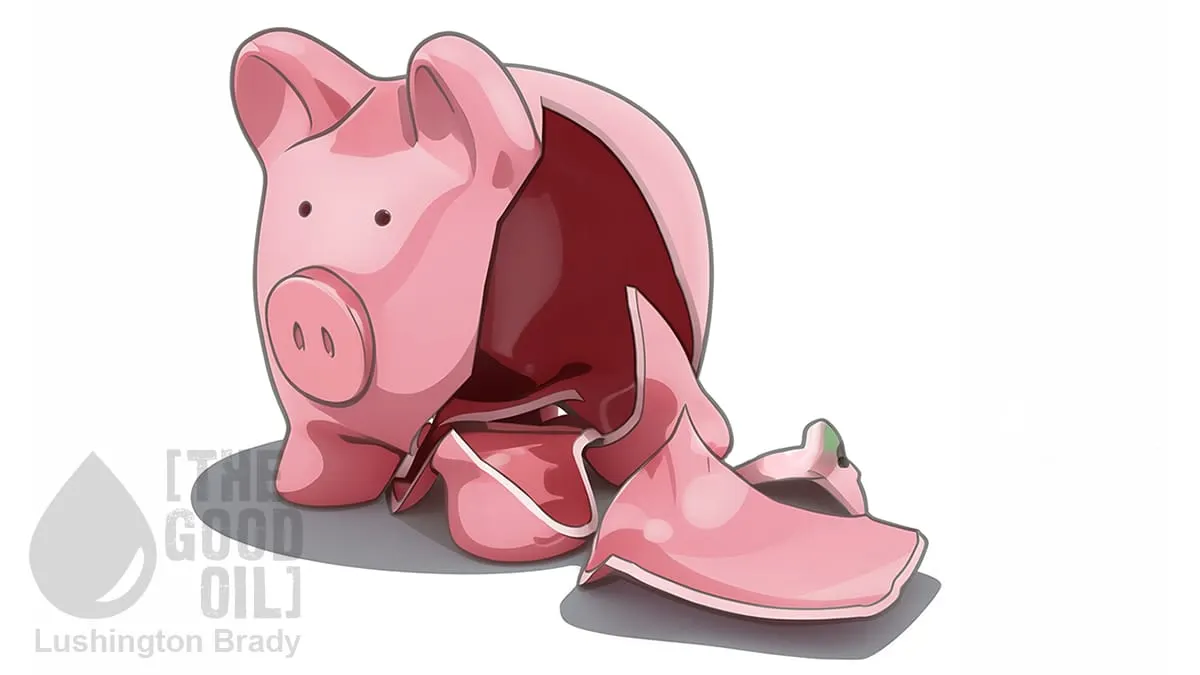
The current administration has presided over a period of wealth evaporation rarely seen outside a global depression. Their socialist-lite experiments, combined with a central bank forced into a corner by government profligacy, have left the average household reeling. Conservative estimates put the scale of the decline of net wealth and purchasing power at half a trillion dollars. Others suggest it is north of $800 billion.
And that’s just in the five months since May.
Australian households have lost an estimated $70,000 each on average since the May budget, as falling property value and inflation combine to destroy national wealth.
We are witnessing the slow-motion implosion of a political agenda that is fundamentally antagonistic to the creation of value. The government pretends this is all part of a grand design for ‘equity’, but the reality is much bleaker.
Labor’s policies have not merely misfired: they have actively smashed the foundations of Australian wealth. The electorate is starting to wake up to the stench of the abyss, but until we have a political class that prioritises national industry and fiscal sanity over vote-buying and net-zero posturing, the slide will continue.