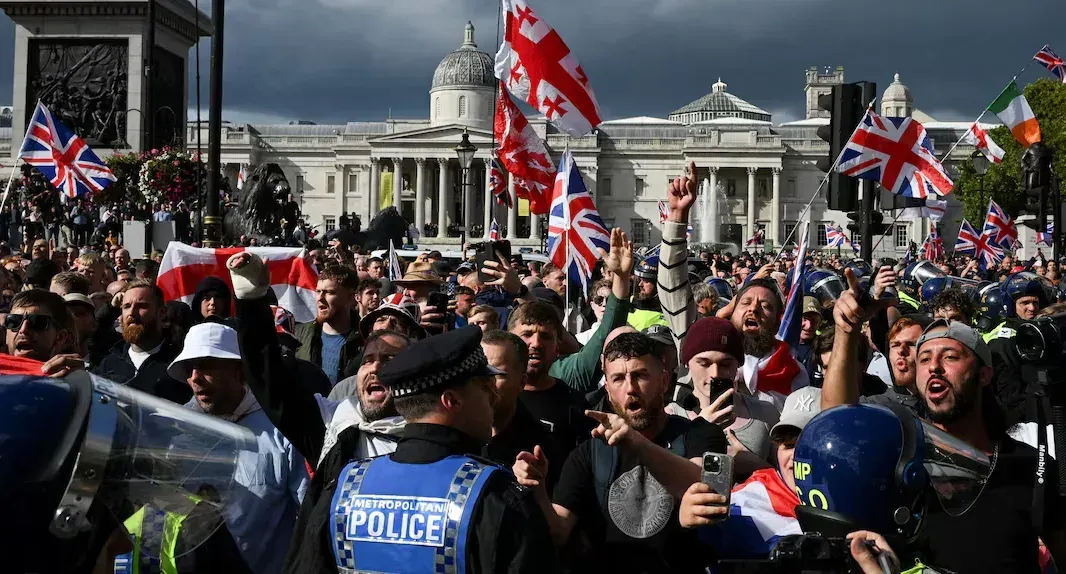
When UK prime minister du jour Keir Starmer indignantly told the White House that the UK has “had free speech for a very, very long time… and it will last for a very, very long time” did even he believe himself? How can a country where thousands of people are arrested every year for social media posts seriously claim to have free speech?
That’s not an exaggeration, either: in 2025 alone, British police arrested 12,000 people for posts on online platforms. This is the same police force that cannot solve even one in every 10 burglaries. Just 11 per cent of violent crimes ever result in an arrest. UK citizens will be jailed longer for deleted social media posts about setting fire to a hotel than an illegal immigrant who actually sets fire to a hotel.
And a taskforce of multiple officers will swoop on ‘non-crime’ speech incidences and drag even teenagers off to the lockup for a day and night with no charges.
Britain has become a global joke. Except that it’s not even funny.
This was the shocking experience of Fraser, a 15-year-old schoolboy and Reform UK activist whose insolence against local authority brought the full, flat-footed weight of the state crashing down upon his bedroom door. Four officers from the West Midlands constabulary descended upon the lad at half-past eight in the morning, hauled him out before his neighbours and locked him away.
His heinous trespass? Mocking an adult Conservative councillor online. Fraser took umbrage at the politician attending a council meeting dressed in shorts and a T-shirt, quipped that the politician looked somewhat better when not resembling a rent boy and digitally stuck bunny ears on a picture of the dignitary’s face.
In what self-respecting democracy should a child be arrested for criticizing an elected politician? The Free Speech Union is supporting Fraser and has taken on his case. His lawyers received an email from West Midlands Police stating that it is alleged that your client’s comments could be considered a hate crime offense. Months later, Fraser is still waiting to learn whether he’ll be charged.
The American press, peering across the Atlantic with a mixture of horror and pity, could hardly fathom the spectacle. Across the pond, the New York Post marvelled at how a Western peer could degenerate into an open-air speech penitentiary. In that benighted archipelago, once hailed as the cradle of parliamentary democracy, an impertinent adolescent can have his DNA harvested and his shoes seized because a local apparatchik had his delicate feelings ruffled.
The police, of course, have no time to track down muggers, car thieves or machete-wielding street gangs, let alone illegal immigrant rapists and Muslim child-rape gangs. But point a phone camera at an officious ward-heeler and the Thin Blue Line becomes an impenetrable phalanx of offended bureaucrats.
Worse still, this is not an eccentric, isolated hiccup by overzealous constables with time on their hands. It is the deliberate, statutory operational mode of modern Britain.
Home Office data for the fiscal year 2025–2026 projects over 13,000 arrests, a 10 per cent increase from the previous year. London Metropolitan Police alone accounted for nearly 2,000 cases in 2025, followed by Greater Manchester and West Midlands forces. Convictions under these acts numbered around 1,500 in 2025, down from peaks in the early 2010s, per Times reporting.
Notice that grotesque disproportion: over 13,000 arrests annually for ‘offensive’ verbiage, set against a tiny fraction of convictions. In other words, 90 per cent of these arrests are totally without merit.
But as Franz Kafka understood long before Whitehall turned his nightmares into official procedure, the process itself is the punishment. You are dragged into custody, paraded through the neighbourhood, placed under open-ended bail conditions, stripped of your livelihood and left dangling in bureaucratic purgatory for months on end. Even if the Crown Prosecution Service eventually sheepishly drops the matter, your life has been thoroughly derailed.
All of this stems from legislation drawn up decades ago, such as Section 127 of the Communications Act 2003, which criminalises messages that are ‘grossly offensive’: a phrase so hopelessly malleable that it covers whatever a bruised bureaucrat or political grievance-monger decides to weep about on any given Tuesday. The UK Labour regime, far from arresting this march into madness, merely doubles down with censorship-enabling internet laws that prod tech platforms into acting as digital snitches – laws that the Australian and New Zealand governments are falling over themselves to copy
Britain has abandoned the free world and embraced the clownish despotism of the speech squad – Australia and New Zealand are not far behind.