Table of Contents
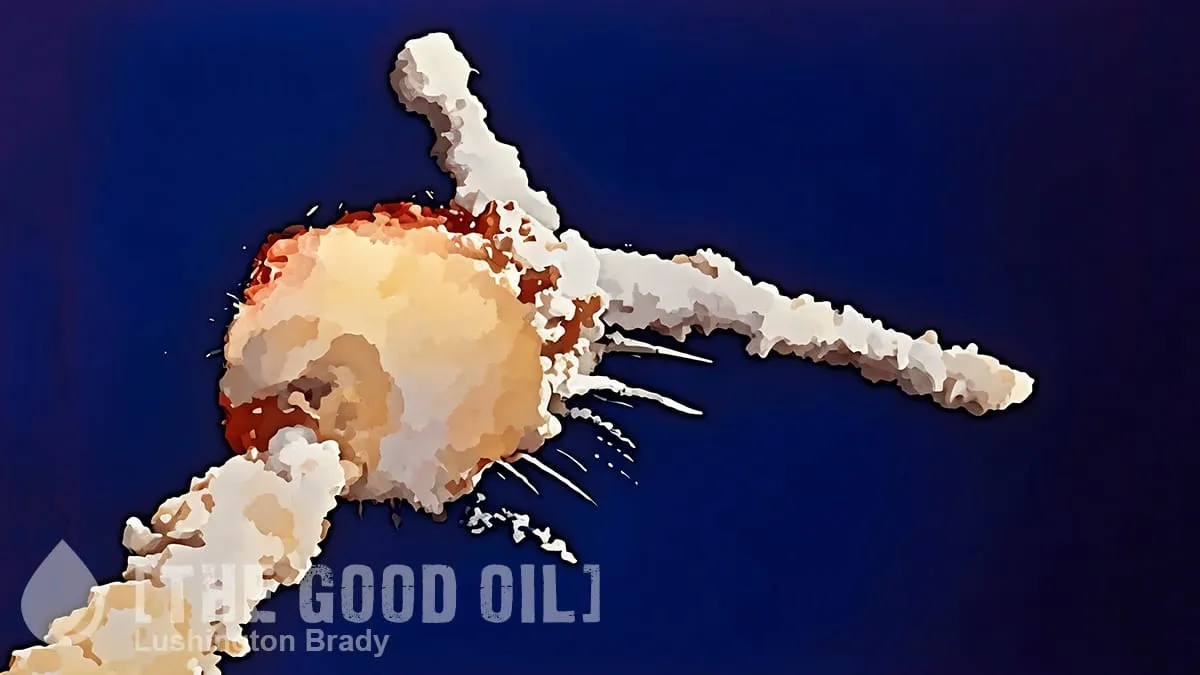
Forty years ago, the space shuttle Challenger exploded. It was one of the worst disasters in space exploration, and the US’ first astronaut deaths for nearly 20 years.
The disaster was all the more traumatic because it was being beamed live into schoolrooms around the country.
To try overcome growing public boredom with spaceflight, NASA staged a publicity blitz around sending a teacher into space. To say it backfired monumentally is an understatement.
In schools across the country, kids from kindergartners to high school students were ready to watch Sharon Christa McAuliffe, the first teacher in space, launch into orbit. Instead, they saw a tragedy […]
Challenger exploded in front of our eyes.
It was, in fact, the first time the world had really had to confront a disaster in a space programme that had come to seem about as routine as a commuter flight.
Most assumed that the space shuttle could be counted on to launch flawlessly time after time. There had been disasters. But most Americans didn’t know about Soyuz 1’s parachute failure or the decompression of Soyuz 11.
Apollo 13? We got our astronauts back. Apollo 1? That happened in a ground test and made little impact outside NASA circles.
But seven astronauts getting blown to hell on live national TV? That was a new and shocking development.
It wasn’t much better inside Mission Control. As footage shows, controllers were at first completely dumbfounded.
I was working in data communications. My job was to ensure all telemetry links between the space shuttle and NASA’s ground communications system (NASCOM) were operational. Everything was green on my board, the shuttle launched, and a few seconds later, everything went to hell. I stared at my controls, tried to get things to reconnect, and then I finally looked up at the TV display.
To make it worse, in the weeks and months that followed were revelations that bureaucracy let it happen.
Roger Boisjoly, an engineer at Morton Thiokol, the manufacturer of solid rocket boosters, has written a memo predicting a potential “catastrophe of the highest order” involving the boosters’ O-rings. This would create a real risk of “losing a flight.” He was ignored by both Morton Thiokol and NASA, and seven brave people died.
They wouldn’t be the last.
On Feb 1, 2003, the shuttle Columbia broke up on re-entry.
Once more a technical problem, a problem with external tank foam insulation, management mistakes and poor internal communications combined to lead to the death of seven more astronauts.
It was, as they say, different times.
As a measure of just how different, it took me, a space fanatic since childhood, most of a day to even get the Challenger story, even though the story broke in time to hit the morning news. Catching my early-morning commute, I overheard someone say, “Did you hear about the space shuttle?” But that was all I knew until that afternoon, when everyone on the train home had their papers with the infamous ‘scorpion’ photograph of the explosion plastered on the front papers.
No smartphone, no universal internet connectivity, no ubiquitous screens, no 24/7 news cycle.
In many ways it was the beginning of the end of US government-run manned spaceflight. NASA had become just another moribund government bureaucracy.
Long before then, NASA’s manned spaceflight initiatives were doomed. Even when I worked at NASA in the 1980s, we were making do with hopelessly outdated equipment. One of the tertiary communication links I monitored in 1984 was a Telex line dating back to the 1950s to the Bermuda tracking station.
Why? Because once the space race to the moon was won, America never wanted to spend money on space. NASA’s billions only look big when they’re taken out of context. NASA’s budget makes up a mere 0.5 per cent of the Federal budget.
Today, the torch has been passed to the private sector, with already-spectacular results. Elon Musk’s SpaceX has slashed the cost of getting a kilogram of payload into orbit, after it had been stuck since the late ’60s, with the price set to drop even further in coming years.
That doesn’t mean there won’t be further disasters though. The simple fact remains that spaceflight is inherently risky.
The price of exploration is always paid in blood.
But it’s always worth it.