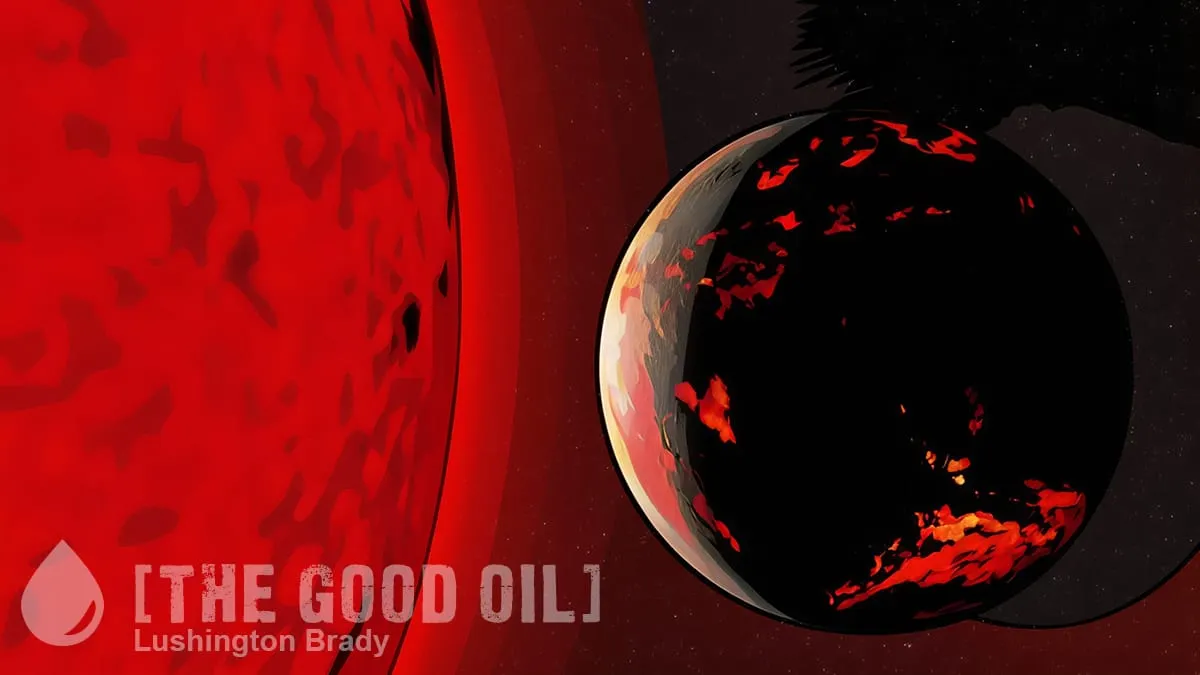
One of the bleakest images in H G Wells’s The Time Machine is when the Time Traveller fast-forwards billions of years into the future. The Earth is a bleak, freezing desert, where the only sign of life is a repellent football-like object flopping at the edge of the black, oily sea. The dying planet is lit by a swollen, red giant Sun.
We’ve long known that the Sun, in its later life, will become a red giant. Scientific consensus has been that it will become so huge that it will eventually consume the inner planets entirely. After which, it will shrink to a white dwarf, and billions-of-years-long stellar senescence, with Earth long reduced to a cosmic cinder.
But new modelling of stellar evolution argues that the Earth may well survive the red giant phase.
Now, in a Letter to the Editor published June 19 in the journal Astronomy & Astrophysics, astronomers used stellar evolution models and observed a nearby dying star to reassess Earth’s ultimate, potentially fiery, fate.
When the Sun enters its later life stages, Earth will be at the mercy of two competing forces – a fate shared by countless worlds throughout the unimaginably immense span of cosmic time.
Those two battling forces are the tidal drag pulling Earth inward, and mass loss from the star’s outer layers weakening its gravitational grip, potentially flinging our world to a safer orbit.
“The fate of Earth depends on a delicate balance between these two effects,” Mats Esseldeurs, a doctoral candidate at KU Leuven’s Institute of Astronomy in Belgium and first author of the study, said in a statement. “If tidal interactions dominate, Earth is engulfed. If mass loss dominates, Earth escapes to a wider orbit.”
Observations of intact worlds around white dwarfs suggest such a survival is possible. Remnants of shattered planets around others show it isn’t guaranteed.
The uncertainties remain large. Better data on how much mass Sun-like stars actually shed will be crucial. Missions like ESA’s PLATO, launching next year, should help by spotting planets around ageing stars.
If nothing else, it’s a reminder of how much we still don’t know about the universe’s long game. Humanity’s brief flicker on this rock may end long before the Sun’s final act. Or perhaps our descendants will have long since left for greener cosmic pastures. Either way, the sheer scale of stellar evolution puts our daily political hysterias into sobering perspective.
H P Lovecraft similarly wrote that such a cosmic perspective put our human vanities into their rightful perspective. Indeed, Earth’s ultimate fate may well follow his description of “the dark planet Yuggoth, at the rim of the solar system”, to visit which would “drive any weak man mad”. Such a hellish fate may well be Earth’s ultimate destiny.
In the vast indifference of cosmic time, our species is but a mayfly. The Sun’s death throes are billions of years away. We have rather more pressing problems: most of them self-inflicted by governments convinced they can control the climate while unable to keep the lights on.