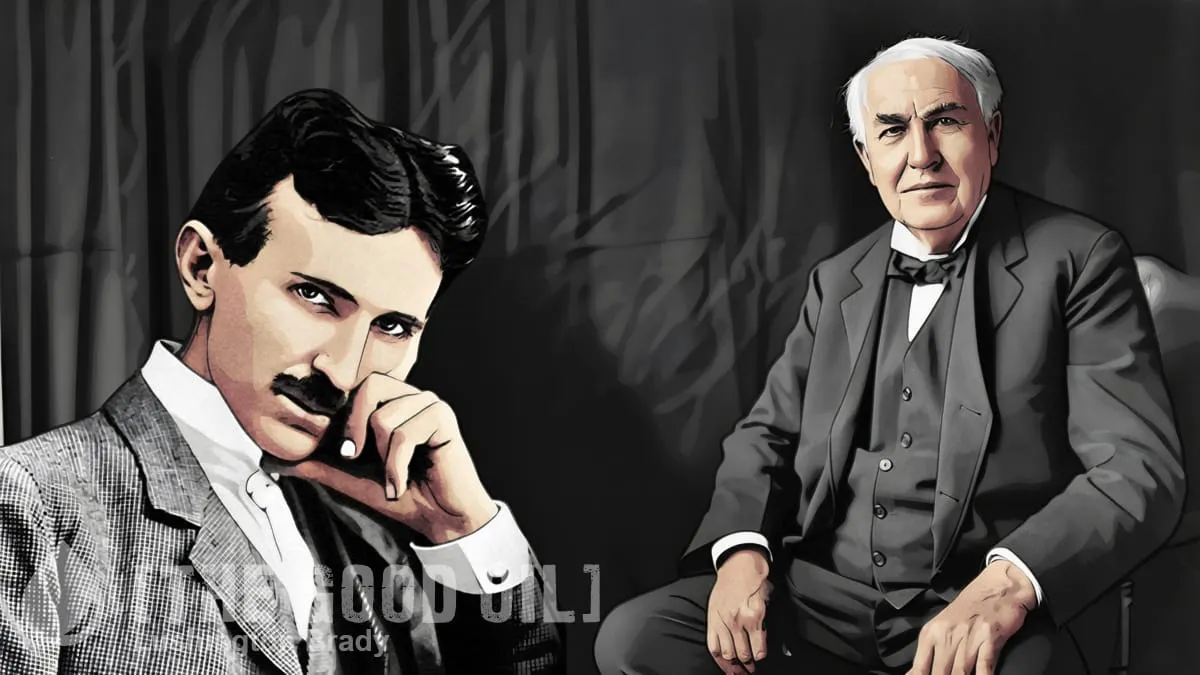
In recent years, a peculiar cult has grown up among neckbearded keyboard warriors: the Cult of Tesla, which, like all cults, has its Great Satan: Thomas Edison. The founding myth of the cult is that Nikola Tesla was the supreme genius of the ages, who would have had us all piloting our flying cars on rays of free energy, if only the devil himself, Edison, hadn’t ground down this technological archangel out of a fit of pique that made Lucifer himself seem merely a bit miffed by comparison.
There’s only one problem with this narrative: it’s a steaming pile of horse dookey.
Like the popular myth of vengefully jealous Salieri destroying Mozart, it’s a complete myth (Mozart and Salieri were in fact mutually respecting colleagues, and Salieri tutored Mozart’s children). The only difference is that Amadeus author Peter Shaffer was always upfront that he made the whole story up for the sake of a good drama, not a documentary.
For most of history… if you asked just about anyone which of these men was greater, you would likely have gotten a response something like: ‘Edison, of course. I mean, he gave us light.’
That was the sane consensus for decades. Then the internet discovered Tesla memes. Suddenly Edison became a thieving brute who crushed the pure visionary out of petty jealousy. The reality, as usual, is more complicated and far less cinematic.
There was no feud. In fact, there wasn’t even any real conflict between Tesla and Edison during the War of the Currents: because, contrary to popular belief, Tesla wasn’t really that involved in it.
The War of the Currents was already winding down when Tesla’s AC induction motor ideas gained traction. Contrary to the lone genius myth, practical implementation came from others, especially Benjamin Lamme at Westinghouse. Tesla’s concepts built on earlier work by Faraday, Ferraris and others. Edison’s DC system had its limits for long-distance transmission, but AC’s victory was engineering teamwork, not Edison’s cartoon villainy.
The $50,000 bonus story that supposedly caused Tesla to storm out in righteous fury? Also heavily embroidered. By all accounts, the two men almost never interacted in their lives, even when Tesla actually worked for Edison.
When Tesla’s lab burned down in 1895, destroying years of work, Edison offered his facilities. Hardly the act of a mortal enemy.
The fact is that the two men were simply completely different types of genius. Tesla was brilliant at big ideas and visionary concepts. Edison excelled at systematic development, commercialisation and turning prototypes into products that actually worked at scale. Both advanced humanity.
The lone genius versus evil capitalist narrative is techbro catnip that flattens complex reality into cartoon heroes and villains.
As historian Keith N said very aptly about Edison, he is actually one of the least well-known of all famous people, and much of what everybody thinks they know about him is no more reliable than a fairy tale. As for Tesla, after doing a deep dive on him as well, the consensus among our team is that this is even more the case for him than for Edison.
Tesla’s later years were marked by eccentricity and declining mental sharpness. He obsessed over pigeons (literally falling in love with one bird, “As a man loves a woman” in his own words), made wild claims and struggled with debt. Edison remained the relentless tinkerer. Neither was a flawless saint or cartoon monster. Progress came through iteration, teams and building on each other’s work, not solitary geniuses crushed by corporate malice.
The Tesla cult loves portraying him as anti-establishment prophet of free energy suppressed by greedy industrialists. The truth is messier and far more human. Both men left immense legacies. Edison lit the world. Tesla’s AC work helped power it. Romanticising one while demonising the other tells us more about modern ideological priors than about history.
Neckbearded techbros, especially of the leftist persuasion, adore Tesla because he fits the persecuted visionary template. They need Edison as the capitalist villain.
The real story is collaboration, competition and the messy grind of turning ideas into working technology. That’s how actual progress happens: not through internet memes or selective hagiography.