Idealists and legacy media shills would have us believe that scientists are dispassionate seekers after truth at all costs. In other words, they’ve never spent much time around actual scientists. The reality is that most scientists would rather die than admit that their pet theories were wrong.
Richard Dawkins loves to bore us all with an anecdote about a professor congratulating a student for demolishing his pet theory. I suspect the only reason Dawkins remembers the incident so well is because it was so exceptional. In the real world, the upstart student would probably have his grants pulled, his papers ganged up on by ‘pal reviewers’ and his academic career turned into an uphill battle.
Climate ‘scientists’ are even worse, which probably explains why they’ve suddenly decided that one of the most spectacularly publicly failed experiments of the past few decades is now being touted by the Climate Cult as a resounding scientific success.
In fact it was a stark illustration of what so often happens when beautiful theories meet harsh realities – not to mention an abject lesson in not letting scientists run a real-world show.
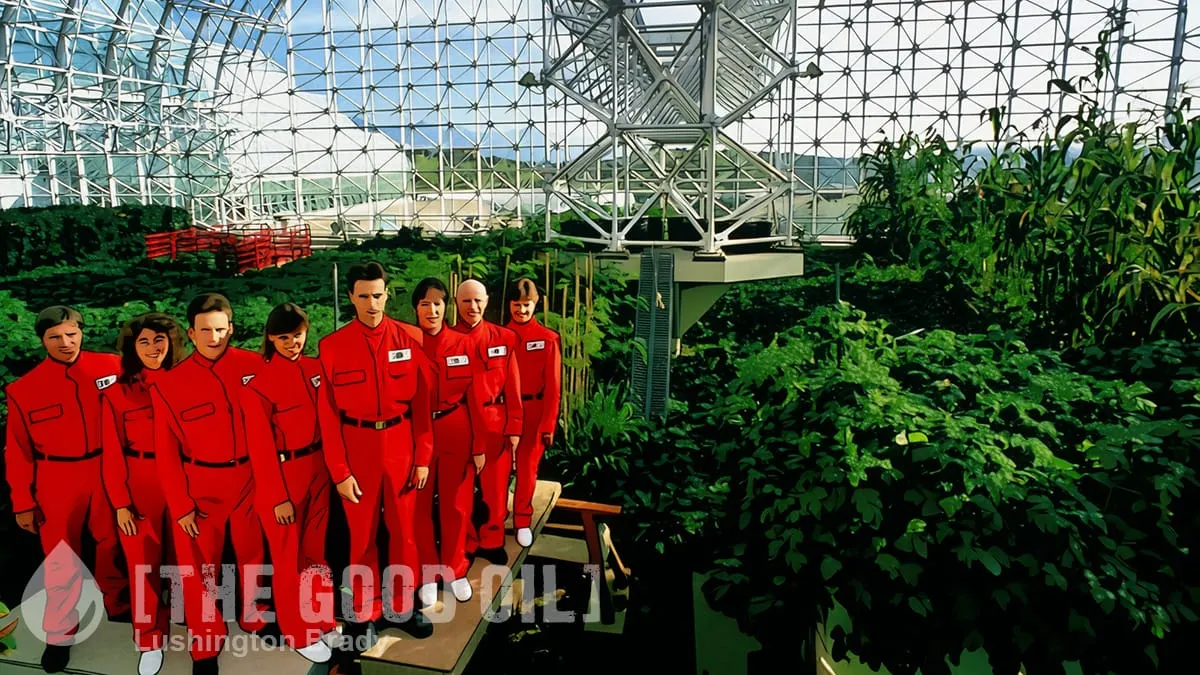
Eight people sealed themselves in a glass dome to prove humanity could feed itself on plants, and spent two years starving in front of the world’s press.
Men lost nearly a fifth of their body weight; women about a tenth. Fatigue, depression, mental fog and an all-consuming preoccupation with food took over. They stole from each other. They split into factions that stopped speaking. The ecological research the project was built for was largely abandoned. No, no, no, you see: it was about life extension.
Roy Walford, the crew doctor, [was stuck] in a sealed box with seven hungry colleagues and his own life’s work. Walford was a UCLA pathologist who had spent 30 years arguing that severe calorie restriction extends lifespan. He had doubled it in mice. And here was reality handing him his own hypothesis with the door welded shut.
So he called it a health programme.
It worked. Sort of. The bloodwork was textbook, according to Walford’s theoretical calculations. The reality was more Lord of the Flies than Methuselah.
Fatigue, depression, mental fog, and a preoccupation with food that ate the entire interior life of the crew. They stole from each other. They split into two factions that stopped speaking. The ecological research the building had been constructed for was largely abandoned by people who no longer had the headroom for anything past the next meal. The ants and cockroaches, by contrast, were thriving.
The air was leaving too. Oxygen started at 20.9 per cent and kept dropping and nobody knew where it was going. Columbia eventually worked it out: the concrete was quietly eating it. So oxygen had to be pumped in from outside, which is an interesting result for a sealed world.
Walford later admitted that any other physician aboard would have panicked and declared they were starving. Instead, Walford pretended that all was going to plan.
He came out in 1993, developed ALS, blamed the conditions inside, and died in 2004 aged 79 after years on 1,600 calories a day in pursuit of a longer life.
The mice might have doubled their lifespans: Walford didn’t even make it to the average for an American professor.
It’s the real-life example of the classic joke about a scientist whose calculations show how a chicken farmer can double production, ‘So long as it’s a spherical chicken in a vacuum’.
Biosphere 2 had chickens, as it turns out. Had.
Biosphere 2 had livestock, and the crew ate the pigs first.
Zazu and Quincy were Ossabaw dwarf pigs. In the first year one of them produced a litter of seven, which inside a sealed glass building where every calorie was counted should have been the best news anybody had.
They killed them anyway.
The chickens went too.
The irony is that they didn’t kill the livestock for meat. They killed them because the animals were competing for the same scarce calories the humans needed.
Eight of the most motivated humans alive, handed three acres of the best-managed farmland on the planet and no meat, could not feed themselves.
The press at the time reported the fighting as a personality clash. Now, the legacy media and the Climate Cult are denying even that it was a colossal failure. No, no, no: it was ‘ahead of its time’, you see.
In fact, today, the facility is bustling with scientists testing the effects of climate change on its living ecosystems. Far from helping humans escape Earth, Biosphere 2 seems to have become one of our best tools to understand Biosphere 1.
“It wasn’t a failure,” [Lisa Rand, a historian of science at the California Institute of Technology] says.
The same experiment that demonstrated the practical impossibility of a sealed, plant-heavy, low-animal system is being repurposed as proof of ecological insight, which probably shouldn’t surprise us, coming as it does from people who think computer models know better than the real world.
Every fashionable argument of the last decade – grow it locally, take the animals out, eat less, watch the planet thrive and everyone live longer – was already running inside that glass dome. Reality delivered its verdict with the door welded shut.
When beautiful theories collide with hungry people, the theories do not usually blink first. Scientists, meanwhile, simply redefine the hunger as success and move on to the next grant.