Table of Contents
No modern pandemic, be it Covid, the likely far-worse Hong Kong flu of 1968–69, or even the post-WWI Spanish flu, can hold a candle to the Black Death. Covid, even on the ludicrously generous definition of a ‘Covid death’, killed just 0.2 to 0.4 per cent of Western populations. The Spanish flu perhaps five times as many (about 1.1 per cent).
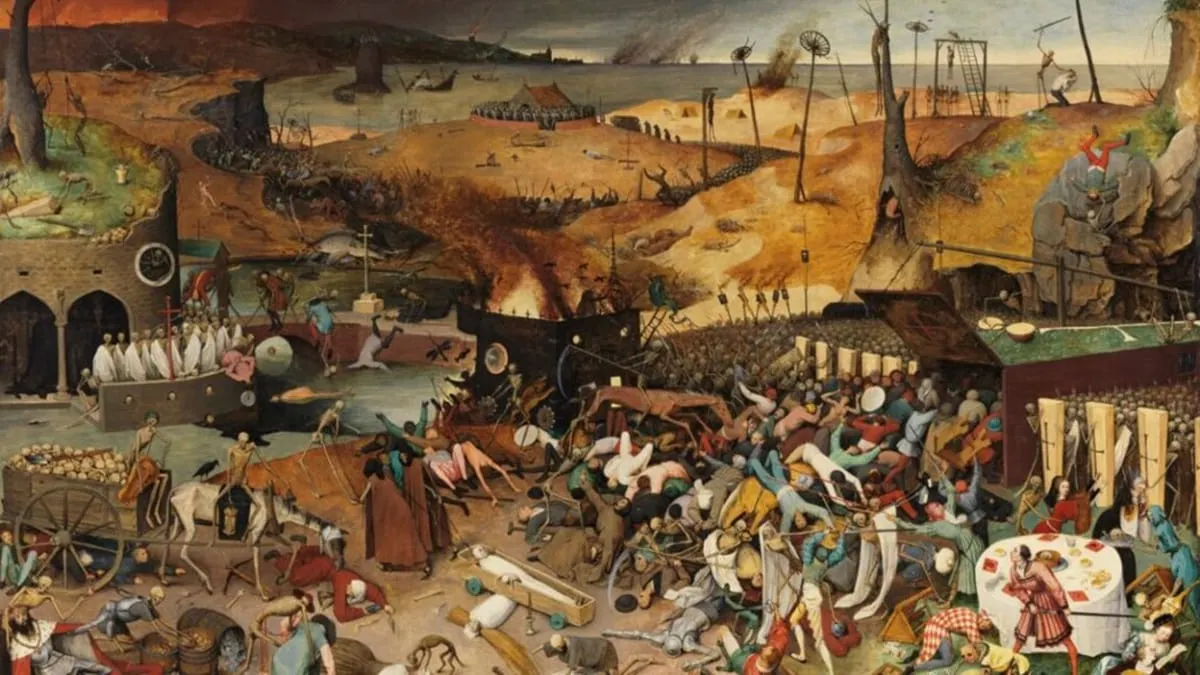
The Black Death killed 250 times as many people, as a percentage of population, as Covid. While total deaths varied by region, it’s estimated that it killed as many as half of the total population of Europe. Agnolo di Tura’s harrowing account of burying his entire family with his own hands is a microcosm of the suffering the plague unleashed: “so many died that all believed it was the end of the world”.
Boccaccio describes wider calamity:
There was not enough consecrated ground to provide graves for the vast number of corpses which were brought in the greatest haste, day and night, indeed almost every hour, to the churches for burial… as soon as a grave yard was full, they dug a huge trench and laid the bodies in it as they arrived, hundreds at a time. They piled them up the way merchandise is stacked in the hold of a ship, layer upon layer, each covered with a little earth, until the trench would hold no more.
As Boccaccio relates, “The disease seemed to set at naught all the art and learning both of doctors and their remedies.” It remained so for centuries: it was not until the end of the 19th century that the bacteria responsible, Yersinia pestis, was identified. More recent research has indicated that the bacterium evolved as much as 5,000 years ago in what is now the border of Latvia and Estonia. Around the same time, populations of Neolithic farmers in northern Europe went into marked decline.
But the modern strain of Y. pestis responsible for the Black Death is thought to have first spread from Central Asia to Eastern Europe by the Mongol Golden Horde at the 1347 siege of a Genoese trading port in the Crimea. In the fatal month of October 1347, 12 ships fleeing the siege arrived in Sicily. The event is described in vivid detail by chronicler Michele de Piazza: galleys driven from the east “by the stinking breath of wind”, full of sailors who “carried such a disease in their bodies that if anyone so much as spoke with one of them he was infected with a deadly illness and could not avoid death”.
What, though, caused a millennia-old bacterium, apparently lying dormant in Central Asia, to suddenly sweep through Western Europe with such horrifying mortality and such astonishing speed? Up to six kilometres or more per day, overland in some places.
New research suggests the devastation may have begun with a volcanic eruption in the year 1345, which then led to a series of events that brought the deadly disease to Europe: climate shock, famine, and trade in the Black Sea.
But why were Europeans so increasingly relying on trade with Black Sea countries?
The search for answers began when Martin Bauch, a medieval and environmental historian who studies historic famine, was looking through records and found that northwestern Italy had faced a devastating crop failure in late 1345. This came after a long, unusual period of rainstorms – and the Black Death began just three years later.
With deadly inexorability, the dominoes began to fall.
Looking through further records showed that the crop failure had made Mediterranean cities desperate. They had exhausted their food supplies and were forced to import grain from the Black Sea region to avoid starvation, unwittingly importing the deadly Yersinia pestis bacterium alongside it.
“For more than a century, these powerful Italian city states had established long-distance trade routes across the Mediterranean and the Black Sea, allowing them to activate a highly efficient system to prevent starvation,” Bauch told the BBC.
And unwittingly instigating a far deadly calamity: transmitting the Black Death to Western Europe.
But what had caused the crop failure in the first place?
To answer this question, Bauch and colleagues analyzed the rings of ancient trees from Spain’s Pyrenees Mountains and discovered that they’d seemingly experienced slowed growth during the summers of 1345 and 1346. This aligned with an increase in sulfur trapped in the world’s ice sheets from the same time period. Together, these clues suggest that a volcanic eruption somewhere in the world – likely the tropics – in 1345 had deposited massive amounts of ash into the atmosphere that subsequently blocked out sunlight and lowered global temperatures.
The scenario seems very similar to the stupendous 1815 eruption of Mount Tambora in Indonesia, triggering the infamous ‘Year Without a Summer’. This volcanic winter caused widespread crop failures and famine, in the wake of the Napoleonic Wars, and snowed in a group of upper-class dropouts in a Swiss chalet, where they passed the dark days and nights telling stories. One even wrote hers down: Mary Shelley’s Frankenstein.
All this reminds us, as geologist Ian Plimer says, that just one volcanic burp can knock human greenhouse gas emissions into a cocked hat.