
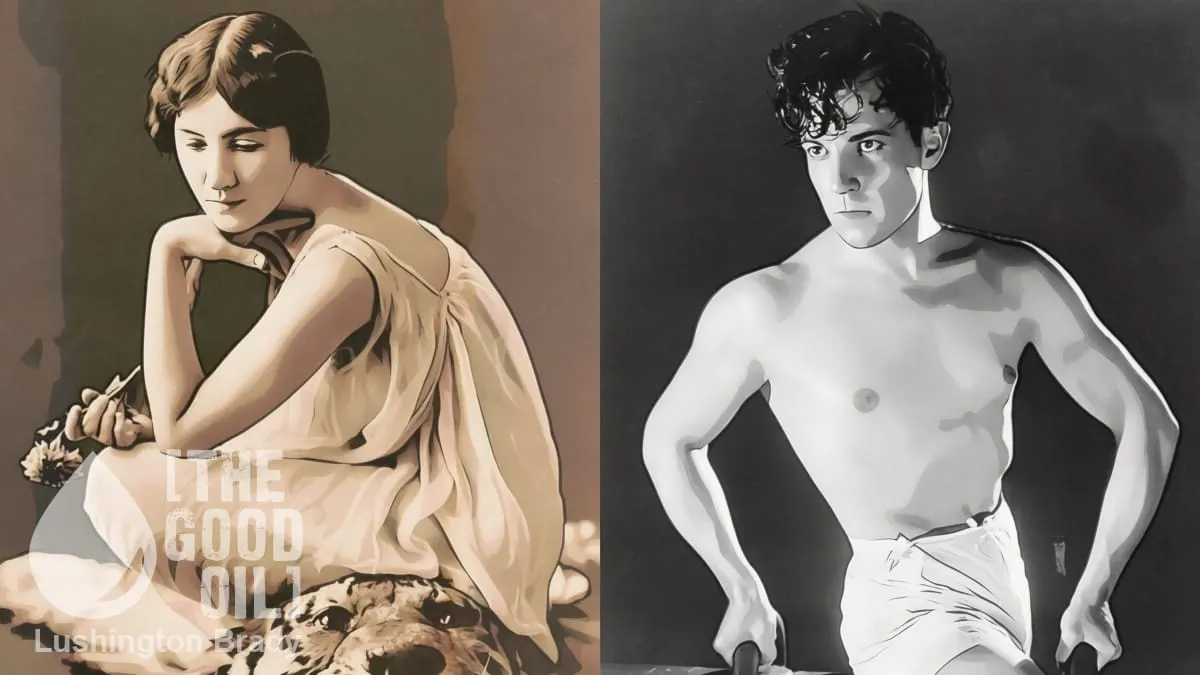
As Bart Simpson once lamented in The Simpsons: “George Burns was right: show biz is a horrible bitch goddess.” The stardust myth of the dream factory has always been a seductive lie. Behind the Klieg lights and red carpets lies a merciless machine that elevates beautiful faces to godlike status, only to discard them when the novelty fades or scandal sticks. Two cautionary tales from the silent era – one a pioneering model turned ‘supermodel’, the other a dashing Latin Lover – reveal the brutal truth. The dream factory doesn’t just break hearts. It destroys souls.
Burns’ longevity would have given him a unique perspective: he’d likely have remembered the names of Audrey Munson and Ramon Novarro long after the rest of the world had forgotten them. While Novarro was one of the many whose careers were broken when the silent era ended, Munson is seen by millions of New Yorkers every day. Yet, still she died alone and forgotten, institutionalised for six decades and without a single visitor for a stretch of 20 years.
Audrey Munson, born in 1891, became ‘America’s first supermodel’ before the term existed. Discovered on Fifth Avenue in 1909, the 17-year-old quickly became the favourite muse of New York sculptors. Her flawless figure graces some of Manhattan’s most iconic works: the gilded Civic Fame atop the Municipal Building, pieces inside the Frick Mansion and dozens more across the city. By 1915 she was modelling for three-fifths of the statuary at the Panama-Pacific International Exposition in San Francisco.
Newspapers hailed her as “Miss Manhattan” and predicted her image would outlive everyone who knew her. They were right, but in the most bleak way imaginable.
When she broke into the new medium of film, what might have seemed like a golden opportunity turned out to be a poison chalice. When she appeared nude in Inspiration (1915), one of the first non-pornographic films to show full frontal nudity, the moralisers pounced. In 1921, she was arrested on morals charges for her nude scenes in a different movie, though she was later acquitted. She was already dogged by scandal. She attempted suicide the following year and her mental state continued to decline throughout the 1920s.
One scandal in particular torched her career. While Jodie Foster’s career survived John Hinckley’s attempt to murder President Ronald Reagan, Munson’s career didn’t survive a crazed obsessive with “the greatest love offering in the history of the world”: Munson was destroyed by a similar deranged “love offering”. In 1919, her boarding house landlord, Dr Walter Wilkins, murdered his wife in a demented bid to win Munson. Munson had no knowledge of Wilkins’ intentions and she was never implicated in any sort of crime, but the scandal made her untouchable. Work dried up. She slid into paranoia, ranting about Jewish millionaires persecuting her, attempted suicide and by 1931 was committed to St Lawrence State Hospital for the Insane on her 40th birthday.
She spent the next 64 years locked away, forgotten by the city whose beauty she had immortalised. After her mother died in 1958, she received no visitors for more than two decades. When she died in 1996 at 104, she was buried in an unmarked grave. A headstone only appeared in 2016 after fundraising. As one caretaker later said, Audrey possessed “a soul that didn’t quit… peaceful, and loving, and kind”. The art world kept her body, but the dream factory discarded the woman.
In one of my favourite pieces of juvenalia, The Secret of Terror Castle, youthful detectives, The Three Investigators, explore a reputedly haunted castle built for a star of silent horror films whose career abruptly ended when audiences discovered their favourite monster had a squeaky, lisping voice. While “Stephen Terrill” is fictional, many silent film careers were indeed destroyed by the advent of ‘talkies’. One such was Ramon Navarro.
Born Ramón Gil Samaniego in Mexico in 1899, he fled the revolution and hustled odd jobs in Los Angeles before landing roles in silent pictures. His breakthrough came with Ben-Hur (1925), the most expensive silent film ever made at the time. When Rudolph Valentino died in 1926, MGM crowned Novarro the new ‘Latin Lover’. He earned up to $10,000 a week, threw lavish parties in a Frank Lloyd Wright-designed mansion and starred opposite Garbo and Crawford.
Talkies killed his career. His Mexican accent was deemed fatal in the sound era. By the 1930s MGM dropped him. He scraped by in smaller roles and TV guest spots while battling alcoholism and the internal torment of being a closeted gay Catholic in an industry that demanded heterosexual sex-symbol status.
On Halloween 1968, two brothers, 22-year-old Paul and 17-year-old Tom Ferguson, arrived at his Laurel Canyon home. They drank, possibly had sex, then demanded $5,000 Novarro didn’t have. The beating was savage. Novarro was bound and gagged, choking to death on his own blood. Eerily foreshadowing the Manson Family’s attempts to spark a race war by laying a false trail supposedly pointing to black radicals, the Ferguson brothers tried to cover their tracks by scrawling homophobic slurs on the mirror and sheets before ransacking the house. They were caught quickly but served less than a decade before parole, as attitudes of the time treated the victim as partly culpable for his ‘lifestyle’.
In its obituary, the New York Times nudged and winked that, “Mr Novarro, who never married, lived alone but was known to entertain often.” During the trial, Novarro’s homosexuality was even more openly aired – and criticized. “Back in the days of Valentino, this man who set female hearts aflutter, was nothing but a queer,” Tom Ferguson’s attorney declared. “There’s no way of calculating how many felonies this man committed over the years, for all of his piety.”
Despite their early parole for Novarro’s murder, both brothers ultimately spent the rest of their lives in prison after multiple subsequent convictions, including for rape.
What makes these old stories sting is how little has changed. Hollywood still sells youth, beauty and forbidden glamour while quietly destroying those who deliver it. The studios, agents and publicists who profited from Munson’s body and Novarro’s smouldering gaze offered no safety net when the ride ended. Today’s managers and platforms do the same: monetise the image, discard the human. Kenneth Anger’s Hollywood Babylon chronicled the cold cruelty of the “hideous bitch goddess” with gleeful malice decades ago, exposing the cocaine, perversion and casual cruelty behind the silver screen. Munson and Novarro fit the pattern perfectly: elevated for their beauty and youth, then discarded when inconvenient.
The modern celebrity machine is no kinder. It simply operates faster and louder. Instagram ‘influencers’ and Netflix starlets chase the same false promise – relevance through exposure – only to discover that the public’s appetite for fresh meat is insatiable. One wrong tweet, one ageing wrinkle, one scandal and the algorithm moves on. The lucky ones end up as cautionary TikToks; the unlucky spiral into addiction, institutionalisation or early graves.
In an age of OnlyFans and reality television, the warning from a century ago remains brutally relevant: fame is fleeting, the machine is eternal and very few escape unbroken. Audrey Munson’s statues still watch over Manhattan, silent witnesses to a city that worshipped her form but had no use for her soul.



![[The Good Oil] Stuff Up of the Day](https://storage.ghost.io/c/31/f4/31f4e20a-0315-499e-83ff-139e8eab53bf/content/images/size/w1304/format/webp/2024/09/Stuff-up-image-1.webp)

