Table of Contents
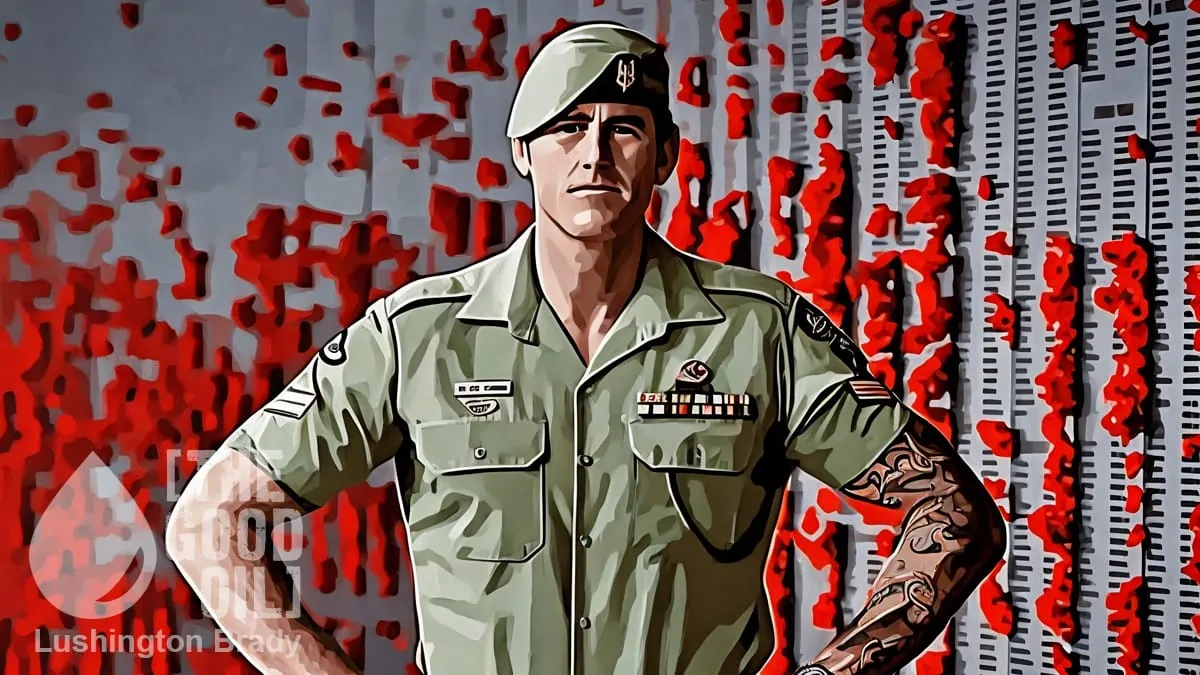
As independent journalist Drew Pavlou has exposed, the civil case against Australia’s most decorated soldier, Ben Roberts-Smith, was a sick travesty of justice. Key witnesses admitted to a pathological hatred of ‘infidels’ and sympathy for the Taliban terrorists. The same witnesses, illiterate subsistence farmers whom even interpreters could barely understand, were paid vast amounts of money to testify.
Yet, the judge chose to airily dismiss all that and the very idea that paying all the living costs for up to 30 of their family members might be an inducement for dirt-grubbing goat farmers to lie.
There is little chance the criminal case against Roberts-Smith will be any less of a travesty.
This country needs to come to terms with the fact that there is a real risk that Ben Roberts-Smith will not be given a fair trial.
This would be the worst possible outcome – far worse than having a decorated former soldier convicted on five charges of war crime murder.
If we cannot provide a fair trial for Roberts-Smith it would shake confidence in the justice system and send a terrible signal to those in the military as well as potential recruits.
How can anyone have confidence in a bureaucracy that has spent over a decade, and some $300 million, on such an obvious witch-hunt? The very fact that an AFP commissioner who still can’t find time to interview all the survivors of the worst terror attack in Australian history, yet managed to go to great trouble to orchestrate a theatrical arrest, with media well tipped-off, should be ringing alarms bells loud and clear.
Then there is the disgraceful conduct of the legacy media, who have already all but declared Roberts-Smith tried and convicted. In some cases, the same legacy media who paid huge, secretive sum to witnesses in the civil case.
The risk arises from two factors: the extreme delay in bringing charges over what Roberts-Smith is alleged to have done in Afghanistan, and the unprecedented volume of prejudicial media coverage.
This points to potential problems with two of the most important elements of criminal justice: witness accounts about historic events that could be unreliable, and a jury pool that could be fatally biased.
On jury bias, the judge will almost certainly instruct the jury to ignore everything they have read or heard in the media and to consider only what they hear in court.
This will be frankly impossible, given that the elite chatterers, from legacy media, to politicians, to the top-heavy Australian Defence Force itself, have shouted their condemnation from the rooftops for years.
That task has been made more difficult by statements by public figures who must have forgotten the difference between a proven fact and an allegation.
After Paul Brereton’s inquiry into war crime allegations in Afghanistan, and before anyone had been charged let alone convicted, the then head of the defence force, Angus Campbell, apologised to the people of that country.
Roberts-Smith will not even be extended the largesse that was given to industrial-level corrupt politicians like Eddie Obeid. Obeid and his son were given a judge-only trial, due to the publicity surrounding their years of blatant corruption. But the Australian Constitution specifies that federal indictable offences – which includes war crimes – must be heard by a jury.
In this case, a jury that has been pump-primed by a witch-hunting establishment.
The second problem for the judge is this: by the time this case comes on for trial, witnesses will be giving evidence about events that are alleged to have taken place about 20 years in the past.
Some would have given statements to Brereton’s inquiry, the Office of the Special Investigator, the Nine newspapers that had pursued Roberts-Smith, and to the defamation proceedings he initiated against those newspapers.
And even those were already confused and contradictory. Almost no two people could agree on events, and some were quoted by journalists as telling stories that they later flatly denied.
Memory does not improve with time. Accounts might become more polished the more often they are told but they are not necessarily more accurate.
Michael McHugh, a former High Court judge, pointed out in 1989 that the longer the period between an event and its recall, the greater the margin for error.
“The fallibility of human recollection and the effect of imagination, prejudice and suggestion on the capacity to ‘remember’ is well documented,” McHugh wrote in his judgment in a case known as Longman […]
When Roberts-Smith was arrested this week, it was over events that are alleged to have taken place up to 17 years ago.
Yet, during a royal commission in 1983, former Chief Justice of NSW Sir Laurence Street expressed grave doubts about the reliability of testimony about even just five or six years in the past. The events Roberts-Smith is accused of were three times that long ago.
Does anyone have even a shred of confidence that this has been a fair process at any stage or that this criminal trial will be any less of a travesty of justice?