For decades now, the supposedly nuclear-button rebuttal of the Climate Cult to even the mildest questioning of its dogmas has been to screech ‘Denier!’ of a 15th-century Dominican sighting a heretic, which is odd, because nobody I’ve ever met denies there’s a climate.
Or do they mean climate change denier? Well, very few people I’ve ever met, read or heard deny that the climate changes. In fact, for a great many sceptics of the Climate Cult’s doom narrative, that’s precisely their point. Climate changes: it always has and always will. That it’s changing now is just the normal state of things.
Aha! declares the Cultist with the passionate certainty of the perennially wrong. But it’s the rate of change! The climate, they assert, has never changed so rapidly in the past as it now is.
Except that it has. And, far from doomed to extinction, humans lived through it pretty well. And that was long before such modern, climate-ameliorating, life-saving conveniences such as air-conditioning, artificial heating or even much in the way of warm clothing.
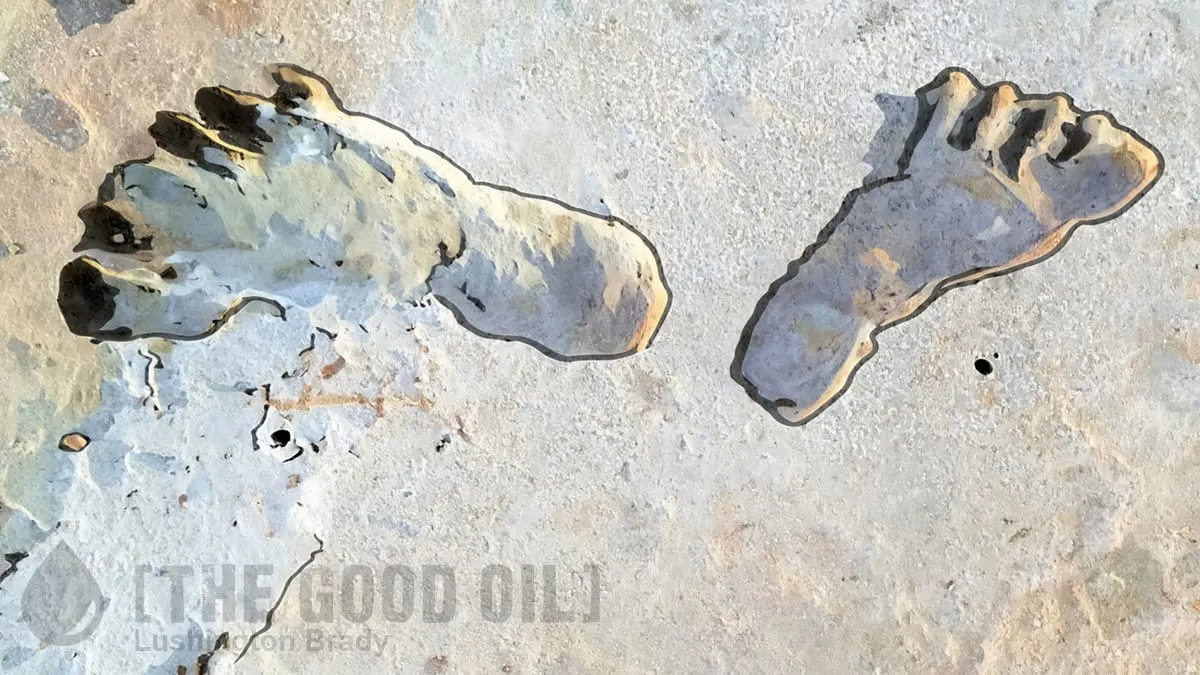
The evidence has recently been dug up, quite literally, in New Mexico. Some 23,000 years ago, at the height of the last Ice Age, when the world was roughly four degrees Celsius colder than today and the American Southwest was unrecognisable, a group of people walked across the muddy margins of a lake that no longer exists and left their footprints in the sediment.
Some 23,000 years ago, during the coldest part of the last ice age, people walked across the muddy margins of an ancient lake in what is now White Sands national park, New Mexico.
Twenty separate layers of footprints, spanning nearly two millennia of the glacial maximum. Conifer forests giving way to oak and sagebrush. A lake shrinking, its water growing saltier as the basin dried. And then, around 23,200 years ago, a short and savage drought – one that shows up simultaneously in the Greenland ice cores thousands of miles away.
And people were there. Not fleeing, not merely surviving, but repeatedly returning, walking that same shoreline as the climate swung violently around them. Change so rapid it would have been noticeable during a single, foreshortened lifetime.
And here these people were: barefoot, presumably, or in the rawhide equivalent. No air-conditioning, no central heating, no greenhouse-gas-emitting agriculture and no government scientific establishment telling them the world was ending.
Now, the Cultist will say: ‘Yes, but they were primitive! They had no technology! They couldn’t possibly have coped!’ This is the standard refuge and it is precisely inverted. These people had:
No antibiotics, so any infected cut was a coin-flip on sepsis. No metallurgy worth the name, so every tool was knapped stone or bone. No agriculture, so no surplus, no storage, and no capacity to ride out a failed season but for what the landscape gave them that week. No fire beyond what they could coax from a hearth in bad conditions, and no means to warm a shelter beyond a hide and a banked fire. No medicine, no dentistry, no sociology, no written record to consult and no idea whatsoever what caused the drought or when it would end.
Modern industrialised society, by contrast, has refrigeration, sealed housing, piped water, telecommunications, global food supply chains, antibiotics, engineering, and weather forecasting. The modernists’ ‘extinction’ claim is, ipso facto, that we are less capable of coping with climatic variation than a group of naked people with stone tools.
Does anyone really believe that?
There is also the delicious matter of the record itself. The researchers’ agent-based modelling produced a genuinely humbling result: the gaps in the archaeological record do not demonstrate absence and a surface covered in footprints does not indicate a population boom. A handful of people repeatedly crossing soft mud can leave hundreds of tracks. What gets preserved is not a picture of what happened, but a lottery of what happened to be buried.
The footprints demonstrate unequivocally that people were present at particular moments. But the gaps between footprint surfaces do not demonstrate that people were absent.
That is a useful corrective for the archaeological industry generally, and an even more useful one for the climate lobby, which has spent half a century modelling the future with the same confidence and the same evidence: a few proxies, a great deal of assumption and a chart with an arrow on the end.
The two-thousand-year White Sands record, by contrast, is not a projection, but a receipt. People were there, through drought and warming and a shrinking lake, for generation after generation. They did not merely endure the change: they walked back to the same spot and did it again.
So spare me the ‘unprecedented’.
Climate change is a great deal more precedented than the panic merchants admit and our ancestors’ response to it was rather less hysterical than ours. They had no air-conditioning, no carbon budget and no lecture series on the moral imperative of denial. They simply got on with it, because getting on with it was the only option available.
And that, come to think of it, is also one available to us.