Table of Contents
What is the cost of lies? It’s not that we’ll mistake them for the truth. The real danger is that if we hear enough lies, then we no longer recognize the truth at all. What can we do then? What else is left but to abandon even the hope of truth and content ourselves instead with stories? In these stories, it doesn’t matter who the heroes are. All we want to know is: “Who is to blame?” – “Chernobyl”
What happens when, to paraphrase The Lord of the Rings: The Fellowship of the Ring, history becomes legend and legend becomes myth? We end up in a society of top-to-bottom lies, where even the hope of truth is deliberately destroyed and the only thing that matters to the elite liars is telling everyone else who to blame.
For decades now, academic historians in Australia have embarked on a systematic campaign of lies: what the late historian Keith Windschuttle called The Fabrication of Aboriginal History. The lies range from ludicrous to heinous.
At the ludicrous end is Bruce Pascoe’s risible fairy tale Dark Emu, which hilariously claims that Aborigines practiced large-scale agriculture, lived in sprawling towns and invented democracy. Despite its comical implausibility, Pascoe’s silly little book has become a bestseller and is being foisted on a generation of gullible schoolchildren.
At the heinous end are the vicious lies of so-called ‘genocide’ levelled at ‘the colony’. The mendacity readily receives the imprimatur of government approval: the University of Newcastle’s fraudulent ‘massacre map’ is splashed across multiple government sites, while the Victorian government’s sinister ‘Yoorrook Justice Commission’ accuses that state of the most heinous crime: genocide. (With, naturally, a demand for ‘reparations’, no doubt to be in the billions.)
The evidence for these claims? Either vague to the point of meaninglessness or utterly fabricated, and in the latter case, often by the most ludicrously circular arguments. Academic historians literally make things up, then repeatedly cite themselves as ‘evidence’.
I started with Henry Reynolds’ claim in The Other Side of the Frontier that 10,000 Aborigines had been killed in Queensland before Federation. The reference Reynolds provided for this was an article of his own in a work called Race Relations in North Queensland. This was a typescript publication held by only a few libraries but I found a copy and read it. To my surprise, it was not about Aboriginal deaths at all. It was a tally of the number of whites killed by Aborigines. Nowhere did it mention an Aboriginal death toll of 10,000. Reynolds had provided an inaccurate citation of his evidence.
This is barely the tip of the iceberg. My own state of Tasmania has been at the particularly egregious receiving end of this sustained campaign of lies, distortions and fact-free hyperbole.
Lyndall Ryan cites the Hobart Town Courier as a source for several stories about atrocities against Aborigines in 1826. However, that newspaper did not begin publication until October 1827 and the other two newspapers of the day made no mention of these killings. Ryan cites the diary of the colony’s first chaplain, Rev Robert Knopwood, as the source for her claim that, between 1803 and 1808, the colonists killed 100 Aborigines. The diaries, however, record only four Aborigines being killed in this period […]
Between 1828 and 1830, according to Ryan, “roving parties” of police constables and convicts killed 60 Aborigines. Not one of the three references she cites mentions any Aborigines being killed, let alone 60. The governor at the time and most subsequent authors regarded the roving parties as completely ineffectual.
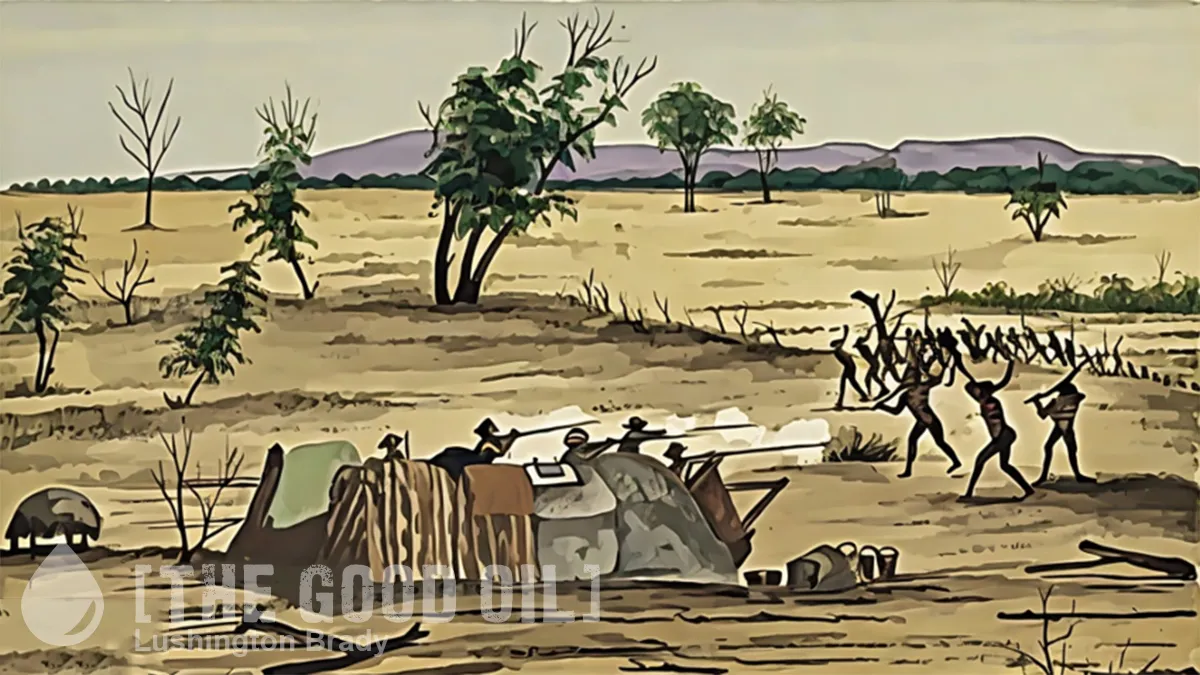
Then there’s the cause celebre of the leftist fabricators: the so-called ‘Black War’.
Ryan says the “Black War” began in the winter of 1824 with the Big River tribe launching patriotic attacks on the invaders. However, all the assaults on whites that winter were made by a small gang of detribalised blacks led by a man named Musquito who was not defending his tribal lands. He was an Aborigine originally from Sydney who had worked in Hobart for ten years before becoming a bushranger.
Lloyd Robson claims the settler James Hobbs in 1815 witnessed Aborigines killing 300 sheep at Oyster Bay and the next day the 48th Regiment killed 22 Aborigines in retribution. However, between 1809 and 1822, Hobbs was living in India, the first sheep did not arrive at Oyster Bay until 1821 and in 1815 the 48th Regiment never went anywhere near Oyster Bay.
And so it goes.
I need only step out my door to see the rugged granite landmark of Quamby Bluff. We’re often told that it’s named after an heroic Aboriginal resistance fighter. Another vainglorious lie.
Quamby Bluff was not named after an Aboriginal person at all. The first account of how it got its name appeared in the Hobart Town Courier in March 1829. A party of white kangaroo hunters came across a lone Aborigine who fell to his knees crying “Quamby, Quamby” meaning “mercy, mercy”. In other words, “quamby” was not the name of a man but an expression of the language. More than a year later George Augustus Robinson invented the story about the Aboriginal resistance leader, which academic historians now repeat as if it were true.
It gets worse.
The pre-historian and archaeologist, Rhys Jones, reports the following catalogue of horror:
The atrocities committed by sealers and convicts and reported to the 1830 committee included rape, flogging of women, burning with brands, roasting alive, emasculation of men, cutting flesh off and feeding it to dogs, dashing out the brains of children, kicking off a baby’s head in front of its mother.
In fact, the sources Jones cites mentions almost none of this. There is a sole report of an Aboriginal woman being thrown onto a fire – to which it might be pointed out that that is exactly what Aboriginal men did to the unwanted baby brother of Dolly Dalrymple (one of my pen-namesakes). The rest are known to be ‘definitely false’.
The truth is that there was nothing on the Aborigines’ side that resembled frontier warfare, patriotic struggle or systematic resistance of any kind. The so called “Black War” was a minor crime wave by two Europeanised black bushrangers, followed by an outbreak of robbery, assault and murder by tribal Aborigines.
Yet, the full-blood Tasmanian Aborigines did die out (notwithstanding which, Tasmania now has the highest percentage of ‘Aborigines’ of any state). How?
This was almost entirely a consequence of two factors: the 10,000 years of isolation that had left them vulnerable to introduced diseases, especially influenza, pneumonia and tuberculosis; and the fact that they traded and prostituted their women to convict stockmen and sealers to such an extent that they lost the ability to reproduce themselves.
Despite its infamous reputation, Van Diemen’s Land was host to nothing that resembled genocide, which requires murderous intention against a whole race of people.
Claims to the contrary by academic historians represent nothing less than one of the most egregious and sustained campaigns of academic fraud in Australian history. Yet, far from being held to account for their frauds, the liars and shonks are feted and showered with government sinecures.