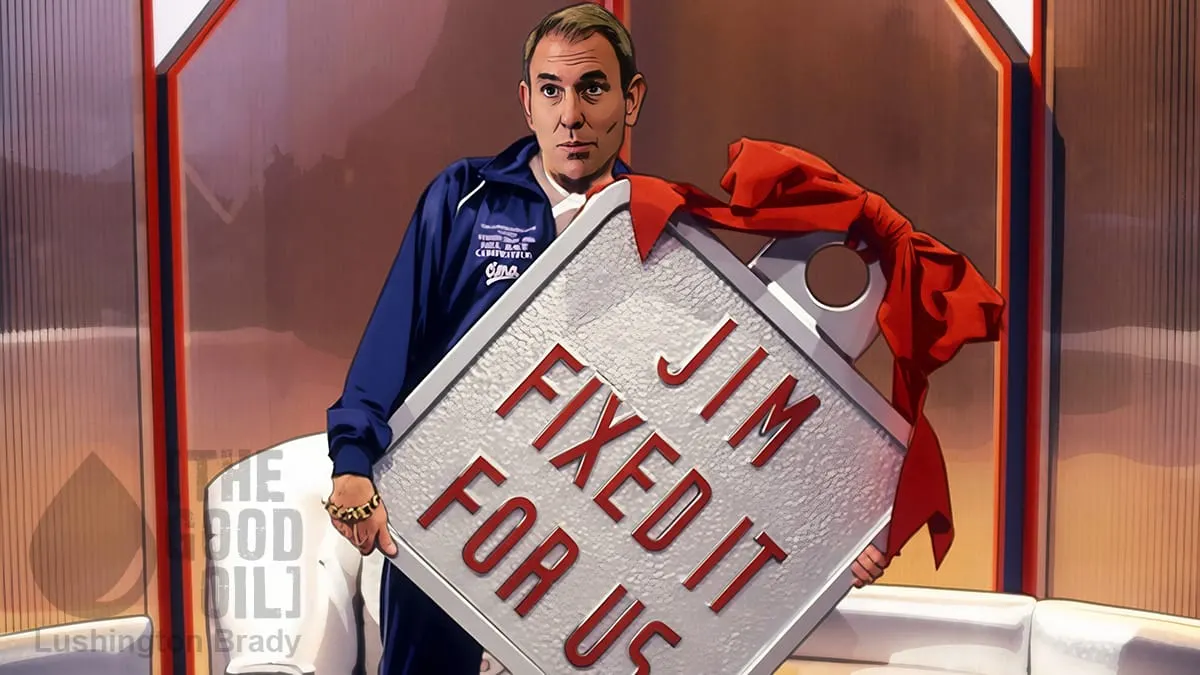
Australian Treasurer Jim Chalmers is a bit like Sylvester the Cat. Except that Sylvester was meant to be a joke. But, like the Looney Tunes feline, Zippy is running around, madly telling us, “I know just where I went wrong!” Hindsight’s a wonderful thing when you’re completely insulated from the cost of being wrong, unlike the millions of Australians who’ve just seen their single biggest source of wealth smashed by Labor’s hamfisted socialist idiocy.
Jim Chalmers is “not necessarily” surprised by plunging house prices since his May budget, conceding the removal of property tax concessions was “one of a number of reasons” for the property market downturn.
The treasurer stood firm on his department’s modelling in the budget papers, which predicted Labor’s tax policies would reduce home price growth by two per cent over a couple of years and increase rents by just $2 a week, again claiming they must be judged over the “next couple of years” not months.
Except that they’re the only reason that matters. The timing is the story: within barely a month of Labor’s policies slamming into the market, house prices have plunged, home lending has cratered and investors (you know: those who supply the rental stock) are fleeing faster than a cartoon cat seeing a giant mousth. As for Zippy’s sunny claims of reducing growth by two per cent, prices have already fallen (not just slowed growth, but a reversal of growth) by nearly twice that much. Analysts who don’t live on the taxpayer dime in the Canberra bubble are predicting much worse to come over the “next couple of years”.
HSBC chief economist Paul Bloxham said he now expected another interest rate increase this month. He said he expected GDP to soften and for home prices to drop by 13 per cent, up from his previous forecast for values to decline by eight per cent.
“We see this weakening growth more into 2027 and have revised down our growth forecasts such that growth nearly stalls around the turn of the year,” Mr Bloxham said. “We expect higher rates will now mean an even bigger housing correction, with a peak-to-trough decline of 13 per cent (previously eight per cent),” he said.
At the same time, productivity has cratered, GDP per capita has fallen and the only reason there is even sluggish economic growth at all is because of uncontrolled government spending.
So, what happens when the kindergarten socialists on the government benches run out of other people’s money?
Don’t you worry, says Zippy. I know just where I went wrong! First the powder, then the wadding, then the shot… pack it down real good… and, well, you know what happens next.
So, what is Chalmers’ latest dead cert for fixing the economy he wrecked? Forget ‘Net Zero’, that’s sooo 2025. Nope, Jim’s new monomania is… AI.
Chalmers has changed his tune. Until recently he was saying that achieving net zero was the biggest economic prize on offer. In March last year he called it his “obsession” and “reason for being”.
But with the public’s faith in this particular utopia now crumbling after two decades of rising power prices, the government needs another one. And AI fits the bill ideally, since this revolution has barely begun. It is a kind of Rorschach test, allowing us to project our hopes and fears as our inclination strikes us.
Never mind that data centres are a complete contradiction of everything Labor have spent years telling us are non-negotiable if we want to save the planet.
The government’s commitment to high-cost and intermittent energy sources that cannot meet the growing demands of AI data centres is made worse by Canberra’s bizarre insistence (until recently) on the kind of energy that is unsuited to data centres.
Data centres gulp electricity like a drought-struck cattle station. Labor’s high-cost, intermittent energy grid cannot feed them. Coal and nuclear are the only viable options which can – and Labor have categorically ruled out both.
I don’t pretend to know whether the AI revolution will prove to be a big bang or a whimper. But if it proves to be the former, it will – like every previous positive structural shock we have experienced – cause considerable economic pain.
Not to mention wiping out the jobs of Labor’s most loyal voting bloc: white-collar, university-educated women in service jobs, most of them in the public sector. These tilty-headed loons will soon find that, if they can do their jobs sitting on their couches in their pyjamas while Bluey babysits the kids, an LLM will do it much cheaper, without demanding parental leave, mental health days, domestic violence leave, ‘Cultural leave’, ‘Sorry Business’ leave…
When a possible technological revolution beckons, the choice is simple. Embrace it, trusting the gains for the many will outweigh the pain for the few. Or resist it, Luddite-style, putting every threatened job ahead of everyone else. Chalmers, in his characteristically muddled way, thinks he can have both. When a treasurer cannot admit a trade-off that obvious, perhaps he should be looking for another portfolio.
Preferably one that doesn’t involve gunshot, powder or other people’s houses.