Table of Contents
Await some spin regarding falling beneficiary numbers.
But be skeptical.
After two months of data problems, MSD has managed to produce monthly statistics for February 2026.
The total percentage of working-age people on a benefit has dropped from 13.1 per cent in December 2025 to 12.8 per cent in February 2026.
However, benefit numbers are consistently subject to seasonal changes. For example, students pile onto the Jobseeker Support Student Hardship over summer.
What really matters is the year-on-year comparison.
In February 2025 the percentage of working-age people on a benefit was 12.4 percent. Now it’s 12.8 per cent. Up.
And if you hear about higher cancellations of benefits, that’s largely due to people cancelling their Jobseeker Support Student Hardship.
And by the way, those cancellations mainly constitute a transfer back to Student Allowance. Another ‘benefit’ but one that comes out of the Ministry of Education’s budget.
In the chart below, what matters is the final right-hand column. All the big number benefits are up.
For all their well-intentioned work-activation policies, the bulk of people forming the statistics below will stay put without some radical re-think.
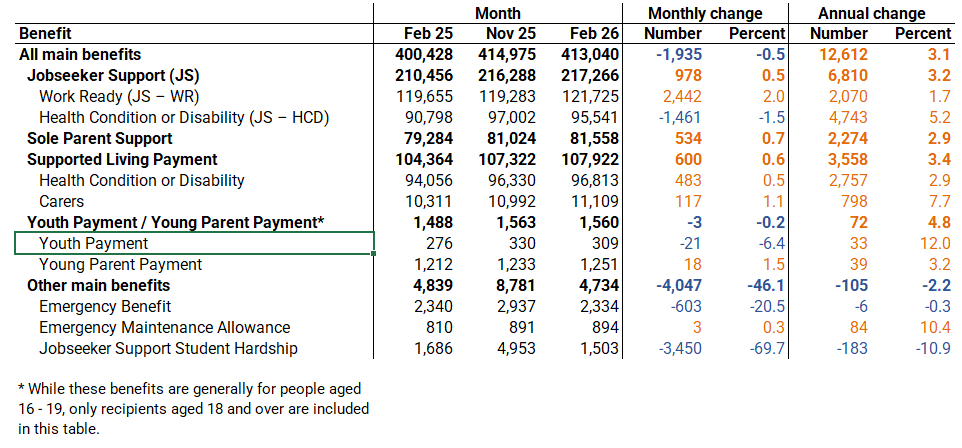
NB: Because data was lost for December and January, the “monthly” change actually covers three months.