Table of Contents
Penny Marie
Mum, Woman, Female. NZ based independent investigative reporter, researcher, writer, coach, truth seeker. Founder of Let Kids Be Kids NZ.
Watching Secretary of State Marco Rubio step onto the Munich Security Conference stage last weekend, you could feel the room bracing for a Washington hawk. Instead, what Europe got was something closer to an intervention: a call to rebuild Western strength, yes, but anchored in sovereignty, borders, culture and an end to permanent war as a way of life.
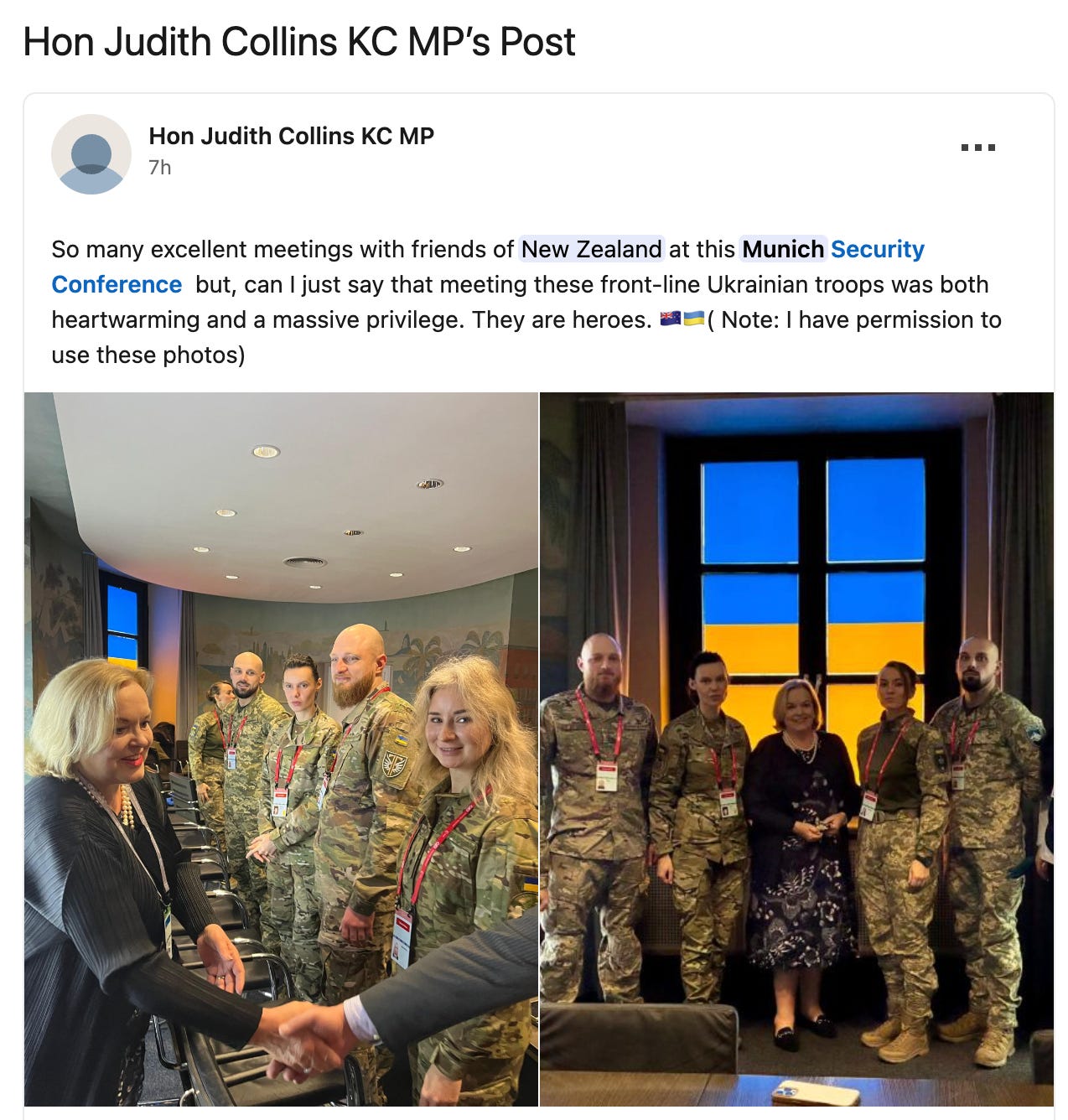
This is not the tone New Zealanders are hearing from our own Minister of Defence, Judith Collins, whose talking points still orbit around “standing in solidarity” with Kyiv and pouring more money and kit into a war with no clear exit – see Mick Hall’s analysis of Collins’ action at the Munich Security conference in 2025, RNZ’s report on the ‘covert nature of Collins’ visit to the Ukraine in September 2025, and Collins with Winston Peters announcing a further $15 million sent in December 2025 by the NZ Govt to NATO to fund the Ukraine war.
Opening with history – and a warning
Rubio began by locating Munich in its original Cold War context – a divided continent staring down nuclear annihilation:
When this conference began in 1963, it was in a nation. Actually, it was on a continent that was divided against itself. The line between communism and freedom ran through the heart of Germany.
He reminded his audience how close the world came to catastrophe:
The Cuban missile crisis had brought the world to the brink of nuclear destruction. Even as World War II still burned fresh in the memory of Americans and Europeans alike, we found ourselves staring down the barrel of a new global catastrophe.
Against that backdrop, he pointed to what actually worked: unity around a clear civilisational purpose.
Thousands of years of Western civilization hung in the balance. At that time, victory was far from certain. But we were driven by a common purpose. We were unified not just by what we were fighting against. We were unified, but we were what we were fighting for.
This framing matters for New Zealand, because Collins’ rhetoric has consistently accepted a European framing of endless “war mode” as inevitable – “countries involved in the West’s security architecture had to step up because of China’s ‘aggressive stance’ and Russia’s invasion of Ukraine,” as one report on her Munich remarks last year put it.
I posted this in January 2025…
Why is Judith Collins and the New Zealand Government so pro-Ukraine?Penny Marie 26 January 2025
Rubio’s Munich message: security without endless war
Rubio then turned his fire on the post-Cold War consensus that many Wellington officials still treat as gospel. The euphoria of victory “led us to a dangerous delusion that we had entered quote the end of history. That every nation would now be a liberal democracy. That the ties formed by trade and by commerce alone would now replace nationhood. That the rules-based global order, an overused term, would now replace the national interest. And that we would now live in a world without borders where everyone became a citizen of the world.”
“This was a foolish idea,” he said, “that ignored both human nature and it ignored the lessons of over 5,000 years of recorded human history and it has cost us dearly.”
He listed the costs: the dogmatic free-trade model that “shutter[ed] our plants” and “de-industrialized” societies, shipping “millions of working and middle class jobs overseas, and handing control of our critical supply chains to both adversaries and rivals.” He criticised Western governments for outsourcing sovereignty “to international institutions” while others embarked on “the most rapid military buildup in all of human history and have not hesitated to use hard power to pursue their own interests.”
Where Wellington still talks about “rules-based order” as a sacred phrase and signs cheques for European weapons for Ukraine – another $15m towards NATO’s trust fund and defence equipment as of late 2025 – Rubio is openly saying the old order has failed and must be rebuilt around national interest.
Borders, migration and civilisational confidence
One of the most striking sections – and the least likely to be quoted in New Zealand media – was Rubio’s blunt link between mass migration and social cohesion.
In a pursuit of a world without borders, we opened our doors to an unprecedented wave of mass migration that threatens the cohesion of our societies, the continuity of our culture and the future of our people.
He stressed that controlling borders is not bigotry but basic statecraft:
We must also gain control of our national borders, controlling who and how many people enter our countries. This is not an expression of xenophobia. It is not hate. It is a fundamental act of national sovereignty and the failure to do so is not just an abdication of one of our most basic duties owed to our people. It is an urgent threat to the fabric of our societies and the survival of our civilization itself.
For a New Zealand audience repeatedly told that questioning mass migration or demographic change is off-limits, this is a very different conversation. Rubio is saying you cannot defend “the West” abroad if you are unwilling to defend its cohesion and culture at home.
A love letter to Europe – the antidote to warmongering rhetoric
Rubio’s speech was also a love letter to Europe – just not the version Brussels is used to hearing.
For the United States and Europe, we belong together. America was founded 250 years ago, but the roots began here on this continent long before.
He described the deep historical and spiritual ties:
We are part of one civilization, Western civilization. We are bound to one another by the deepest bonds that nations could share. Forged by centuries of shared history, Christian faith, culture, heritage, language, ancestry, and the sacrifices our forefathers made together for the common civilization to which we have fallen heir.
That’s why, he said, Washington sometimes sounds harsh:
This is why President Trump demands seriousness and reciprocity from our friends here in Europe. The reason why, my friends, is because we care deeply. We care deeply about your future and ours.
The key line, and one New Zealanders should sit with, is this:
We want Europe to be strong. We believed that Europe must survive because the two great wars of the last century serve for us as history’s constant reminder that ultimately our destiny is and will always be intertwined with yours.
Compare that to Collins’ messaging, which has focused on “standing up for Ukraine” and insisting that “we can’t depend on one nation’s taxpayers to protect the rules-based order”, a line which effectively commits New Zealand to perpetual burden-sharing in distant wars rather than to redefining that order on saner terms.
Why New Zealand isn’t hearing this in Collins’ defence briefings
When Rubio reached the United Nations and Ukraine, the peace narrative became explicit. He did not pretend the UN has managed the war:
The United Nations still has tremendous potential to be a tool for good in the world. But we cannot ignore that today on the most pressing matters before us, it has no answers and has played virtually no role. It has not solved the war in Ukraine. It took American leadership in partnership with many of the countries here today just to bring the two sides to the table in search of a still elusive peace.
He then catalogued where diplomatic forums failed and hard power forced movement – Gaza ceasefire, Iran’s nuclear program, Venezuela’s narco-dictator – and drove the point home:
In a perfect world, all of these problems and more would be solved by diplomats and strongly worded resolutions. But we do not live in a perfect world. And we cannot continue to allow those who blatantly and openly threaten our citizens and endanger our global stability to shield themselves behind abstractions of international law which they themselves routinely violate.
This is peace as a hard-nosed objective: shorten wars by using leverage, coercion and deals, instead of extending them indefinitely through abstract commitments to “stand with” one side “for as long as it takes”. At Munich, reporting on the sidelines confirmed that US officials have been pushing talks, and Rubio himself acknowledged “we do not know whether Russia is serious about ending the war in Ukraine”, but that negotiations have narrowed to the hardest issues.
New Zealand’s contribution, by contrast, has been almost entirely framed as moral support and incremental funding of Ukraine’s war effort, with Collins’ secret Kyiv visit described as strengthening her “resolve to continue to stand up for Ukraine” and discussion of investing in Ukraine’s defence industry.
Economical renewal is the pathway to peace
The heart of Rubio’s message was renewal – and a refusal to accept the managed decline that so many European and New Zealand policymakers quietly treat as inevitable.
De-industrialization was not inevitable. It was a conscious policy choice, a decades long economic undertaking that stripped our nations of their wealth, of their productive capacity, and of their independence.
Mass [migration] is not was not is some fringe concern of little consequence. It was and continues to be a crisis which is transforming and destabilizing societies all across the West.
Under Trump, he said, “the United States of America will once again take on the task of renewal and restoration, driven by a vision of a future as proud, as sovereign, and as vital as our civilization’s past. And while we are prepared, if necessary, to do this alone, it is our preference and it is our hope to do this together with you, our friends here in Europe.”
And then the line that should worry every bureaucrat invested in the current system:
For we in America have no interest in being polite and orderly caretakers of the West’s managed decline.
Instead, Rubio called for “a reinvigorated alliance” that recognises “what has ailed our societies is not just a set of bad policies, but a malaise of hopelessness and complacency,” and an alliance “that boldly races into the future… ready to defend our people, to safeguard our interests, and to preserve the freedom of action that allows us to shape our own destiny, not one that exists to operate a global welfare state and atone for the purported sins of past generations.”
This is diametrically opposed to the narrative that paints Trump’s Washington as isolationist or anti-European. It is also a challenge to governments like ours, which treat increased defence spending almost entirely as a down-payment on other people’s wars rather than as an investment in genuine sovereignty and industrial capacity at home.
A civilisational story – compared to NZ history being touted
Rubio closed not with spreadsheets, but with story – a civilisational story that made his own life part of Europe’s long arc. He spoke of “an Italian explorer whose adventure into the great unknown to discover a new world brought Christianity to the Americas”, of English settlers who gave the US “the whole of our political and legal system”, of Scots-Irish, German, French and Spanish roots, and of ancestors in Piedmont-Sardinia and Seville who could never have imagined “one of their direct descendants would be back here today on this continent as the chief diplomat of that infant nation”.
“For us Americans,” he said, “our home may be in the Western Hemisphere, but we will always be a child of Europe.”
And he brought it back to the alliance he wants:
We want to do it together with you, our cherished allies and our oldest friends. We want to do it together with you. With a Europe that is proud of its heritage and of its history. With a Europe that has the spirit of creation and liberty that sent ships out into unchartered seas and birthed our civilization. With a Europe that has the means to defend itself and the will to survive.
New Zealanders rarely hear ourselves placed inside this civilisational story. Yet our officials fly to Munich, pledge support for Ukraine, and speak in the same room. The question is whether we see ourselves as junior clerks of the rules-based order – or as a small but sovereign Western nation that can say: we will not fund endless war, but we will back a serious peace; we will not accept managed decline, but we will defend our own culture, borders and economic independence.
Rubio ended with a simple statement of direction:
Yesterday is over. The future is inevitable and our destiny together awaits. Thank you.
For a New Zealand audience, the choice is whether our defence policy continues to be written in Brussels and London – or whether we are willing, as Rubio suggests, to join an alliance that wants to end wars on terms that protect Western civilisation, not sacrifice it in the trenches of someone else’s forever war.
This article was originally published on Penny Marie NZ.