LilBaP
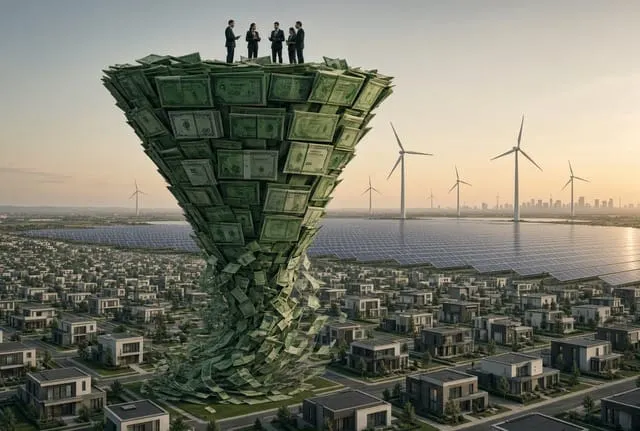
A Ponzi scheme is a money ‘merry-go-round’. It compensates early investors with money taken from subsequent investors. It doesn’t generate real returns but creates the appearance of profitability as long as new capital is continually being introduced. When that new money stops, the scheme collapses.
The name originates from Charles Ponzi, a con artist in the 1920s. In more recent times Bernie Madoff used the same scheme with a roughly $65 billion scam in the 1990s.
They each promised high returns with low risk, by relying on new capital to pay the earlier investors. Each collapsed when the new money dried up and they ended up facing criminal prosecution for fraud. Each created intricate, yet seemingly genuine, narratives to suck in the money.
A quote often attributed to Nazi propaganda official Joseph Goebbels goes: “A lie told once remains a lie, but a lie told a thousand times becomes the truth.”
The practical effect is the same with any scheme attached to money that has no independent way to effectively audit outcomes.
This brings us to Net Zero. Wherever an organisation can rake in large sums of other people’s money under a story that is hard to audit and easy to moralise, the same pattern appears. Net Zero is at the top of the carbon accounting, offset markets and public funding streams.
Sitting in the middle of the money-go-round is the operator with taxpayers, ratepayers, shareholders and pension funds on the outside. New money keeps arriving – your money. Then it gets recycled as grants, consulting fees, offsets, subsidies and conference circuits.
The activity keeps going as long as the story holds up and the capital keeps flowing. Governments keep shelling out for what they call an obligation.
NGOs have become experts at the language needed to keep the money flowing. ‘Climate initiative’ or ‘climate crisis’ is now preferred. COP 31 is an example.
It’s been an existential crisis for 50 years but we still need more money because the trillions you’ve provided so far isn’t enough, even though it hasn’t made a degree of difference. For them the real crisis is they haven’t taken enough of our money yet.
The phrases no longer require a measurable drop in temperature. They cover tree planting, carbon accounting, community engagement, policy advice and international travel. Large climate conferences continue to attract global elites and political attendance, so media coverage goes hand in hand.
UNDRIP, the United Nations system and the World Health Organisation all use the same vocabulary. They don’t show that their activity actually produces a measurable drop in temperature or a measurable improvement in health – they just tell you that the activity has to continue. We are told the outcome follows the science – their ‘science’ of course.
Any emissions trading scheme that requires a specialist fund or financial manager to explain the simplest details has the same opacity that helped Ponzi and Madoff keep the new money coming in. That complexity is part of what keeps the capital moving.
Carbon credit markets have already produced the same pattern at scale. Europe’s emissions trading system was hit by a VAT carousel fraud that Europol put at about €5 billion. Groups bought allowances tax-free in one country, sold them with VAT in another and vanished without paying the tax.
A carousel fraud is a cyclical chain of fictitious transactions. In some markets, the fraudulent trades made up most of the volume until the loopholes were shut.
In 2024, US regulators brought the first major actions against CQC Impact Investors and its former executives. They submitted inflated data and received millions of extra credits that were then sold.
A German investigation the same year found Chinese projects approved into a European scheme that generated roughly €1 billion in credits; many of the installations already existed and had simply been re-labelled as new.
The setups look fine as long as new projects pop up faster than the old ones crash or slip under the radar. The constant influx of fresh credits masks the failure rate. But when the flow of new money slows down, those hidden losses start to show, and suddenly, the safety net isn't big enough anymore – the money-go-round stops.
There are many examples of mismanagement and abuse of the system – but you get the grift.
New Zealand’s Emissions Trading Scheme and the forestry component that sits inside it follow the same logic. Units are created. Credits are issued for trees that may or may not sequester the tonnage claimed over the period claimed. The units get traded. The price rises or falls according to political announcements and international commitments, rather than actual, tangible results.
Land gets locked into permanent forest. The earlier participants receive the credits. Later participants face rising costs or restricted land use. The scheme continues as long as new capital – further compliance obligations or further public money keeps entering.
In recent years farmers and their associations have increased their resistance to the continued expansion of these obligations. Ground-level objections have focused on the permanent lock-up of productive land, the effect on farm viability when credits are issued for trees that may later be harvested or fail to deliver the claimed sequestration and the absence of a practical exit if the accounting later changes.
When the political willingness to enforce the rules weakens, or when the physical results don’t match the accounting, the structure has the same weakness as any other scheme that depends on a continuous inflow of new money.
Intelligent people and high-net-worth individuals are not immune. Madoff’s investors included sophisticated institutions. The same pattern shows up with climate and equity products. The language is complex and technical but the moral framing always seems good and virtuous.
Street-wise scepticism gets treated as ignorance or some sort of stigmatising name, especially within mainstream media and the environmentalists. The result is that large amounts of money move from people who ask few questions to people who control the narrative, some media and of course the cash-flow.
The test is simple. If the activity continues only while new money arrives, and if the claimed benefit cannot be verified independently of the people receiving the money, the activity has the characteristics of a Ponzi scheme.
There is already differing evidence on the drivers of recent atmospheric CO₂ increases and on the practical effects of net-zero policies.
Papers by researchers such as Dr Willie Soon use carbon-isotope data to argue that fossil-fuel emissions are a smaller contributor than the dominant view holds. Those papers have not yet changed the institutional position that underpins emissions trading and net-zero programmes.
From a New Zealand perspective, since 2020 governments have committed many billions to climate and net-zero activity. Treasury recently reported the potential cost of buying offshore credits to meet the 2030 Paris target at up to $5 billion.
For a small economy with global greenhouse-gas emissions usually cited around 0.15–0.18 per cent, that is a large commitment from taxpayers that never had a say about getting on this money-go-round.
The financial incentives to keep the existing accounting in place remain. If further evidence accumulates and begins to affect the political and market willingness to keep feeding the schemes, the continuous input of new capital that the structures depend on could slow or stop the money-go-round.
A collapse, if it arrives, will not be caused by a change in temperature or CO₂ levels. It will be caused by the same thing that ended every other scheme of this type – the new money stops. Some people should probably be prosecuted but maybe that’s just wishful thinking.