In Michael Crichton’s novel State of Fear, which Hollywood seems strangely reluctant to make a blockbuster movie out of, he takes a well-deserved blowtorch to the towering conceit of environmental activists. Using a century of lurching from one disaster in Yellowstone National Park to another, Crichton demolishes the notion that environmentalists are wise and omnipotent stewards of the environment. Too often, environmental disasters aren’t caused by evil corporations or climate deniers: they’re caused by well-meaning humans who think they can ‘fix’ nature without understanding how it actually works.
‘Climate change’ is one vast case study in how the road to ecological hell is paved with green intentions.
While Boofhead Bowen throws billions of taxpayer dollars at greedy cowboys wantonly bulldozing vast swathes of native forest, it might seem a no-brainer that solar panels in the desert are a harmless option. Except, scientists modelling huge solar installations in the Sahara discovered something inconvenient: solar farms alter the local climate dramatically.
Dark solar panels absorb far more heat than reflective desert sand. This extra heat drives stronger convection: hot air rises faster, pulls in moisture, cools at altitude and… forms clouds. Rain clouds. In the Sahara.
Good news, surely? On paper, maybe, more rain in the desert sounds lovely. In practice, it’s another feedback loop that could reshape entire ecosystems in ways no computer model fully predicted. Vegetation changes. Weather patterns shift. The delicate balance of one of Earth’s harshest environments gets rewritten by industrial-scale human hubris.
Oh, but we can just put them out at sea where they won’t bother anyone, maybe. Tow them out past the environment, as it were.
You can guess where this is going…
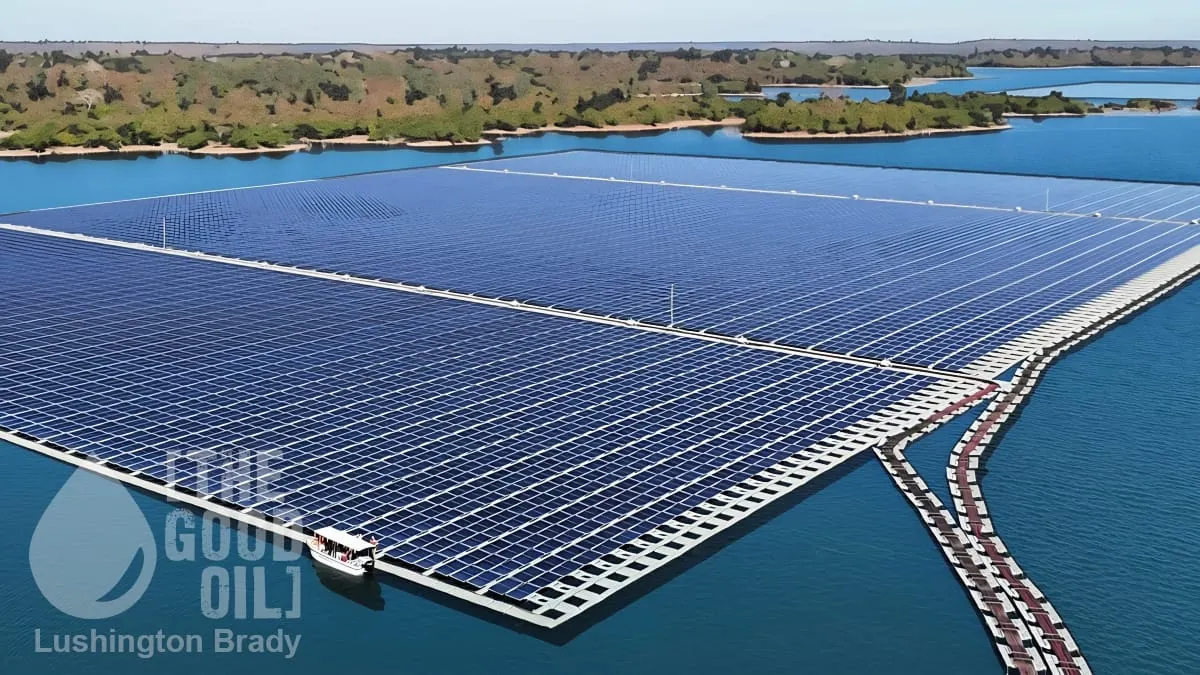
Floating solar farms, the trendy ‘dual use’ solution for lakes and reservoirs, are quietly choking the life out of the water beneath them.
Plankton numbers were also declining around the solar arrays… dissolved oxygen levels plummeted.
A major study in China’s Yangtze River basin found that panels block sunlight, crash photosynthesis, slash plankton and algae and starve the entire food chain. Fish disappear. Birds and other wildlife follow. The very ‘green’ technology meant to save the planet is turning productive water bodies into underwater dead zones. At the same time, offshore wind proposals face growing evidence they damage marine life, including whales, through noise pollution, electromagnetic fields and disrupted migration patterns.
Except you can bet already that the activists foaming at the mouth about Tasmania’s salmon farms won’t say a word against solar farms killing aquatic biospheres.
Everywhere the pattern repeats. The ‘solution’ creates new, often worse, problems than the one it was meant to fix. Solar panels that alter desert climates. Floating arrays that suffocate lakes. Turbines that chop eagles and deafen whales. Forests levelled so city elites can feel virtuous about their EVs.
None of this should surprise anyone who’s read Crichton. Environmentalism long ago stopped being about prudent stewardship and became a quasi-religious crusade demanding sacrifice. Preferably from someone else. Rural communities lose their landscapes and sleep. Wildlife pays with its life. Taxpayers foot the bill for unreliable power and the endless subsidies required to prop it up. The inner-city commentariat and political class get the warm inner glow of ‘doing something’.
With climate activists now seriously advocating massive ‘solar dimming’ projects in the atmosphere, the cautionary tales only get more cautionary. On paper – again – the idea sounds plausible. Reality, though, is waving more red flags than an arena in Barcelona.
Nature is not a simple machine we can reprogramme with enough panels and turbines. It is a complex, interconnected system full of feedback loops, thresholds and unintended consequences. Every time we forget that, we create new messes.
Crichton warned that the greatest danger wasn’t climate change itself but the politicised, unscientific panic driving reckless ‘solutions’. We’re living that warning now, with possibly worse to come.