
Maryanne Demasi
Maryanne Demasi is an investigative journalist who writes for online media and top-tiered medical journals. For over a decade, she was a TV presenter for the Australian Broadcasting Corporation (ABC).
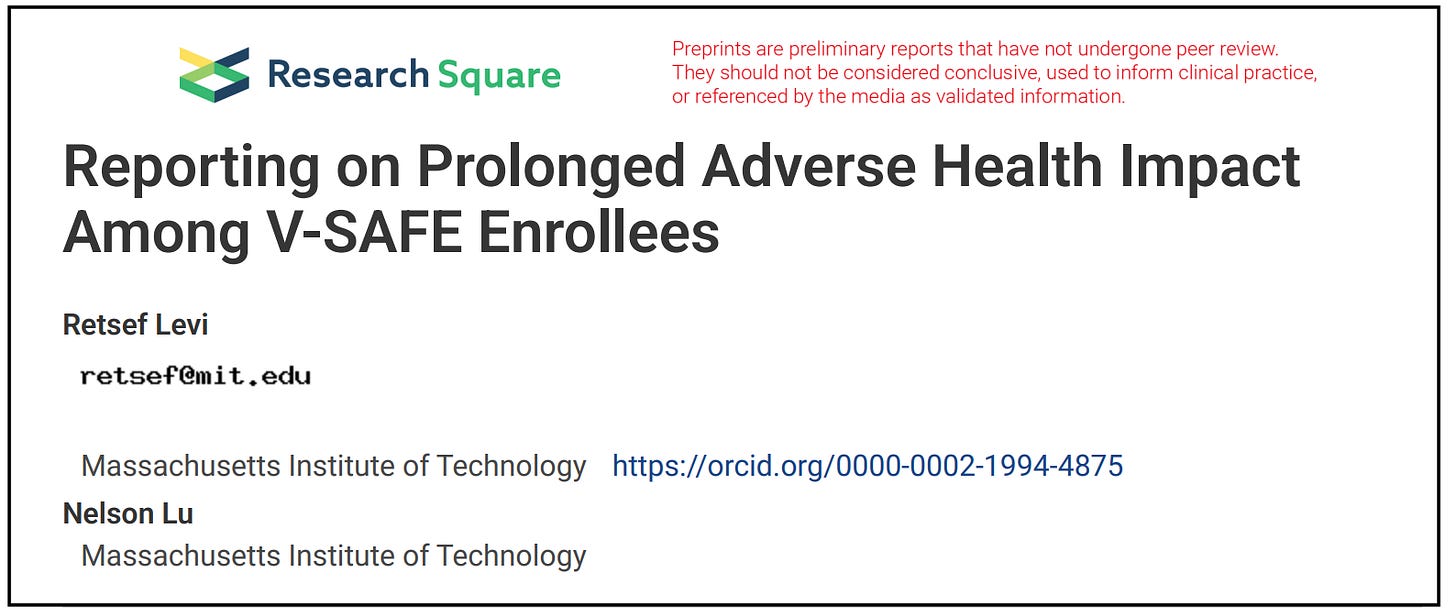
A new preprint analysis from MIT researchers examines data from the CDC’s V-SAFE system – the smartphone app used to actively monitor health outcomes following Covid-19 vaccination.
Led by Retsef Levi and Nelson Lu, the analysis of responses from nearly 10 million people aged 16 and older found that 185,285 individuals (1.87 per cent) reported health deterioration lasting three months or longer and attributed that decline to Covid vaccination.
Roughly half of this group – about one per cent of all V-SAFE participants – described their outcomes as severe, including inability to work or perform daily activities, hospitalisation, or potentially disabling symptoms.
The V-SAFE survey reports, collected between December 2020 and mid-2023, remained largely inaccessible to independent researchers until FOIA litigation by Informed Consent Action Network forced their release.
Speaking with MD Reports, MIT professor and lead author Retsef Levi said the findings warrant prompt attention.
“This is not something one can ignore,” Levi said.
“The fact that close to two per cent of V-SAFE enrolees over 16 years old report prolonged health worsening they attribute to vaccination – and nearly one per cent describe long-term disability, hospitalisation or severe adverse events – is very concerning.”

“If these rates translate to the broader US population, there are millions of people who believe they suffered prolonged disability or adverse health impacts from Covid vaccination,” Levi added.
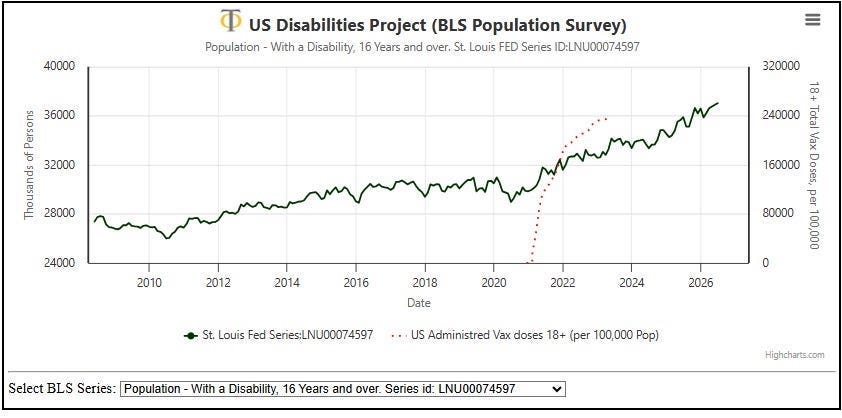
This self-reported health decline aligns with broader population-level trends in the US.
According to the Bureau of Labor Statistics, the number of Americans aged 16 and over reporting a disability reached a high of 37 million in July – up roughly 23 per cent since February 2021, when the vaccine rollout accelerated.
Levi and Lu’s analysis found that V-SAFE participants frequently reported complex, multi-system complaints – including fatigue, headaches, joint pain, dizziness, shortness of breath, chest pain, palpitations, nausea, rash, swollen lymph nodes, insomnia and tinnitus.
This symptom profile closely mirrors descriptions of post-acute Covid-19 vaccination syndrome (PACVS) reported in patient surveys carried out by React19.
The study also found that many people who received a second dose reported the same symptoms returning or worsening. Known as a “rechallenge,” this pattern can strengthen suspicion that the vaccine played a role.
Follow-up survey responses showed that functional impairments often persisted or increased, contrasting sharply with participants without prolonged health declines, whose reported problems rapidly resolved.
Notably, a comparable group of 189,982 participants (1.92 per cent) reported health declines lasting three months or longer but did not attribute them to the vaccine.
This cohort reported higher rates of respiratory symptoms and post-vaccination Covid-19 infections, offering potential alternative explanations for their lingering illness.
Addressing whether participants could accurately identify the root cause of their decline, Levi acknowledged the subjective nature of self-reporting.
“Mistakes can happen, both with patients who mistakenly attribute their injury to vaccination, but also with patients who mistakenly do not attribute their injury to vaccination,” Levi said.
He is careful not to claim that the V-SAFE data ‘prove’ the vaccines caused these health problems.
“It goes without saying that systems like V-SAFE cannot by themselves establish causality, and that is not the purpose of the study,” he said.
However, safety surveillance systems are designed to detect potential signals that warrant investigation rather than establish formal proof – and that, Levi argues, is where the CDC fell short.
“The CDC had a plan to follow up with V-SAFE enrolees in real time. This plan, to say the least, was not executed,” he said.
Despite operating an active surveillance system complete with contact details and established protocols for telephone outreach, the CDC did not systematically follow up on these cases or explain why this potential signal was left unexplored.
For Levi, there is little ambiguity about what should happen now. Asked whether the findings warrant a formal CDC investigation, his answer was unequivocal.
“Absolutely,” Levi remarked.
This article was originally published by MD Reports.





![[The Good Oil] Stuff Up of the Day](https://storage.ghost.io/c/31/f4/31f4e20a-0315-499e-83ff-139e8eab53bf/content/images/size/w1304/format/webp/2024/09/Stuff-up-image-1.webp)

