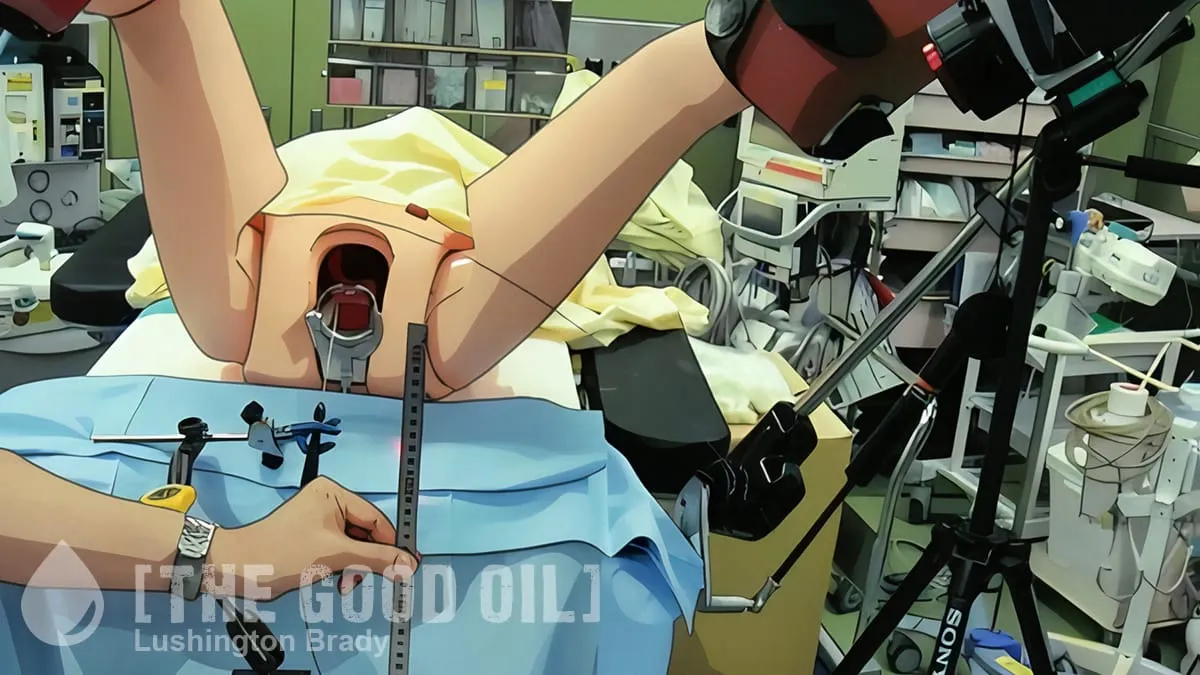
What do you get if you combine a life-size doll with an ersatz vagina, a pile of lean beef, intestinal gases and a laser? Science!
No, seriously.
It sounds like one of those urban legends involving small animals and the word Armageddon!, but this one is strictly from the serious medical literature.
An operating room snafu out of Japan is generating headlines because of its bizarre nature: It seems a patient’s fart ignited a fire that left her with serious burns. The incident took place at Tokyo Medical Center, reports the Asahi Shimbun. A laser was being used on the cervix of a woman in her 30s when she broke wind, according to a newly released assessment of the April incident released by the hospital. All equipment was operating normally, leading a panel to conclude that the woman’s gas ignited the laser.
The poor patient ended up with a wide range of burns to her thighs and rear. Cervical conisation is a procedure used to remove pre-cancerous cells or early stage cervical cancer, by excising a cone-shaped portion of tissue from the mucous membrane of the cervix. The laser was doing its job down there when nature called in the most spectacular fashion. Methane and hydrogen in intestinal gas are the culprits that make a fart potentially flammable. In an operating theatre full of high-energy equipment, even the tiniest spark can turn comedy into catastrophe.
Entirely properly, Japanese doctors did not just shrug and move on. They launched a proper scientific investigation. After ruling out faulty gear, alcohol-based antiseptics or drapes catching fire, they recreated the exact conditions in the lab. Researchers used a test doll positioned like a real patient, a bucket of lean beef and actual intestinal gases at varying concentrations. They fired the same type of laser at the setup.
The results were conclusive. Gas from the rear can get sucked forward into the surgical field. Once there, it meets the laser energy and boom. Or rather, petard: a small but very real and dangerous explosion.
No word on whether the scientists chowed down on the presumably medium-rare steaks afterward.
“When the patient’s intestinal gas leaked into the space of the operation (room), it ignited with the irradiation of the laser, and the burning spread, eventually reaching the surgical drape and causing the fire,” says the report. The resulting fire burned much of the patient’s body, though no details are provided about her condition.
All jokes aside, this was serious science. Operating theatres use lasers every day for precise work. The risk of ignition from bodily gases is minuscule, but it is not zero. Surgeons and anaesthetists need to know exactly how it happens so they can stop it happening again. Better patient positioning, different gas management, or simple precautions around the laser field could make the difference between a routine procedure and a patient with serious burns.
The researchers confirmed two things beyond doubt. Farts can indeed be lit on fire by a laser. And under the precise conditions of cervical surgery, that fart can reach the exact spot where the laser is working. It is the kind of finding that sounds ridiculous until you remember real people get hurt when it goes wrong.
So, the next time someone tells you science is boring, remind them that somewhere in Japan a team of doctors spent serious time and effort proving that a patient’s wind can turn an operating theatre into a very small fireworks display.
The goal isn’t low-brow comedy: it’s to make sure no one’s steak curtains ever get seared again.
(Sorry, I couldn’t help myself.)