
Mike Lyons
Mike Lyons is a graduate of the United States Military Academy at West Point, a combat veteran, business leader, and frequent contributor to national media outlets.
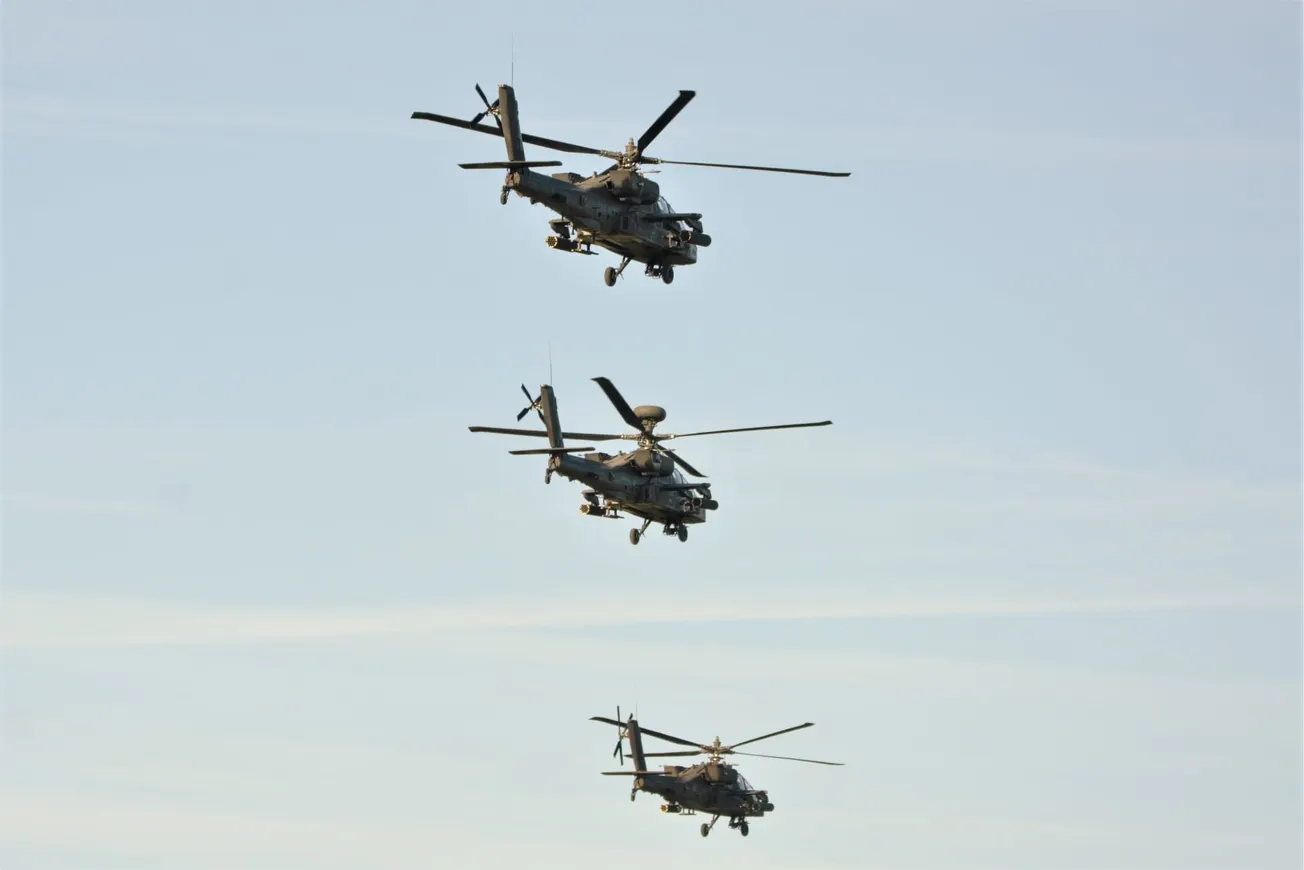
On the evening of June 8, a US Army AH-64 Apache attack helicopter went down over the Strait of Hormuz. President Trump says Iran shot it down. Early indications point to an Iranian loitering munition, a drone that costs roughly $20,000, pitted against one of the most sophisticated rotary-wing aircraft ever built, worth about $30 million. The investigation remains open, but the asymmetry it exposes does not depend on the final cause.
The two army pilots survived. They were pulled from the water within two hours by an uncrewed navy surface vessel, the first sea-drone rescue in American military history. An American drone will soon examine how an enemy drone may have downed a helicopter whose crew a friendly drone saved. Three unmanned systems, one combat incident.
Welcome to the new face of war.
This isn’t a story about one bad night over the Persian Gulf. It crystallizes everything the US military has been learning, and failing to apply fast enough, from Ukraine, the Red Sea, and more than a hundred days of the Iran war. In the days after the Apache went down, the war lurched back into open strikes, then into the ceasefire and settlement now ending it. The drones do not care which. Whether the shooting is on or off, the cost-asymmetry problem persists, and America’s adversaries have solved it in their favor while we have not.
The numbers tell the story. In the first 38 days of Operation Epic Fury, the US and its allies intercepted thousands of Iranian ballistic missiles and drones. Each Patriot interceptor costs about $4 million. Each Iranian drone costs about $20,000. Firing million-dollar missiles at 20-thousand-dollar drones isn’t a tactical inconvenience: it is a strategic crisis.
Iran is a severely degraded adversary. Its navy is at the bottom of the sea, its defense industrial base is shattered, and it cannot manufacture conventional missiles at scale. Yet China produces advanced drones and loitering munitions in quantities that make Iran’s output look artisanal. If we cannot solve it against a weakened Tehran, we are unprepared for the adversary that actually keeps Pentagon planners awake at night.
None of this should be surprising. Since 2022, Ukraine has shown what drone warfare looks like when fought in earnest: cheap sensors and munitions compressing the kill chain from days to minutes. The US military has acknowledged the lessons, published doctrine, started programs... What it failed to do is field them at the speed the threat demands. Bureaucratic procurement runs on five-to-10-year timelines – breaking wars do not.
The war in Iran has already produced three military firsts that will be studied at West Point for generations.
The first is AI-enabled warfare at scale. Nearly 900 strikes in 12 hours on the opening day of Operation Epic Fury would have been impossible without artificial intelligence at the targeting and deconfliction layers. The kill chain that took hours in Desert Storm, where I commanded an artillery battery in 1991, has compressed to minutes.
The second is the uncrewed combat rescue. A navy unmanned surface vessel recovered two downed pilots in a hostile maritime environment within two hours, turning a future concept into reality.
The third is the unmanned loop. Attack, rescue, and investigation are now run by uncrewed systems, with humans setting the parameters rather than flying every mission.
The underlying vulnerability is what we must fix. Every counter-drone system the United States has deployed creates a defensive bubble around a fixed location: a ship, a base, a port... We are very good at protecting things that do not move. But wars are won by things that move. The moment a manned platform leaves the bubble, it enters the space between bubbles, where adversary drones operate without opposition.
The Apache was flying an armed maritime patrol, low and slow over open water, hunting fast boats and watching for minelaying. A loitering munition orbiting the strait needs only to detect a heat signature, dive, and strike. The helicopter’s countermeasures, conceived decades ago to defeat fast, hot Soviet missiles, are blind to slow, low-signature plastic drones. The crew had seconds of warning. You can’t outrun a threat you can’t see.
Closing that gap is now the priority. The answer to a $20,000 drone cannot be only a $4 million interceptor. It has to be a $40,000 hard-kill pod, a low-cost escort drone, or a laser that fires for dollars instead of millions. None of it exists today at the scale the threat demands, and the Apache loss should make all three of the army’s most urgent procurement priorities.
The real obstacle is a procurement bureaucracy that prizes perfection on paper over speed. The answer is not mainly more money, though the next budget must reflect the emergency. It is an authority structure that bypasses normal requirements and funding timelines, the way Mine-Resistant Ambush Protected vehicles were rushed to Iraq in 2006 to save lives. That took directives from the top of the Pentagon and immediate backing from Congress.
The defense leaders who woke to news of this Apache loss must inject that urgency into the system today. The war is ending in a settlement, and the danger now is that its hardest lesson gets filed away with the ceasefire. The vulnerability the Apache exposed does not end when the shooting does. The crew came home. Whether the next one does is now a procurement decision.
This article was originally published by RealClearDefense and made available via RealClearWire.








.jpg)