Table of Contents
Peter MacDonald
The recent summit involving Zelensky, European leaders and Trump can be read as a reflection of NATO countries’ desperation to save face. Russia, having effectively outmanoeuvered them in the Ukraine conflict, has left NATO scrambling to maintain unity and control the narrative.
Trump’s meeting with Zelensky was notable in that it was ‘hijacked’ by European leaders who insisted on being present. This suggests they fear Zelensky is increasingly out of his depth and wanted to steer the discussion themselves. Rather than genuinely seeking peace, NATO members appear determined to keep the war going, as their broader aim is not simply Ukraine’s defence but regime change in Russia.
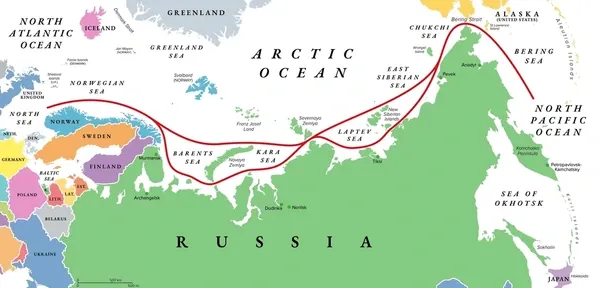
The long-term goal is to fracture the Russian state into more ‘manageable’ entities, allowing Western elites to seize control of its vast natural resources, particularly oil, gas and mineral wealth. Another strategic prize is the emerging Arctic trade routes. Arctic sea lanes offer shorter alternatives to traditional routes via the Suez and Panama Canals due to melting ice. The three main corridors – the Northeast Passage along Russia’s coast, the Northwest Passage through Canadian and Alaskan waters and the proposed Central Arctic Route over the North Pole – promise reduced travel times and significant cost savings. However, they remain in early stages of development, requiring ice-strengthened vessels, infrastructure investment and the resolution of geopolitical rivalries.
Patrick Henningsen of 21st Century Wire observes an ironic ‘lefty-green’ partnership driving these developments: NATO countries are using the climate emergency narrative declared by many member states as justification to expand military control of the Arctic. In reality, as Henningsen points out, the ice in winter months continues to block these trade routes, so the notion of a fully navigable Arctic remains largely aspirational (21st Century Wire, Henningsen Instagram).
To secure these routes, the US is reportedly establishing approximately 47 military bases across the Arctic region, including Greenland, Finland, Norway and other northern territories. This expansion reflects a strategy to assert influence, safeguard access to natural resources and counter Russia’s dominance along the Northern Sea Route and position the US to control emerging Arctic trade with China, which is increasingly interested in using these northern corridors for faster, shorter shipping routes.
The war in Ukraine itself has become a brutal war of attrition. Over 1.5 million Ukrainian men are estimated to have been killed – the majority being conscripts used as cannon fodder. Russia’s losses, though significant at around 200,000 killed, remain sustainable. Meanwhile, more than a million Ukrainian men have fled abroad, seeing little point in fighting a war they view as unwinnable. Russia already holds the strategic territory it needs and has no interest in fully annexing Ukraine, as that would impose an impossible economic burden. From Moscow’s perspective, Ukraine and NATO have already been defeated.
Trump’s private discussions with Putin reinforced this reality. By cutting through NATO-aligned advisors, Putin was able to present Trump with the hard facts of the conflict. For Zelensky, this leaves no room to manoeuver. Any future meeting with Putin would involve surrender terms only. European leaders are determined to prevent such an outcome, which is why they inserted themselves into Trump’s recent meeting with Zelensky to keep control of the process and ensure the war drags on.
For Zelensky, personally, peace could mark his downfall. Having reportedly salted away millions abroad, he would likely flee Ukraine in the wake of any settlement. Yet exile may not protect him: factions within Ukraine’s underworld, many with Russian ties, and Russian Intelligence would almost certainly regard him as a marked man.
In this light, Ukraine, NATO and the Arctic are all interconnected in a broader struggle for strategic dominance. Just as Russia seeks to secure its borders and resources, NATO and the West are manoeuvering to maintain influence, control trade routes and shape the post-war geopolitical order and, as usual, at enormous human cost.