Table of Contents
For years, indigenous Britons have been subjected to a sustained attempt to erase their identity. Britons indigenes are, after all, inconveniently white, which is an affront to the sensibilities of the left elite. Hence the relentless barrage of pseudo-science and bad ‘history’ attempting to claim that indigenous Britons were, somehow, ‘black’.
Aside from ludicrous Netflix ‘historical dramas’ portraying historical British figures as sub-Saharan Africans, schoolkids are indoctrinated with garbage like Brilliant Black History (the product, not of native Britons, but African immigrants). Another immigrant with the temerity to ‘black-splain’ British history and culture to white Britons is Nish Kumar, host of a ‘documentary’ claiming that things such as tea aren’t really British because ‘it came from India’. Leaving aside that it was in fact the white British who brought tea to India, from China, one is left to ponder: if tea isn’t British because it ‘came from India’, what does that say about one ‘Nish Kumar’?
Worst, though, are so-called ‘scientific studies’ promoting such nonsense as ‘black’ Cheddar Man (whose direct descendants are notably very white) or that the builders of Stonehenge were ‘black’.
The BBC, of course, is gaga for this crap. Aside from hosting the likes of Kumar, the Beeb relentlessly trumpets claims such as that a Roman-era skeleton of a woman found at Beachy Head was a sub-Saharan “first black Briton”. The wokerati got so excited, they even erected a plaque repeating the claim.
It’s been taken down since. Because the claim was arrant bullshit. The woman wasn’t just not from sub-Saharan Africa, or even from the sorta-kinda-olive Mediterranean.
She was white-as-white British all along.
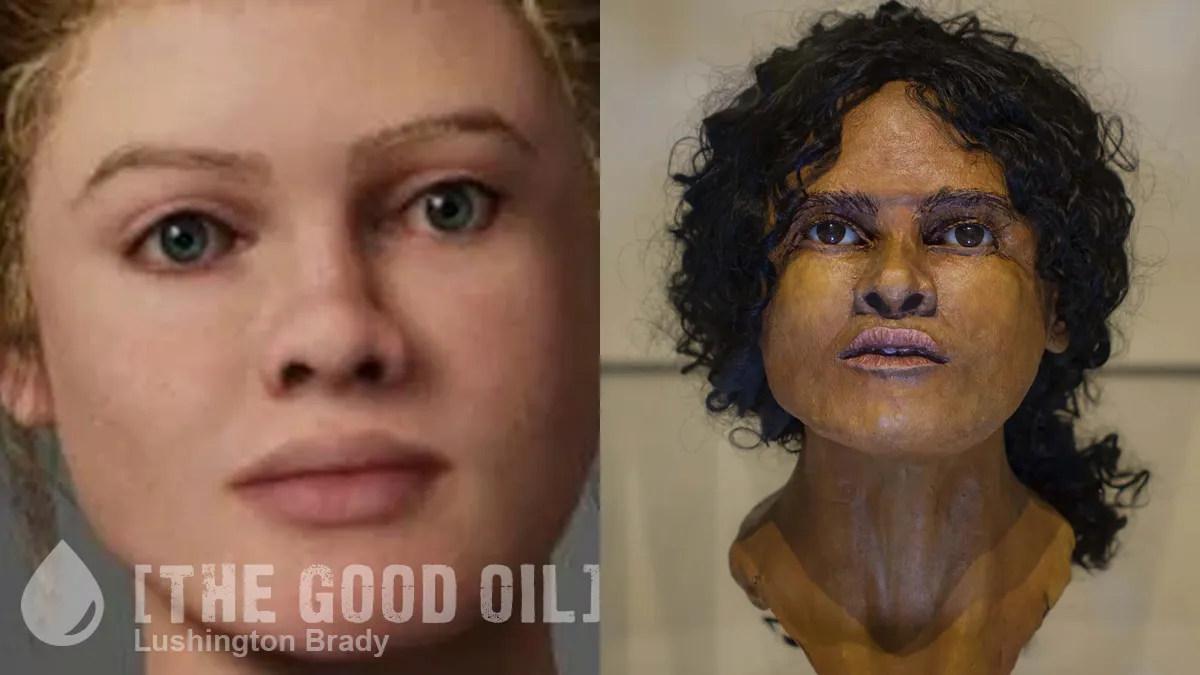
A new DNA analysis of the skeleton by scientists at the Natural History Museum has shown that the woman originated from southern England and was white, with blonde hair and light eyes.
Dr William Marsh, who carried out the genetic study, said, “By using state of the art DNA techniques we were able to resolve the origins of this individual. We show she carries genetic ancestry that is most similar to other individuals from the local population of Roman-era Britain.”
Yet again, the BBC was telling a-historical porkies.
The claim about the skeleton’s African origins was made in Prof David Olusoga’s documentary series, which told the story of the “enduring relationship between Britain and people whose origins lie in Africa”.
A relationship that mostly seems to consist of people whose origins aren’t British, presuming to erase white British history.
In episode one, the Beachy Head woman was presented as “sub-Saharan African in origin”, and the programme featured a reconstruction of her features, with dark skin, hair and eyes.
In the programme, Prof Olusoga remarked that “she’s a black Briton”, while Jo Seaman, an expert archaeologist, explained that her African origins and the age of her remains were likely to have made her the “earliest black Briton”.
Neither of which claim is even remotely true.
Now it has been confirmed that the woman descended from the local British population of Roman-era southern England. Radiocarbon dating showed she died between 129 and 311AD, corresponding to the Roman occupation of Britain.
Analysis of her skeletal remains suggested that she was around 18–25 years old when she died, and stood at just over 4.9ft. A healed wound on her leg suggested a serious but non-fatal injury at some point in her life.
Dietary analysis looking at the carbon and nitrogen values in her bones also revealed that her diet was likely to have included a lot of seafood.
What? A woman who lived at Beachy Head ate a lot of seafood? Well, I never.
As for the ‘black’ builders of Stonehenge…
However, some genetic studies have shown that the inhabitants of Britain in the period when Stonehenge was completed, around 2,500BC, were pale-skinned early farmers, whose ancestors had spread from Anatolia – modern-day Turkey.
Never mind, I’m sure next week the BBC will produce a ‘wartime documentary’ featuring Lenny Henry as Winston Churchill.