Table of Contents
Australia has a lamentable record when it comes to world-class innovations. Not that we can’t come up with them: we just can’t get anyone here to invest in making them. In an echo of the infamous ‘cultural cringe’ of the past, Australia has a long-running ‘technological cringe’ that has seen a steady stream of inventions palmed off to overseas developers to make and make money off. Are we about to repeat the same mistake, with what promises to be a boom industry in the next decade or so – small modular nuclear?
Australia is in the top echelon for research papers, but ranked 30th in the world for innovation outputs. Part of the problem is that much of the research is pointless guff aimed purely at meeting academics’ KPIs. A bigger problem is the lack of vision among business investors in Australia. The list of inventions and startups Australia has lost to overseas investors is a long one. The Black Box flight recorder, Google Maps, the cochlear implant… even the humble Aerogard makes not a cent for Australia, after the CSIRO gave the formula away for free, only to be commercialised by Mortein.
It’s still going on. ConryTech CEO Sam Ringwaldt relates that, having no other choice but to seek funding overseas, their company turned a $26m investment from Canada into billions “for the North American economy”. Billions lost to the Australian economy.
Now it’s happening again, solely because of Australia’s Boomer-era nuclear phobia.
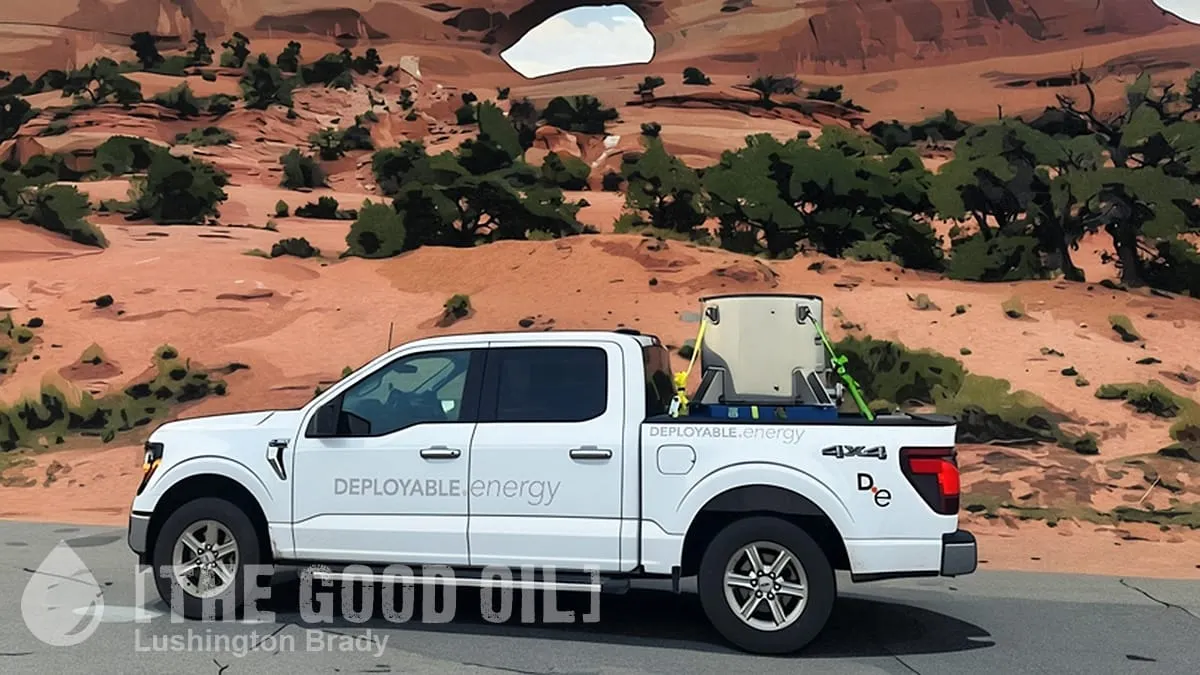
An Australian-owned company, Deployable Energy, has developed a nuclear microreactor under a US government pilot programme launched after an executive order from President Donald Trump. The reactor is small enough to fit in the back of a ute and is currently being transported from Texas to Idaho for safety testing at the Idaho National Laboratory. It reached criticality – a self-sustaining nuclear chain reaction, a key step toward commercialisation – in just 155 days.
“It provides electrical power to power up to 1,000 homes for five years without needing to be refuelled and then it can just be swapped out after that five-year period … like a gas bottle.”
The company aims to produce 1,000 units a year from its Texas manufacturing facility by 2030. Founder Bobby Gallagher sees clear applications in Australia for remote communities, islands, mine sites, manufacturing and data centres.
“The potential is to be able to provide affordable, modular, scalable power to where it’s needed in Australia without the constraints of the grid or traditional infrastructure.”
Federal LNP member for Flynn Colin Boyce has seized on the development to renew calls for Australia to lift its longstanding nuclear moratorium. He argues that the ban has already cost the country a generation of talent.
“The greatest tragedy of that nuclear moratorium in Australia is that we’ve lost a generation of young people in our education system who have not pursued nuclear engineering or nuclear medicine or nuclear chemistry.”
“We have literally got dozens and dozens and dozens of people who are now overseas learning about nuclear.”
Boyce notes that the coalition’s 2025 election policy to replace ageing coal stations with nuclear reactors received a positive reception in his central Queensland electorate, even though he personally did not support the specific plan. Getting past the Luddite green denialism of the Climate Cult, though, is another matter entirely. Local tree-hugger Emma Smith remains apprehensive, preferring renewables built now. Climate Cultists insist batteries and solar are the answer, in defiance of reality.
Will Shackel of Nuclear for Australia attributes much of the public scepticism to a sophisticated anti-nuclear campaign at the last election, complete with three-eyed fish and radioactive koalas. Energy Minister Chris Bowen has previously dismissed nuclear as a “pipe dream” while pursuing what he calls practical renewables. We’ve all seen how that’s worked out: a trillion dollars in the hole and nothing but a collapsing grid and bulldozed bushland to show for it.
Gallagher is blunt about the policy.
“We’ve run reactors continuously in Australia for over 50 years without any significant safety instances. There is no reason why we couldn’t have a commercial power reactor system.”
“Australia is, unfortunately, going to be a price taker and not a leader in this space.”
Once again, Australian ingenuity is commercialising elsewhere while the domestic ban remains. The technological cringe continues.