Table of Contents
Greg Bouwer
IINZ
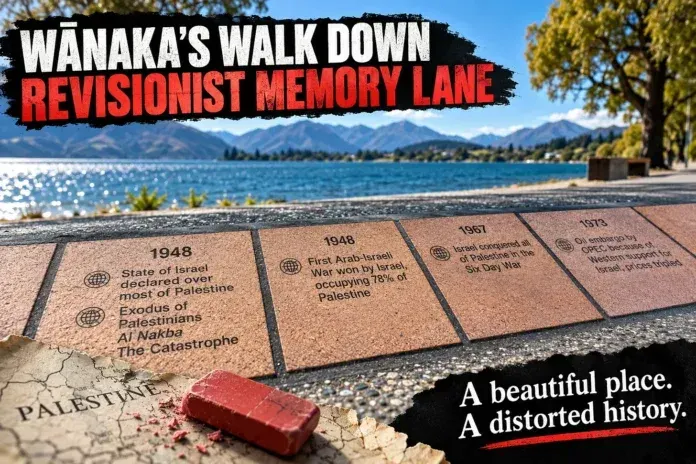
There is something rather extraordinary embedded in the picturesque lakefront of Wānaka.
Not a monument. Not a protest banner. Not even a piece of graffiti.
A history lesson. Literally set in stone.
Along the shores of Lake Wānaka runs Te Ara Maumahara, formerly the Millennium Pathway, a public installation featuring hundreds of engraved tiles commemorating events from a thousand years of local, national and world history.
A lovely idea. An opportunity to educate, commemorate and encourage curiosity about the past.
What could possibly go wrong? Well, apparently, Israel.
Photographs sent to us reveal three entries that tell us rather more about the people presenting the history than they do about the history itself.
1948: Israel’s establishment becomes an occupation.
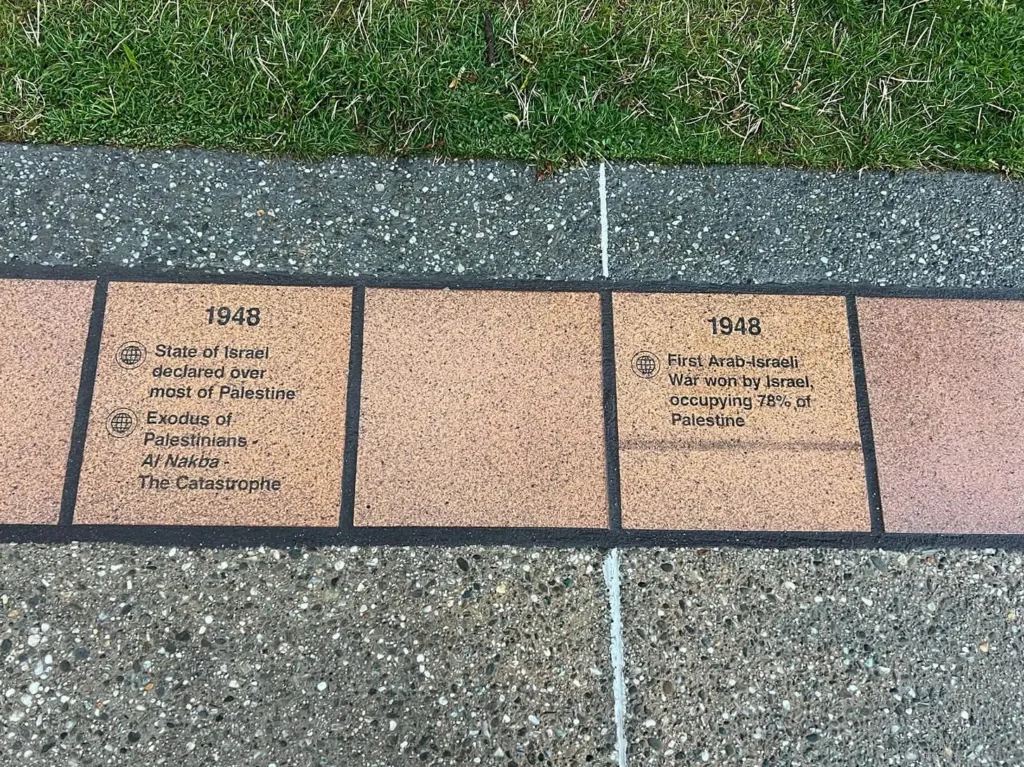
One tile announces:
“State of Israel declared over most of Palestine.”
Another declares:
“First Arab-Israeli War won by Israel, occupying 78% of Palestine.”
Interesting choice of words.
No mention that it was actually British rule before 1948 (and Ottoman rule before that). No mention of the United Nations’ 1947 partition proposal, which recommended dividing British Mandatory Palestine west of the Jordan River into Jewish and Arab states. No mention that Jewish leaders accepted the proposal while Arab leaders rejected it. No mention of the invasion by neighbouring Arab armies following Israel’s declaration of independence.
Instead, we are presented with an Israel that simply materialised, declared itself over the land and apparently occupied most of it.
The figure of 78 per cent refers to the territory Israel controlled following the 1948–49 war. But describing that outcome simply as “occupying 78 per cent of Palestine” is not neutral historical language. It substitutes a politically loaded characterisation for an explanation of what actually happened.
The adjacent tile records the Palestinian exodus, or Al-Nakba, the catastrophe. That displacement was real, and its inclusion is entirely legitimate. Hundreds of thousands of Palestinian Arabs fled or were expelled during the fighting.
But where is the other side of that history? The Jewish communities attacked, the siege of Jerusalem, the rejection of partition, the armies that invaded, or the approximately 850,000 Jews who subsequently fled or were expelled from Arab and Muslim-majority countries over the following decades?
History is not improved by deleting the circumstances that make it intelligible.
1967: Israel conquers Palestine. Apparently, all by itself.
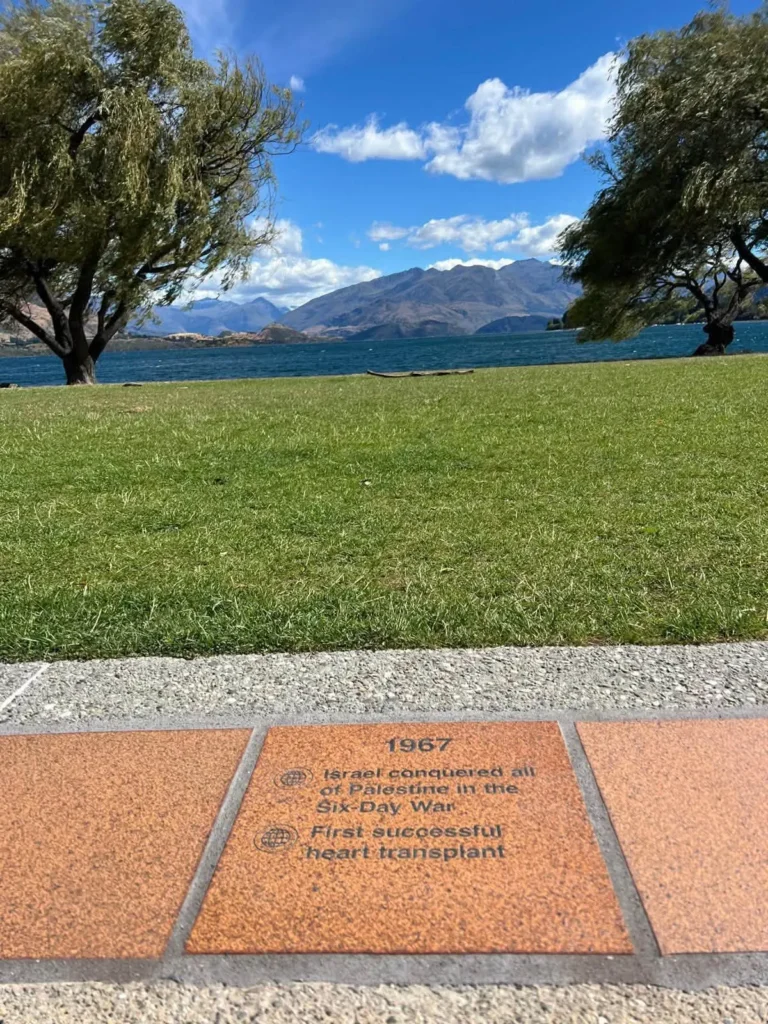
The next inscription announces:
“Israel conquered all of Palestine in the Six-Day War.”
That’s it.
No Egyptian military mobilisation. No expulsion of United Nations’ peacekeepers from Sinai. No Egyptian closure of the Straits of Tiran to Israeli shipping. No Jordanian entry into the fighting despite Israeli warnings. No Syrian attacks.
And no mention that Judea and Samaria (the “West Bank”) had been under Jordanian control since 1948, while Gaza was administered by Egypt.
Instead, Israel simply “conquered all of Palestine”.
The wording also quietly assumes that the entire territory constituted a single Palestinian political entity awaiting conquest, rather than territory divided between Israel, Jordanian control and Egyptian administration.
One can debate the legal status of the territories captured in 1967. One can criticise Israeli policies in those territories. But a publicly funded historical installation ought to distinguish a description of events from the political interpretation imposed upon them.
Apparently, that was too much to ask.
1973: Even the oil embargo gets the Israel treatment.
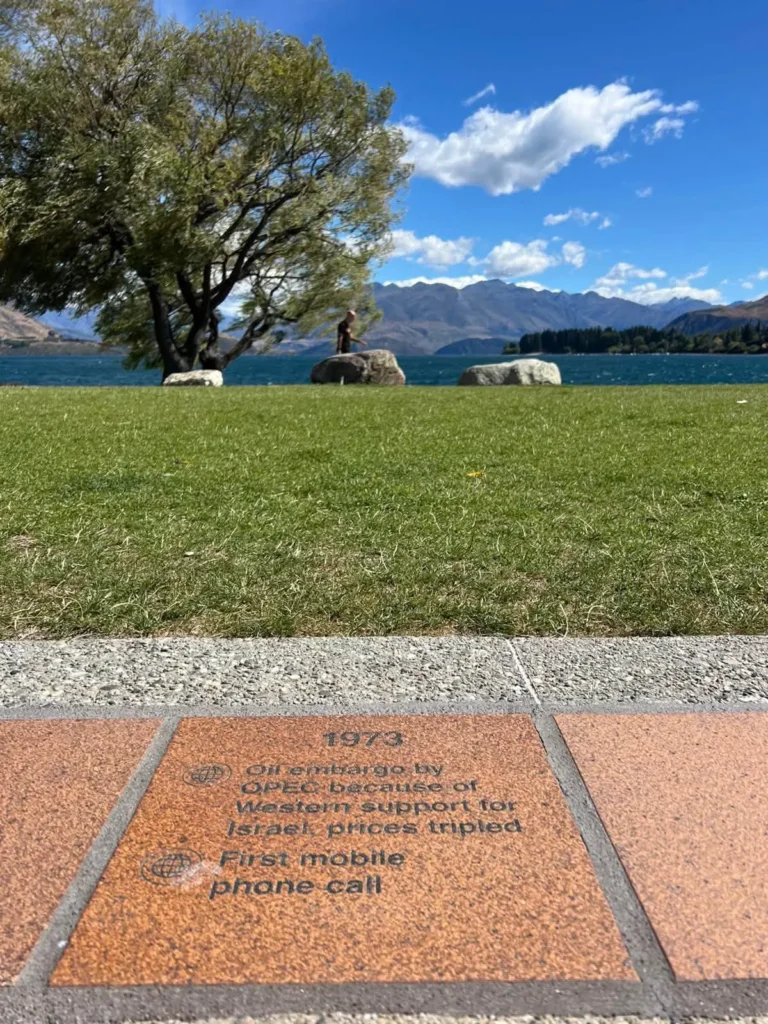
The third inscription reads:
“Oil embargo by OPEC because of Western support for Israel, prices tripled.”
Except that the embargo was imposed by Arab oil-producing countries acting through OAPEC, not OPEC as a whole. The broader oil-price increases involved related but distinct decisions.
A basic historical distinction, apparently lost somewhere before engraving.
And what was happening in Israel in October 1973? Egypt and Syria had launched a surprise attack on Yom Kippur, the holiest day in the Jewish calendar.
The embargo was part of the geopolitical aftermath of that war.
Yet in this inscription, as in the others, Israel appears principally as the object of international grievance, with the circumstances that produced the grievance conveniently absent.
Three years. Three remarkably selective accounts.
Who is responsible for this history?
The Queenstown Lakes District Council announced the installation of the historical tiles in 2023 as part of the Wānaka Lakefront Development Plan.
Council documentation identifies contributors to the historical project, including Ed Waddington, a Mount Aspiring College history teacher, Ken Allen of the Upper Clutha Historical Records Society, and Dr Michael Stevens, who contributed Kāi Tahu history.
But naming contributors is not the same as establishing who wrote or approved these particular inscriptions.
The council should explain who selected the wording, who checked the historical accuracy, what sources were consulted and what editorial standards were applied.
Because this is not somebody’s private political commentary. It is a permanent public installation, presented with the authority of a historical record.
And that authority carries responsibilities.
The problem is not merely what these tiles say. It is what they teach people not to ask.
A visitor reading the 1948 inscription is not encouraged to ask why partition failed or why war followed independence. A visitor reading the 1967 inscription is given no reason to investigate the events preceding the Six-Day War.
Israel is presented as the actor. Arab decisions, threats, military offensives and political agency disappear into the background.
That is a familiar pattern in contemporary anti-Israel narratives. Jewish and Israeli actions are scrutinised relentlessly, while the decisions of their adversaries are treated as irrelevant, inevitable or nonexistent.
The result is a distorted understanding of history in which one side possesses agency and therefore responsibility, while the other is effectively relieved of both.
When a series of inscriptions repeatedly presents Jewish national history through the language of conquest and occupation, without the context necessary to understand the events, it is entirely reasonable to question the assumptions behind the selection.
Particularly when the same project was intended to improve the historical accuracy of the pathway.
History is not supposed to be a morality play with the inconvenient characters edited out.
It is supposed to explain what happened, why it happened, and how competing decisions produced consequences.
A timeline necessarily compresses complex events. Nobody expects an engraved tile to contain a university lecture. But brevity is no excuse for misleading framing. A few carefully chosen words can convey essential context just as easily as a few carelessly chosen ones can erase it.
The Queenstown Lakes District Council has a straightforward choice.
It can defend the inscriptions, publish the sources and explain the editorial decisions. Or it can acknowledge the deficiencies and correct them.
What it should not do is pretend that words permanently engraved in a public walkway are somehow beyond scrutiny.
So here are three questions for the council:
Who wrote these inscriptions? Who approved them? And what historical sources were used?
Wānaka deserves better than politically selective history masquerading as neutral education. And so does New Zealand.
History matters. Context matters. Truth matters.
Especially when it is set in stone.
This article was originally published by the Israel Institute of New Zealand.