David Cumin
Dr David Cumin is an Auckland-based academic and member of the Jewish community.
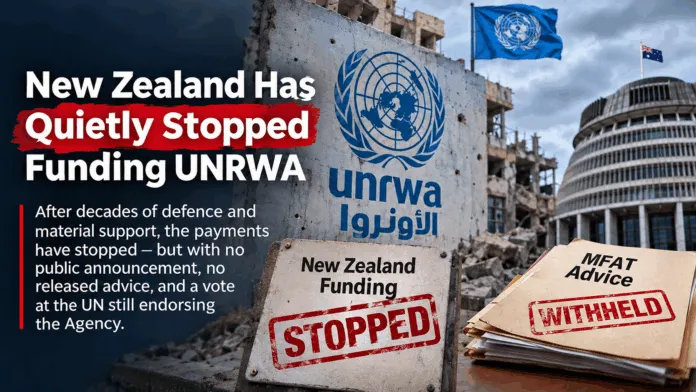
For years officials told ministers, parliament, the Human Rights Commission and the United Nations that UNRWA deserved New Zealand’s support. The public record shows no payment since June 2024. Advice on the agency’s funding went to ministers last December, and the government will not release it.
New Zealand funded the United Nations Relief and Works Agency for Palestine Refugees (UNRWA) from its creation in 1949. From 2006 it paid NZ$1 million a year in flexible core funding. Officials consistently defended that money against every challenge put to them.
The payments have now stopped. The last one on the public record was approved in June 2024. UNRWA’s published list of contributors for 2025 does not include New Zealand. Minister Peters confirmed the suspension and told PILLAR NZ that “We want to know our money is going for a legitimate purpose. And you don’t have to be a rocket scientist to work out it certainly was not. We’re not financing cases where they actually engage with terrorists.”
However, MFAT refuses to release their advice on the matter.
There has been no Beehive release, ministerial statement or MFAT announcement ending, pausing or suspending UNRWA funding. No mainstream media have asked Minster Peters about this issue. Only PILLAR NZ have reported the suspension.
That stands out against how the Government handled each earlier stage of this issue:
- In January 2024, after allegations that UNRWA staff took part in the 7 October attacks, the prime minister announced that no further funding would be paid until the foreign minister was satisfied.
- In June 2024, the foreign minister announced the payment himself, citing assurances from the UN Secretary-General.
- In September 2025, when cabinet declined MFAT’s recommendation to recognise a Palestinian state, the foreign minister explained the decision at the UN General Assembly, and the advice was later proactively released.
MFAT’s public guidance still reads as a defence of the agency. It says New Zealand “did not pause or suspend funding” in 2024. In March 2026, the ministry said its advice on New Zealand’s vote on UNRWA’s mandate would be published on that page by the end of April 2026 (OIA 30733). As of mid-October it does not appear there.
And New Zealand recently voted for a United Nations resolution that expressed a “need for further efforts to comprehensively address the recurrent funding shortfalls” and “recognizes the important and indispensable role of the agency”. It’s as if the staff voting on these resolutions are completely disconnected from the minister’s podcast statements. But this pattern of officials’ support for UNRWA is not new.
Years of defending UNRWA
For decades, officials advised that UNRWA’s problems were isolated and manageable, and ministers kept paying. For example:
- 2019. After IINZ published its report, MFAT said no further payments would be made pending a UN ethics investigation, then said funding had not been formally suspended. Payments continued.
- 2020. Officials told the minister that problems with UNRWA staff and textbooks were not systemic, and that the Palestinian Authority, not UNRWA, was responsible for the curriculum (a claim rejected by a former UNRWA lawyer, and as if that makes the hateful material somehow not hateful).
- 2021. MFAT told the Human Rights Commission it was awaiting an EU-funded review of the textbooks, then paid the 2021 instalment before that review was published.
- 2022. After the review confirmed antisemitic content, the government renewed funding for three years.
- 2023. In December, two months after 7 October, officials told the incoming minister they had seen nothing to suggest systematic or widespread issues with UNRWA’s staff or education programme.
- 2024. New Zealand told the UN General Assembly it had not paused funding and was concerned about disinformation about UNRWA. In August, MFAT told IINZ the government “does not fund organisations that incite violence or hatred, or promote or support terror”.
What changed after June 2024
Much of the evidence against UNRWA predates the last payment, including the UN’s Colonna review and the allegations about 7 October. Officials weighed it and recommended payment. Since then:
- August 2024: the UN Office of Internal Oversight Services found evidence that nine UNRWA staff may have taken part in the 7 October attacks. They were dismissed.
- January 2025: Israeli legislation restricting UNRWA’s operations took effect. New Zealand said it was deeply concerned.
- October 2025: the International Court of Justice issued the advisory opinion MFAT now cites in UNRWA’s defence.
- December 2025 and March 2026: the USAID inspector general criticised the scope of the UN inquiry and referred 14 Hamas-affiliated UNRWA employees to the state department for possible debarment.
- Throughout: New Zealand’s humanitarian support for Gaza and the West Bank grew to NZ$47.5 million, all of it through agencies other than UNRWA.
While the issues have been around for decades, it is refreshing to see New Zealand join the USA, Finland, and Sweden in suspending funding. We hope there is major progress from the Board of Peace and others to reform the hateful curriculum, cease the employment of terrorists, and give Arab Palestinians a chance at a future of peace with Israel instead of our taxes supporting an organisation that ensures ongoing conflict without compromise. We also hope that our next foreign minister continues to stand against funding terror and doesn’t allow MFAT officials to proverbially ‘wag the dog’.
This article was originally published by the Israel Institute of New Zealand.