Table of Contents
Peter MacDonald
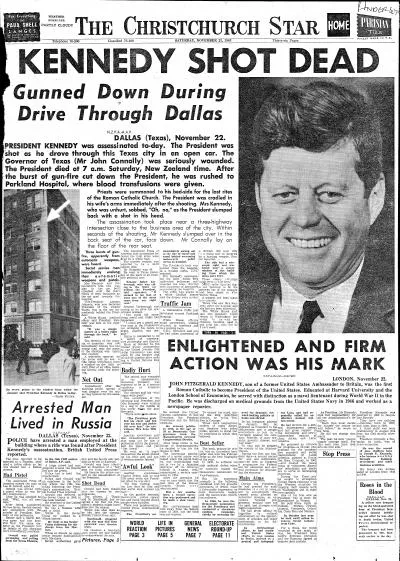
When President John F. Kennedy was assassinated in Dallas, Texas, on Friday, November 22, 1963, the shock reverberated across the world. But few places outside the United States have played as curious and controversial a role in the aftermath as New Zealand; specifically, the Christchurch Star newspaper.
The Timeline from a New Zealand Perspective
Due to time zones, JFK was assassinated at 12:30 pm Dallas time, which was 7:30 am Saturday, 23 November, New Zealand time. Not long after, Lee Harvey Oswald was arrested (at 1:50 pm Dallas time/8:50 am NZ time) and initially charged, not with JFK’s assassination, but with the murder of Dallas Police Officer JD Tippit.
By 10:00 am NZ time, international press agencies like AP, UPI and Reuters began receiving wire reports that Oswald was in custody. That much is plausible. But what happened next defies logic, at least for those of us who worked inside print rooms and newsrooms in the pre-digital age.
The Christchurch Star’s Extraordinary Front Page
The Christchurch Star, a prominent afternoon paper, was published within hours of the assassination and its 23 November 1963 edition included a detailed biographical profile of Lee Harvey Oswald. Not only did it name him as the prime suspect, but it also described:
- His defection to the Soviet Union in 1959;
- His residency in Minsk;
- His return to the US under suspiciously smooth circumstances;
- And his political affiliations and personal history.
As someone who trained as a typographer in 1977, I worked hands-on with the very equipment and systems used at the time: teleprinters, ticker tape, Linotype machines, galleys and proofing trays. I know the steps it then took to turn wire copy into a printed page from receipt, to editing, to setting, to proofing, to final layout. For such a comprehensive profile of an unknown man to appear in the New Zealand press mere hours after the assassination is implausible, unless the material had already been prepared.
A Smoking Gun...
This anomaly became a flashpoint in JFK conspiracy research, especially after Oliver Stone’s 1991 film JFK. In the film, the character “Mr X”, based on former Pentagon insider Colonel L Fletcher Prouty, is shown discovering the Christchurch Star while at Christchurch Airport and shocked that the Oswald narrative had already been printed in such detail.
Prouty, who was chief of special operations for the Pentagon’s Joint Chiefs of Staff, claimed he had been deliberately sent to Antarctica during the assassination to keep him away from the action. His conclusion: the Oswald narrative had been pre-written and globally distributed as part of a CIA-orchestrated media operation to lock in the ‘lone gunman’ story before public doubt could take root.
The Intelligence Connection
According to Prouty and others, the Christchurch Star’s rapid and detailed reporting wasn’t just an anomaly: it was evidence of a coordinated intelligence operation. Oswald’s complex background, including sensitive information about his time in the USSR, was not public knowledge and was unlikely to have been available in real time, certainly not to reporters across the Pacific.
The implication is that international news agencies, and by extension newspapers like the Christchurch Star, were used as vectors for narrative control. The Oswald story was pre-packaged and ready to be injected into the global media bloodstream the moment he was in custody.
From a Typographer’s Perspective
From the inside of a working print room, the timeline simply doesn’t make sense. It’s not just about how quickly wire copy came through: it’s about the real world mechanics of typesetting and printing in the early 1960s. At best, you’d have breaking headlines, not a polished, in-depth biography of a complete unknown individual, set, laid out and printed by early afternoon.
As someone who trained and worked with the tools of that era, I can say plainly that this wasn’t possible without prior preparation. For example, when a high ranking Royal dies, like Queen Elizabeth II, a biography of her entire life can be released within minutes, but this is impossible for a so-called lone nut gunman, unless pre-prepared like the Queen’s biography was.
The Secrecy Continues, Even in the 21st Century
To this day, thousands of classified documents related to JFK’s assassination remain hidden from the public, despite US law requiring their release. In 1992, in the wake of renewed interest spurred by Oliver Stone’s JFK, the US Congress passed the JFK Records Collection Act, mandating that all files be made public by October 2017, unless specific, proven, national security threats prevented it.
When the 2017 deadline arrived, President Donald Trump promised transparency and initially allowed the release of some documents. But, under pressure from the CIA, FBI and other intelligence agencies, Trump delayed full release, granting further time for review. In 2018, he announced that the remaining files would be released in full by October 2021 after his presidency.
President Joe Biden continued the delays, citing pandemic-related staffing issues and national security concerns. Some additional documents were trickled out in 2022 and 2023, but most remained heavily redacted or completely withheld.
Then in 2025, with Trump once again holding public attention, he promised again to release the files, calling for ‘total transparency’ on the JFK matter. But once more nothing happened. No new unredacted files were released. No smoking gun. No breakthrough.
It was another case of political theatre over truth and the pattern repeated. When the intelligence community pushed back, presidents, regardless of party, complied.
The public was left with the same lingering question: if the official story is true and Oswald acted alone, what exactly are they still hiding 60 years later...
A Personal Memory, Where Were You That Day.
For many of Kennedy’s generation, the memory of where they were when they heard the news remains etched in their minds forever. My own father, a Dunedin City Council labourer at the time, remembered it vividly. He was working just outside the Evening Star, on that Saturday morning around 8 am, when news broke on the radio airwaves that President Kennedy had been shot. It was a moment so cataclysmic, so deeply shocking, that he remembered it in precise detail for the rest of his life.
These are the kinds of moments that bind personal memory to global history.
A Forgotten Clue in a Global Mystery
The Christchurch Star front page of November 23, 1963, remains a forgotten but vital piece and clue of the JFK assassination puzzle. It stands as quiet testimony to how narratives can be shaped before the dust settles, before the facts are known and before the public can ask the right questions.
In an age of instant media, it’s easy to forget that the gears of 1960s journalism turned slowly and anything that moved faster than the system allowed, especially at the global level, was likely being helped along.
The Christchurch Star didn’t create the narrative. But it might have confirmed that it was already written.
A Day of Extraordinary Loss: More Than Just Kennedy
November 22, 1963, wasn’t just marked by the shocking assassination of President Kennedy. On the same day, two other renowned figures of history also passed away:
- CS Lewis, the beloved author and scholar best known for The Chronicles of Narnia series, and
- Aldous Huxley, the visionary writer famous for Brave New World.
Though their deaths were overshadowed by the global focus on Kennedy, the coincidence reminds us that this was a day of profound loss on multiple fronts – one that marked the end of an era in politics, literature and culture alike.