Ani O’Brien
Like good faith disagreements and principled people. Dislike disingenuousness and Foucault. Care especially about women’s rights, justice, and democracy
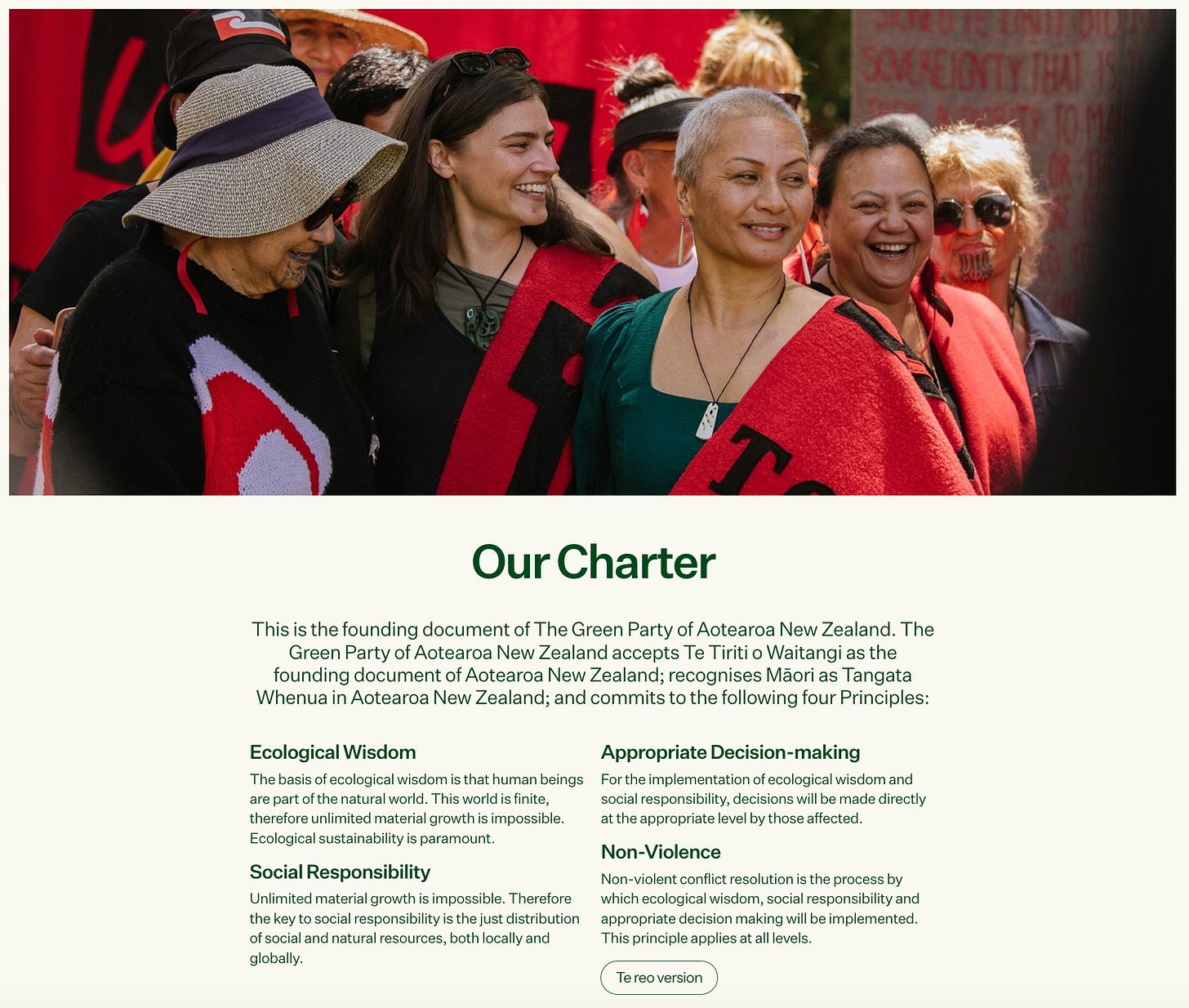
The campaign policies of the Green Party of Aotearoa New Zealand offer a vision for a very different country than the one we currently live in. The Greens are not just proposing cleaner rivers, cheaper buses, and nice ideas about fairness. Across their policy documents, the themes are much more revolutionary. The party wants a larger state, wealth redistribution, power transfer from the private sector to public, more iwi control, heavy market regulation, and constitutional reform based on te Tiriti o Waitangi and Matike Mai.
The Greens have provided extensive policy on their website. They are not hiding what they believe and have laid out a thorough campaign platform that does not leave voters guessing... if they actually read it. These are not policies for managing the current New Zealand model in a more environmentally friendly way. It is an overhaul of our entire system.
The Greens are unusually honest that their programme requires a lot more money. But, even with this honesty, when you read their whole platform, it is painfully obvious that their spending plans are much larger than the increased tax take they are proposing, and much larger than current state capability. The Greens want to “substantially increase government revenue and expenditure as a proportion of GDP” in order to fund “universal” services and reshape the economy. Their 2026 tax package is meant to fund that, with a forecast net gain of $5.147 billion in 2027/28 rising to $5.725 billion by 2030/31.
Reading between the lines of their priorities, it is evident that the Greens are not, in the ordinary sense, an environmental party any longer. They are much more fairly classed as a redistribution party. They want to redistribute money from wealth, property, corporate profits, and higher earners into the state. But they also want to redistribute institutional authority from universal democratic structures into Tiriti-based arrangements. Additionally, they want the state to take over risk usually borne by individuals, while shifting power away from the private sector and towards public systems and Māori-led governance.
The party’s te Tiriti policy says all Green policies must align with the Treaty, endorses constitutional transformation “as envisioned by Matike Mai”, supports devolving power and resources to whānau, hapū and iwi “in all matters that affect them”, and says the Waitangi Tribunal should have binding authority. The Greens want a serious reallocation of political authority. They do not seek a co-governed New Zealand, they envisage a tangata whenua-led Aotearoa.
When it comes to paying for their policies, the Greens repeatedly fall back on aspirational fantasy where costings should be. The Greens’ biggest revenue assumption is their proposed annual 2.5 per cent tax on net wealth above $10 million, which they forecast to raise $3.762 billion in its first year. However, the tax document itself admits the modelling does not estimate the full behavioural response, and instead simply assumes that 28.5 per cent of revenue will be lost to avoidance and evasion. That is a very large caveat attached to the biggest line in the spreadsheet and one that is likely undercooked.
Furthermore, only a small number of OECD countries still operate wealth taxes and revenues are generally low. This does not mean the Greens’ wealth tax is impossible. But perhaps they should ask Scotland how higher taxation is going for them. Scotland increased its top income tax rate to 48 per cent in April 2024 and there are now reports that it cost the country around £22 million in lost tax in its first year. This is the Laffer Curve in action. If you raise a tax beyond a certain point, you may in fact reduce revenues.
Naive assumptions run through the rest of the tax package too. An inheritance-style Capital Acquisitions Tax is forecast to raise $953 million in its first year, and a higher company tax for large companies another $1.37 billion. In practice, inheritance and wealth-transfer taxes are among the easiest to legally avoid unless an enormously intrusive anti-avoidance regime is introduced. Which, to be honest, I would not put past the Greens.
When we turn from revenue to spending, the maths gets much worse, and fast. The Greens have produced an expansive programme, but nowhere is there a credible attempt to reconcile the total cost of their promises with the revenue to pay for it. This is not a manifesto with one or two expensive flagship policies. They have dozens upon dozens of them, across separate policy documents, each apparently written as though it exists in isolation.
They’ve given the welfare state a complete utopian makeover, effectively transforming ACC into a total social-insurance scheme covering illness and disability as well as accidents, potentially adding billions to annual expenditure. Then come free health and dental care, higher benefits and a minimum-income guarantee, free tertiary education, expanded disability support, public housing, a universal child payment, and longer paid parental leave. These are lovely ideas and, in a world where money grows on trees, perhaps we could have all of them. The exact cost of many of these promises is impossible to establish because the Greens have not developed many of them beyond basic descriptions. Even conservative estimations quickly produce billions and billions of dollars in additional annual spending.
And that is only the social policy wish list. Their environmental programme brings a new Department of Animal Welfare and Parliamentary Commissioner of Animal Justice, free pet desexing, and new Māori-led funding bodies. Then climate policy (yes, it is a separate policy document) adds “large-scale, transformational public investment”, greater international climate finance, publicly funded retraining and redundancy compensation, and more money for adaptation. Biodiversity brings another new sovereign fund, a job guarantee programme, expanded DOC staffing and pest control, biodiversity payments to landowners, and public acquisition of ecologically important land. And, true to form, freshwater policy adds another layer of regulation and enforcement. On their own, you can make a case for plenty of these things. Collectively, the taxpayer is starting to have a very bad day.
Energy is one area where the Greens have actually attached detailed numbers, and those numbers give some idea of the scale involved. Their 2026 plan budgets $2.096 billion in additional operating expenditure and $1.036 billion in capital expenditure over four years. That includes $980 million for the new state-owned Kiwipower, nearly $970 million expanding Warmer Kiwi Homes, $421 million for zero-interest clean-energy loans and $460 million putting solar on public housing, alongside smaller community and Māori energy programmes. That is more than $3.1 billion over four years in one policy area, before we even begin adding up the more expensive promises in health, welfare, education, housing, ACC, and transport.
Those are the policies where we actually have numbers. We can tally up some of the other commitments roughly, for example, about $12 billion a year for the Household Income Guarantee, $9 billion a year for free healthcare, close to $1 billion for Kiwipower, hundreds of millions more for overseas aid, and the huge additional investment for lifting research and development spending to three per cent of GDP. But even that doesn’t capture the scale of what they are proposing.
The Greens ultimately want “universal public housing for all”, with means-testing phased out as the housing stock expands. How do we even begin to cost that up? They also say they would establish a Ministry for Green Works to undertake a massive state building programme, expand rent subsidies, and directly fund housing projects through the state rather than relying on private finance. I mean, it sounds like socialism, guys. And socialists always run out of other people’s money.
Their livelihoods policy promises a legal right to a minimum income, higher benefits, compensation for unpaid labour, taxpayer retirement contributions for low-income people and carers, welfare debt forgiveness, hardship grants rather than loans, and legal entitlements to essentials including internet access. Then there is the proposed fund to help whānau, hapū and iwi reacquire dispossessed Māori land as it comes onto the market. None of this is free. Someone has to pay for it.
This is why it is essential to read Green policy as a collection rather than one press release at a time. Almost every policy document comes with another thing the government should fund, subsidise, or create a new bureaucracy to run. And everything has Māori-specific spending layered on top. Many of their ideas can sound modest and, of course, compassionate. When the Greens speak about policy in isolation they look reasonable and other parties look cruel for rejecting lovely-sounding ideas. The media dutifully reports them as plausible and in a positive light and no one is the wiser that they are just one small part of an impossible dream.
The Greens can point to their wealth tax, higher income taxes, and various new levies and insist that the rich will pay for it. But their optimistic revenue estimates have to fund all of this simultaneously. Eventually the numbers have to add up. In the Green Party’s vast policy suite, they simply don’t.
The Greens’ new AI policy is a good example of what the party gets right and what it cannot help get wrong. At the Green Party AGM, Chloe Swarbrick announced a one-year moratorium on consenting new “AI data centres”. The immediate target is the proposed $3.5 billion Datagrid development in Southland, expected to draw roughly six per cent of New Zealand’s present electricity supply. The Greens argue that projects of this scale should not be approved before the country decides what obligations operators should face around electricity, water, and infrastructure. I am with the Greens on this. A development consuming that much power is more than an ordinary land-use matter, and no company should be allowed to privatise the benefits of scarce infrastructure while socialising the costs of expanding it.
The problem is that the Greens’ argument does not stop there. Swarbrick wrapped that perfectly reasonable concern in a rousing speech portraying AI data centres as dystopian symbols of an “extractive economy”, claiming they take local water, turn it into “sludge”, hollow out towns, extract profit, and offer few lasting jobs. Okay, Boomer? Data centres are certainly energy-intensive and do not create employment in proportion to their capital cost once construction ends. But Mr Burns is not behind these developments tapping his fingertips together. They support the AI tools Kiwi businesses and individuals are already using, not just the projects of tech bros. Treating the entire sector as an extraction scam ignores the economic activity, data sovereignty, and resilience benefits that domestic infrastructure can provide.
The false choice the Greens put to us is between letting every project rip without conditions and banning all new consents for a year. But government can impose standards now like requiring additional generation, making developers meet the cost of upgrades, regulating water use, and arrangements during periods of system stress. A blunt ban risks sending another signal that large capital projects entering New Zealand may find the rules rewritten when politicians have anxiety attacks.
The overreaction from the Greens also reveals that despite the party calling for New Zealand to lift research and development spending above the OECD average, build domestic capability, and create a more resilient economy, its most prominent new technology announcement is a halt on doing just that. They want the rewards associated with advanced technology, while protesting the energy, infrastructure, capital, and scale required. Doesn’t this sound familiar? It is opposing mining for minerals while using an iPhone all over again.
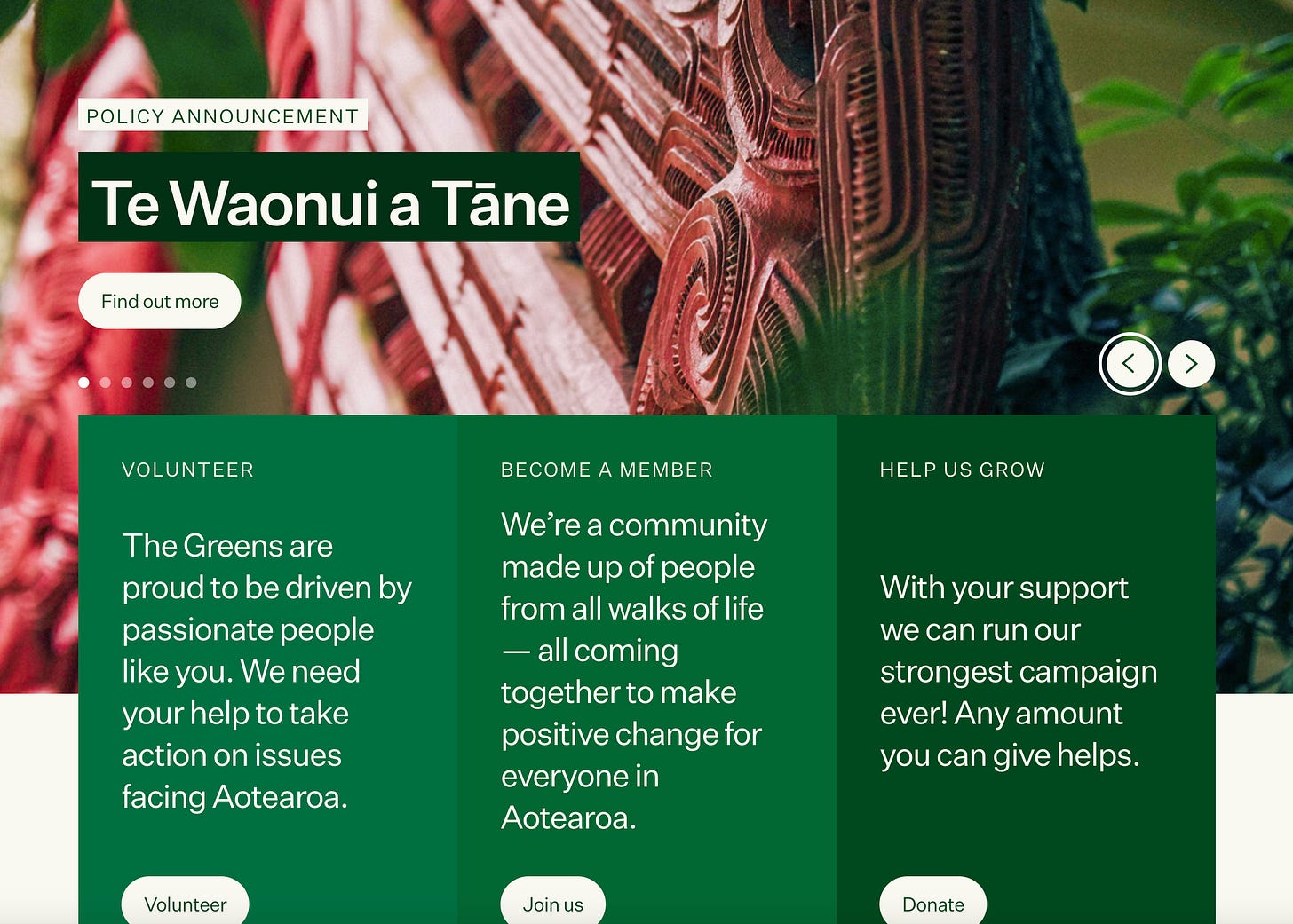
Since the Greens’ AGM, we have been given an even better example of what all of this means. On Sunday, Chloe Swarbrick and Marama Davidson announced Te Waonui a Tāne: Thriving Marae and Thriving Communities, a proposal to put $2.44 billion of Crown money into a new Te Rangatiratanga Trust owned and governed by hapū and iwi. Of that, $400 million would fund immediate projects over four years, while $2 billion would be invested in an intergenerational fund intended to provide an enduring stream of income.
It is true, some marae have functioned as emergency hubs during floods, earthquakes, and other civil defence events. And the Greens say one in three marae are exposed to flooding, one in three are in landslide-prone areas, and two in five are susceptible to liquefaction. So while marae are hardly the only community or religious organisations that step up in emergencies, if the government expects them to perform a public function, there is a legitimate case for helping fund that capability.
And if it were simply a $400 million contestable infrastructure programme then we could probably justify it. But Te Waonui a Tāne goes much further. The remaining $2 billion would be invested permanently, with the Greens estimating the fund could grow to around $3.8 billion by 2039/40 and eventually distribute between $47 million and $118 million a year. The money could support not merely emergency infrastructure for marae but Māori housing, Māori health services, Māori social services, and Māori enterprise.
The best bit, the Greens say, is that having supplied the capital, the Crown would surrender all control of it. The Government would have no power to direct investments, appoint trustees, or alter funding decisions. Nationwide wānanga would determine the governance arrangements, with Matike Mai and Whānau Ora-style commissioning models informing the process. Taxpayers would provide $2.44 billion to establish a permanent institution, after which their elected government would have no governance rights over the money.
Earlier I described them as wanting to redistribute not merely wealth but institutional authority. This is it in practice. The policy transfers a massive amount public capital into an institution deliberately designed to sit beyond ministerial direction. Marama Davidson calls this “actual tino rangatiratanga for iwi”. We should take her at her word because this is much more than just another announcement, and certainly more than fixing a few marae roofs. It is a practical example of the constitutional arrangements the Greens advocate for elsewhere; Crown resources transferred into institutions exercising autonomous Māori authority.
Davidson also complains that existing marae funding depends upon “the priorities of the government of the day”. Well, yes. That is normally how a democracy works. Funding priorities change because voters change governments. Creating an institution specifically designed to prevent future elected governments exercising control over billions of dollars of public capital removes that money from democratic contestability.
And then there is the small matter of paying for it. National’s Māori development spokesperson Tama Potaka quite reasonably asked where the $2.44 billion is coming from. Just weeks ago, the Greens announced a tax package they say will raise a little over $5 billion net annually. Well, this one announcement alone requires initial Crown expenditure totalling nearly half that amount. This demonstrates the extraordinary scale of the commitments being layered on top of one another. The tax package has effectively been spent several times over before the election campaign has even properly begun.
Why not invest in marae resilience? Well, because you’ve already spent billions on dental care, benefits, and public housing. Why not increase overseas aid? Because there is also renewable energy to subsidise, families to pay, Māori land to reacquire, and welfare debt to forgive. The trouble starts when somebody has the unfashionable idea to add all of their costs up.
And this is why I return to the point I made at the beginning of this essay. The Greens deserve credit for telling us what they believe. There is something refreshing about a political party prepared to admit they want to spend $2.44 billion investing in an something that will only ever benefit a small minority of the population. The Greens’ Māori Manifesto says they will “devolve power and redistribute resources back to tangata whenua”. They are telling voters explicitly that their objective is not to improve Māori outcomes within the existing system, nor merely to consult Māori more often. They want power itself devolved and resources redistributed based on race.
Which power, which resources, and from whom? Well, the rest of the manifesto shows that the Greens want iwi and hapū exercising authority in all decisions involving Māori, they want a Māori Education Authority, a Tiriti-based immigration system involving devolved resources and decision making to hapū and iwi, they want local government explicitly constituted as a Tiriti partner, and across central government they want iwi and hapū participating as “partners rather than as advisors”.
And to say power and resources must be redistributed “back” to tangata whenua assumes that authority properly belongs, at least in significant areas, to tangata whenua and has been wrongfully accumulated or retained by the Crown. The manifesto makes exactly that argument, describing the existing system as one created to oppress Māori and saying that Crown actions have eroded Māori social structures and authority. Within that worldview, devolution is about restitution of the kind that we have usually left to the Waitangi Tribunal. Do the Green Party not accept the full and final process of Treaty settlements?
There is an enormous difference between saying Māori should have a voice in public decisions, which few New Zealanders would find particularly revolutionary, and saying political authority should be redistributed according to ancestry. The first operates within a common democratic system, but the second requires remaking the system itself and raises difficult questions about where sovereignty ultimately rests.
None of those questions can be answered by saying te Tiriti and democracy are complementary, as the Greens do. That is just a statement and it carries no reassurance or qualifying information. If ‘partnership’ means consultation, representation, and protection of legitimate rights, then sure, it can sit alongside parliamentary democracy. If it means autonomous spheres of political authority, permanent transfers of public assets, and institutions from which elected governments are deliberately excluded, well then, no, it can’t.
This is also why describing the Green programme as ‘co-governance’ understates it. Co-governance implies two parties jointly administering something. The Greens repeatedly use stronger concepts like rangatiratanga, devolution, redistribution, Māori authority, and constitutional transformation. Again, you have to give it to the Greens, there is at least a logical coherence to all of this that deserves acknowledgement. If you accept the Green interpretation of te Tiriti, their policies make sense. If Māori did not cede sovereignty, and if tino rangatiratanga requires an enduring sphere of independent authority, then just placing more Māori faces inside existing institutions will never be enough. Power and resources must be reallocated. In that sense the Greens are being considerably more candid than politicians who invoke ‘partnership’ without ever explaining where they think the logic of partnership ends.
At some point New Zealanders are entitled to ask who actually gets to make decisions. Are powers currently exercised by governments elected by us being transferred to institutions that answer to a different source of authority? How far does redistribution go? Who gains authority? Who relinquishes it? Do New Zealanders consent to the end result?
A realistic constitutional transformation process of the kind the Greens endorse would require a serious commission, legal drafting, huge public engagement and almost certainly referenda, with an eye-watering bill for the taxpayers before we even get to the real cost, which is political. Either this section of their policy is entirely wishful thinking or the Greens need to start developing an approach that is much more ‘storm the Bastille’.
The Greens’ campaign slogan is “For all of us”. It is clever because so much of the programme is framed in universal terms like free healthcare, secure housing, higher incomes, cleaner energy, stronger communities. Who doesn’t want those things? But read the policies rather than the slogans and the universality starts to look questionable. Some of the promises depend on taking vastly more from a relatively small group of taxpayers. Others explicitly redistribute political authority and public resources according to ancestry. And all assume a level of government competence, administrative capacity, and available money that does not presently exist.
The Greens have probably produced the most ideologically coherent programme of any party going into this election. They know what they think is wrong with New Zealand and they know, at least in theory, what they want to replace it with.
But having a destination is not the same thing as having a credible route there. The Greens are offering direction, but that does not mean the direction does not terrify me personally. And it is direction that requires feats of fiscal acrobatics, an extraordinary faith in the competence of the state, and a certain level of collective delusion, but direction nonetheless.
Strip away the branding and the best description of this programme is not compassionate, progressive, or even particularly green. It is redistributive, maximalist, ethnonationalist, and administratively undercooked.
This article was originally published by Thought Crimes.