Table of Contents
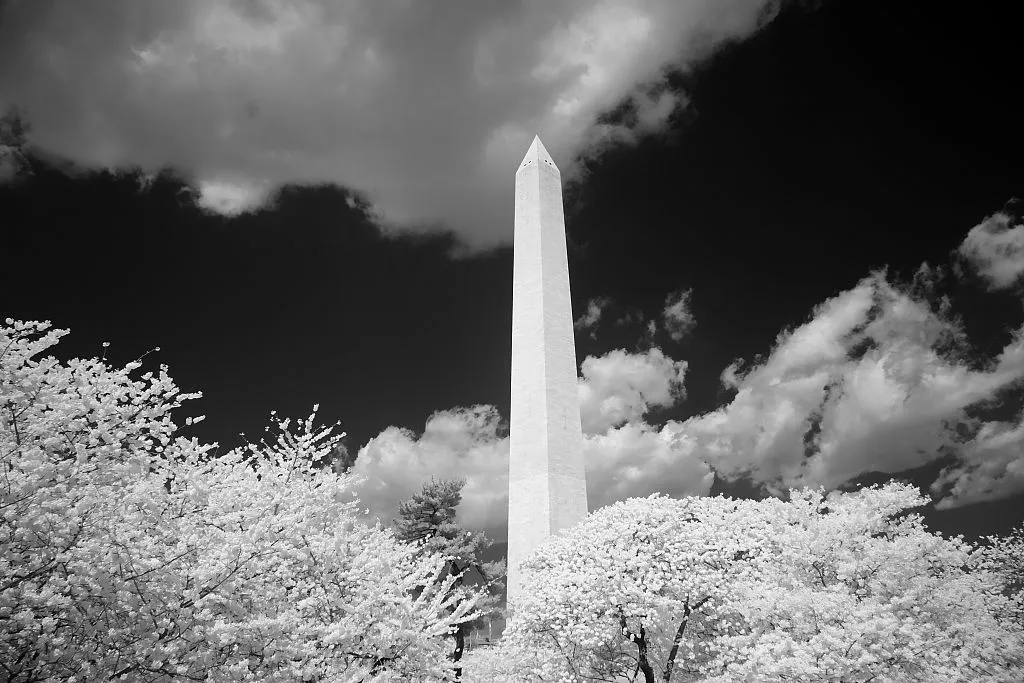
There is nowhere to hide at the base of the Washington Monument.
And so, on the early-early morning of New Year’s Eve, a gregarious but bleary-eyed video producer from Florida named Kyle Barrett shifted side to side, bracing against a bitter wind while waiting on edits from senior administration officials. In less than 24 hours the obelisk would be bathed in moving light.
This was the only dress rehearsal for what organizers called the “Illumination of America,” a titanic spectacle of living images projected directly onto the monument above and the kickoff for the 250th anniversary of the United States. This made Barrett, at least in that moment, the man most responsible for the story Trump’s America tells about herself.
“In the middle of the night, 3:30 am on the 30th, was when we finally, for the first time, saw any of our content up on the monument,” he told RealClearPolitics of the rush job that he had accepted only three weeks prior. It is the crowning achievement of his career. Five years earlier, he was making television commercials for Ashley Furniture.
Congress had only just passed a special authorization into law allowing the monument lightshow on Dec 2. Barrett and his team got the call five days later, leaving them just under three weeks to develop a visual script and execute it. Christmas was postponed for their families. Long nights and work on the weekends, guaranteed. Up until that moment in the cold, no one had seen a preview of their work.
The digital files were so massive that they couldn’t even fit on a single server. The show could only be previewed directly onto the 555-foot marble canvas in the middle of DC. A grid that had been projected onto the monument for digital mapping earlier in the week was immediately spotted and had sent the internet aflutter. To avoid ruining the reveal, the first preview of the show had to be done in the middle of the night at the last possible moment.
They threw the switch. Light and sound exploded. The monument transformed into the open ocean, and Christopher Columbus discovers the New World. Next, hooves pound the marble pavement, and Paul Revere cries out that the British are coming. Then George Washington crosses the Delaware, and afterward, the Declaration of Independence is written in real time by a glowing quill on the towering obelisk.
The subsequent American story plays out in four acts and runs less than 20 minutes from Discovery and Independence to Westward Expansion and from the Industrial Revolution to the Space Age. The White House wanted the monument lit up like “the world’s tallest birthday candle.”
In the early morning, Barrett and his team rushed to take notes from assembled leaders of Freedom 250, the organization responsible for pulling off the national semi-quincentennial. The sky needed to be two shades bluer. The water wasn’t crystal clear. The giant faces of the Founding Fathers chiseled into the monument seemed too faint.
“We rushed back to the office at about 4:30 am and didn’t sleep again until after we uploaded the final piece of content into the servers on the 31st,” Barrett said. The final version was locked in with one hour to spare. While the technical aspects needed to be nailed down, the story was never in doubt. It was a patriotic celebration of America, not critical introspection.
“Some bipartisan entities want to apologize for American exceptionalism. We’re just not going to do that,” explained a source close to Freedom 250. “We took everything that is the best of the best of our nation, whether it was Columbus discovering the Americas, Washington crossing the Delaware on Christmas, or the Apollo missions and the moon landing. We are unapologetic about it.”
The Saturn V rocket was projected onto the Washington Monument six years ago to commemorate the 50th anniversary of the Apollo moon landing. But it was only visible on one of the four faces. For America 250, they would use all four. “Trying to decide when and how to use the monument to tell a particular story,” Barrett explains, “that was challenge number one.”
And the images would not be static. They would be a mix of moving animations. A single image would be projected onto each of the four faces at one moment – for instance, when the astronaut boot of Neil Armstrong touched down on the moon. During other points in the show, a moving canvas would wrap around the entire obelisk as when Sacagawea led Lewis and Clark into the West. All of it was narrated and accompanied by a completely original score.
Organizers positioned 40 different laser projectors around the monument, putting 10 on each side for redundancy. Three of the projectors had to be rushed in last minute from Belgium. They were Barco UDX-4K40s, capable of producing 37,000 lumens, enough light to turn night into day and make certain the Washington Monument was visible everywhere within a 25-square-mile radius.
The second challenge: finding and sourcing historical paintings. They scoured archives, poured through history textbooks, and reviewed the famous paintings that adorn the national Capitol. For the transition from the Wright Brothers to the Space Age, Barrett bounced ideas off his wife, Merlin, a fifth-grade science teacher. It had to be perfect. The display was the kickoff for an entire year of celebration.
“President Trump has spared no effort in ensuring that America gets the spectacular 250th birthday it deserves – and the New Year illumination of our Washington Monument is just the beginning,” said White House spokeswoman Anna Kelly. “Between the Patriot Games, Great American State Fair, UFC 250 Fight, and other exciting events, 2026 will feature a renewal of patriotism and national pride under this president’s leadership.”
Barrett and his team raced back to the Washington Monument to feed a copy of the 19-minute show, about two terabytes of data, into four servers. They had kept an eye on social media, particularly Reddit, all day to see if images of their dress rehearsal that morning had leaked. They had not. Back on the National Mall, they confronted another final, frustrating challenge – high winds had shifted the projectors six inches off target.
“I was terrified when the project started,” Barrett admits. The show attracted an estimated audience of 299 million on television and brought in 7.4 billion online impressions. Beginning on New Year’s Eve, it reran for five days straight. According to a source with direct knowledge, when returning President Trump to the White House on the final night, Marine One circled the monument twice for a better view.
“I was filming sofa chairs and futons five years ago. That’s all I did was shoot broadcast spots for Ashley Furniture,” Barrett said. “The pivot from shooting furniture to counting myself as being seen by 400 million people, or whatever the most recent numbers are, is mind boggling.”
But Barrett admits he had an audience of one in mind on opening night.
His wife, Merlin, had helped him brainstorm ideas. She hadn’t seen the final draft and didn’t know her suggestions, particularly the transition from the rocket to information age, had made the final cut. Before the crescendo, he told her, “I want you to know that all of this is for you.”
“The insane no-sleep-in-two-and-a-half-weeks unimaginable timeline was worth it to be able to say that to her in that moment,” he recalled. “And then she got to watch the fireworks.”
This article was originally published by RealClearPolitics and made available via RealClearWire.