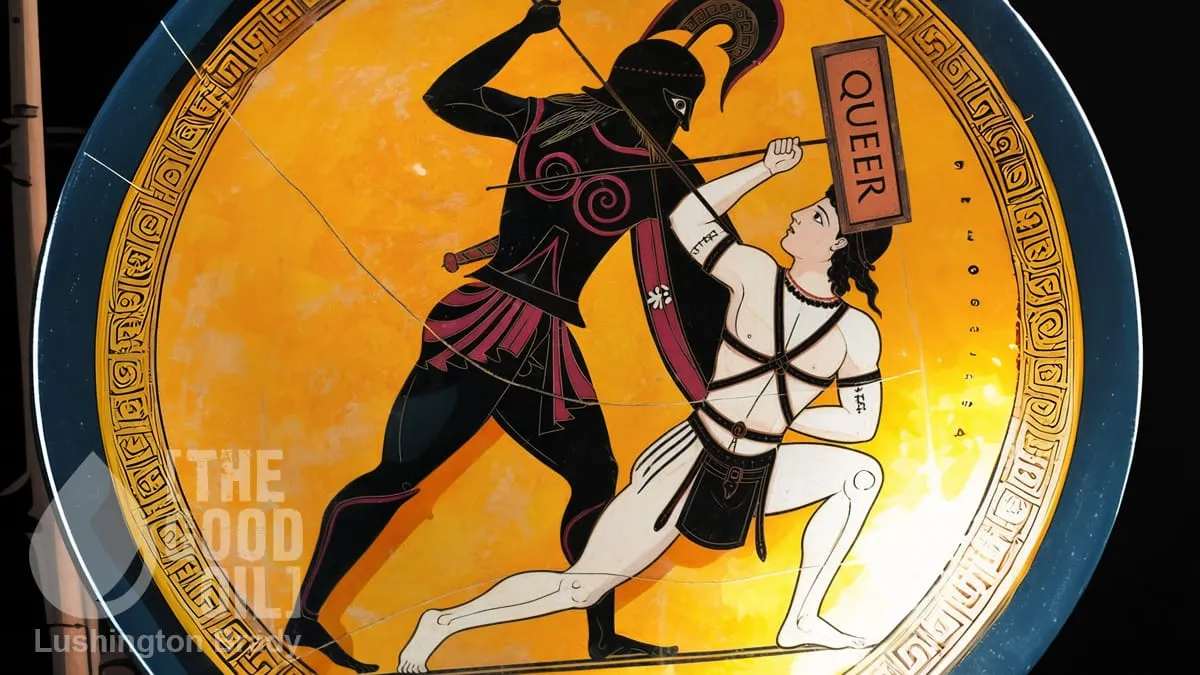
There are plenty of historical myths that refuse to die, from ‘Let them eat cake’ and ‘Napoleon was short’, to ‘Everyone thought Christopher Columbus would fall off the edge of the Earth.’ But one of the most persistent, especially in recent years, is that the Ancient Greeks and Romans were all rampant batty boys. Even Islam, so the story goes, was ‘queer friendly’.
It’s all a load of steaming donkey bollocks, of course.
For starters, ‘Ancient Greece’ was far from a monoculture frozen in any particular instance of time. In fact, Ancient Greece spanned multiple city-states with often startlingly different cultures, across nearly a thousand years of history. Pretending that it was all a millennia-long Hellenic gay orgy, especially based on a handful of surviving artworks out of thousands, is like arguing that the United States has always been a flaming Pride parade, based on excavating a single gay porn shop from 1970s San Francisco.
Even ‘gay’ is a grotesquely misleading term. Even the most dedicated boy-rogering Spartan would have reached for his xiphos at the first sight of a modern-day flaming queen. Just because some (and far fewer than popularly imagined) Greeks and Romans practised a bit of pederasty on the side, did not make them ‘gay’. In fact, they would have been mortally insulted by the inference.
So, how did historical society deal with homosexuality?
The activist pamphlet version is tidy. Greece and Rome were ‘tolerant’. The Islamic world ‘celebrated same-sex love’ in its poetry. Then Christianity arrived, the lights went out and history has been a long march toward the rainbow. A recent survey of the actual record, by contrast, found that the more one digs into it, the more that story falls apart.
The ancient world had quite different values and often brutal punishments for those who disobeyed. If you were the wrong kind of gay man, your life could go very bad. Like, you just got tortured to death bad. And I also saw forces that were much more horrific towards gays than religions could ever manage.
The first problem is the word itself. Sexual orientation or being ‘gay’ really wasn’t on anyone’s mind. Greeks and Romans did not walk around with an inner identity category waiting to be validated. What they noticed was status. Who did the penetrating and who did the receiving. Attraction to men or women was almost beside the point.
What really mattered was whether you were the dominant or submissive part of it.
The ‘tolerant’ system was not enlightened. It was a hierarchy that crushed a different group of people.
In Greece, a high-status man known to have taken the passive role faced social annihilation: no vote, no lawsuits, no temples and possibly execution. What was institutionalised, in some city-states and among some elites, was not two adult citizens setting up house and adopting a couple of theybies.
Paiderastia was an educational arrangement between men in their 20s and boys more akin to mentorship. Complete with ritual, paternal approval and a whole lot of not just cultural expectations, but laws, which, again, varied from city-state to city-state. Some states made sex between adult men and boys illegal. While other cities didn’t, an older man who took the mentoring relationship ‘to the next level’, so to speak, could be the subject of disgusted gossip.
And again not all Greeks participate. The majority of the population didn’t even do this shit. Basically it’s the equivalent. What you’re celebrating is Epstein Island. Just so we’re clear. Does the majority of the population do the shit today that those scumbags did in Epstein Island? No. Well, most likely the majority of the population in ancient Greece didn’t fuck with this shit. But there were some elites that were rich, they were powerful, and they used their power.
Rome was blunter. The Greeks’ boy-cult looked, to Roman eyes, like effeminate decadence. Freeborn Roman boys were untouchable and marked as citizen children, with penalties running to death. Slaves were another matter, of course: no rights, no age line and no mentoring speech. In the Roman army the penalties were savage: flogging and expulsion for the dominant partner, clubs or stones for the submissive. Plutarch even records a young soldier killing a superior who would not leave off and being crowned for it by the dead man’s own uncle. That is not Stonewall, but a honour culture policing penetration.
‘But… but… Nero’s gay marriage…’ Except that even the Roman historians who recorded that one did so with open disgust, leading to the possibility that it never happened at all. It was the Classical equivalent of an American leftist gibbering that ‘Donald Trump is a pedo!’ In any case, power has always purchased what custom forbade everyone else. As with the Epstein Island client list, the rich and powerful, like emperors, felt entitled to carry on with behaviour that would see an ordinary citizen handed over to genpop to take care of.
In the empire, the shift against homosexuality increased. At first, it was driven by Roman politics. There was a worry about passive homosexual behavior and the loss of masculine virtue that in some ways seemed to symbolize the empire’s political submission. The first ban on male prostitution was enacted in 248 AD. But the rise of Christianity would supercharge that. When it became the empire’s official religion, leaders enacted increasingly harsh laws like being burned alive for male prostitution to eventually outlawing all male homosexual activity. It wasn’t just homosexuality that the church was changing, but a broad rewriting of Rome’s moral framework.
In any case, the new laws were more about sex without procreation than homosexuality per se. Masturbation, oral sex, adultery: whatever it was, if there was no chance of a pregnancy, they were against it. Really against it: laws in 13th-century France ran from castration to burning. Spain castrated and hung men by the legs. English law talked of burying alive or drawing and quartering. Application was patchy, and royalty, as always, was kinda-sorta exempt: Edward II and Gaveston, James I and Buckingham: letters and favourites, always deniable, always playing with fire. Henry VIII’s Buggery Act was as much about stripping the monasteries as morals.
None of this is an argument for dragging anyone behind a cart. It is an argument against lying about the past in order to launder the present. The ancients did not think like a human-resources module. They thought in citizens and slaves, active and passive, boys and men. Islam’s poetic couplets sit beside buildings from which men are still thrown. And the modern demand that we retrofit Elagabalus with they/them pronouns, or a mixed grave with a “trans Viking,” is not scholarship. It is a porn shop in San Francisco mistaken for the entire republic.