Ani O’Brien
Like good faith disagreements and principled people. Dislike disingenuousness and Foucault. Care especially about women’s rights, justice, and democracy.
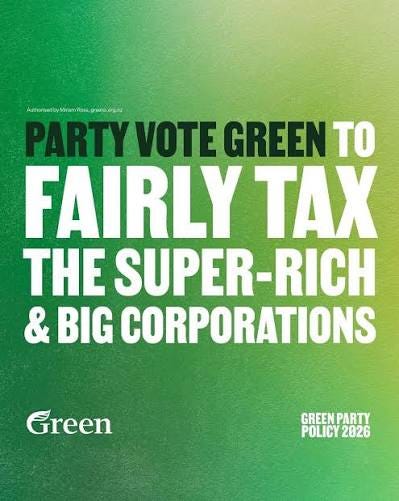
The Green Party released its 2026 tax policy under the slogan “A tax system for all of us”. The package is presented as modest, fair, compassionate, and practically technocratic, in that it is framed as a small tax on the “super-rich”, a contribution from “mega-corporations”, a tax cut for 96 per cent of earners, and some extra enforcement against multinationals. But behind the clever soothing language and the veneer of sensibleness is the familiar ideological Green Party project. The Greens are proposing to reshape New Zealand’s economy around a suspicion of private wealth, profit, investment, inheritance, landlords, banks, large companies, and high earners. They are setting the population against the very people best equipped to grow our economy and improve our collective quality of life. They want us to fight over the dodgy petrol station pie that is falling apart instead of growing a massive gourmet one.
The package includes a 2.5 per cent annual tax on net assets above $10 million, excluding the family home; a 33 per cent capital acquisitions tax on inheritance and gifts above $1 million, again with exemptions for family homes and family farms; a new 45 per cent income tax rate on income over $160,000; a 33 per cent corporate tax rate for companies with turnover over $30 million; a 0.06 per cent levy on major banks’ liabilities; enforcement of a five per cent withholding tax on certain big tech payments offshore; removal of residential rental interest deductibility; and pushing out the bright-line test to 10 years. The party says this would raise net revenue of $5.35 billion in 2027/28, rising to $5.94 billion by 2030/31, while funding income tax changes including a $10,000 tax-free threshold.
This is being sold as a plan to make the rich “contribute fairly”. But what if we ask what wealth is, how it is created, and what happens when the state starts treating accumulated capital as a fiscal quarry to be mined every year. The Green Party speaks about wealth as though it is a pile of idle treasure sitting in a vault as billionaires slide down piles of coins like Scrooge McDuck. Wealth is often equity in companies, farms, private businesses, shares, commercial property, intellectual property, and productive assets. It represents claims on future activity and is the machinery through which investment becomes employment, innovation, productivity, and wages.
A bank might tell you your net worth is $30,000 because you own a car and have some KiwiSaver savings, but that does not mean you have $30,000 in cash available to spend tomorrow. A business owner may be “worth” tens of millions on paper because of the estimated value of the company they built, while drawing a modest salary and reinvesting profits back into growth. If the government demands a significant annual tax bill based on the theoretical value of those assets rather than available cash, owners may be forced to sell shares, liquidate assets, reduce investment, lay off staff, or even sell the business altogether simply to meet their tax obligations. In extreme cases, a tax aimed at accumulated wealth can end up destroying the very enterprises that created that wealth in the first place.
The Greens’ central framing is that New Zealand has “more than enough” and that the problem is with “the rules” they say are making things unfair. That basically assumes [...] distribution is the only serious political question left. This is one of the oldest mistakes of socialist thinking. It imagines an economy as a static stock of resources, rather than a dynamic system of risk-taking, saving, investment, experimentation, failure, and reward. If there is “more than enough”, then in their view hardship can be only explained as the result of greed. If hardship is caused by greed, then the state is justified in punishing the “greedy”. Then, this naive and childish ideology says, once the state has taken more, equality will magically improve. It is a simple, intoxicating story and that is why humans keep wanting to try it despite a 100 per cent devastating consequences ratio.
Capitalism is an imperfect system because all human systems are imperfect. It produces inequality, disruption, anxiety, and, yes, sometimes vulgar excess. But it has also done more than any other economic system in human history to lift people out of material poverty. Market economies, private property, trade, profit, innovation, and capital accumulation have transformed ordinary human life from subsistence and scarcity into abundance. What we now describe as hardship would, in many cases, have been unimaginable comfort to previous generations. The overwhelming majority of us have access to homes, refrigeration, supermarkets, antibiotics, phones, cars, public hospitals, global communications, and goods and services beyond the dreams of most of human history. This did not happen because committees redistributed wealth more fairly. It happened because people were free to build, invest, invent, trade, compete, fail, and profit.
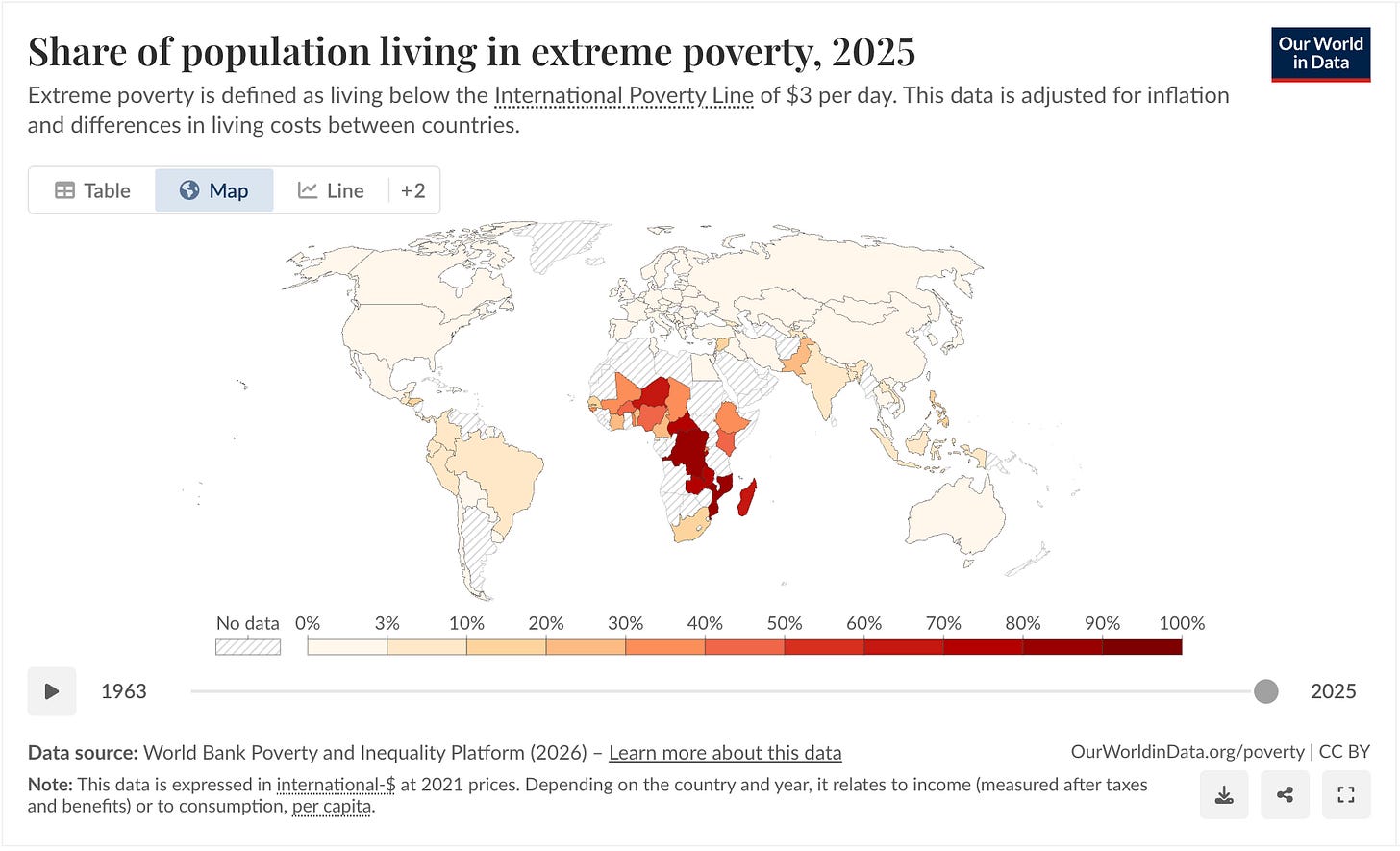
Modern political debates often use the word poverty in a way that would have been almost unrecognisable to previous generations. Absolute poverty is the inability to meet basic human needs like adequate food, shelter, warmth, sanitation, healthcare, and security. Relative poverty, by contrast, measures people against others within their own society. Someone can be classified as poor because they have less than their neighbours, even while enjoying a standard of living that would have seemed luxurious for most of our history. The Greens are almost always talking in terms of relative poverty while using the language of absolute.
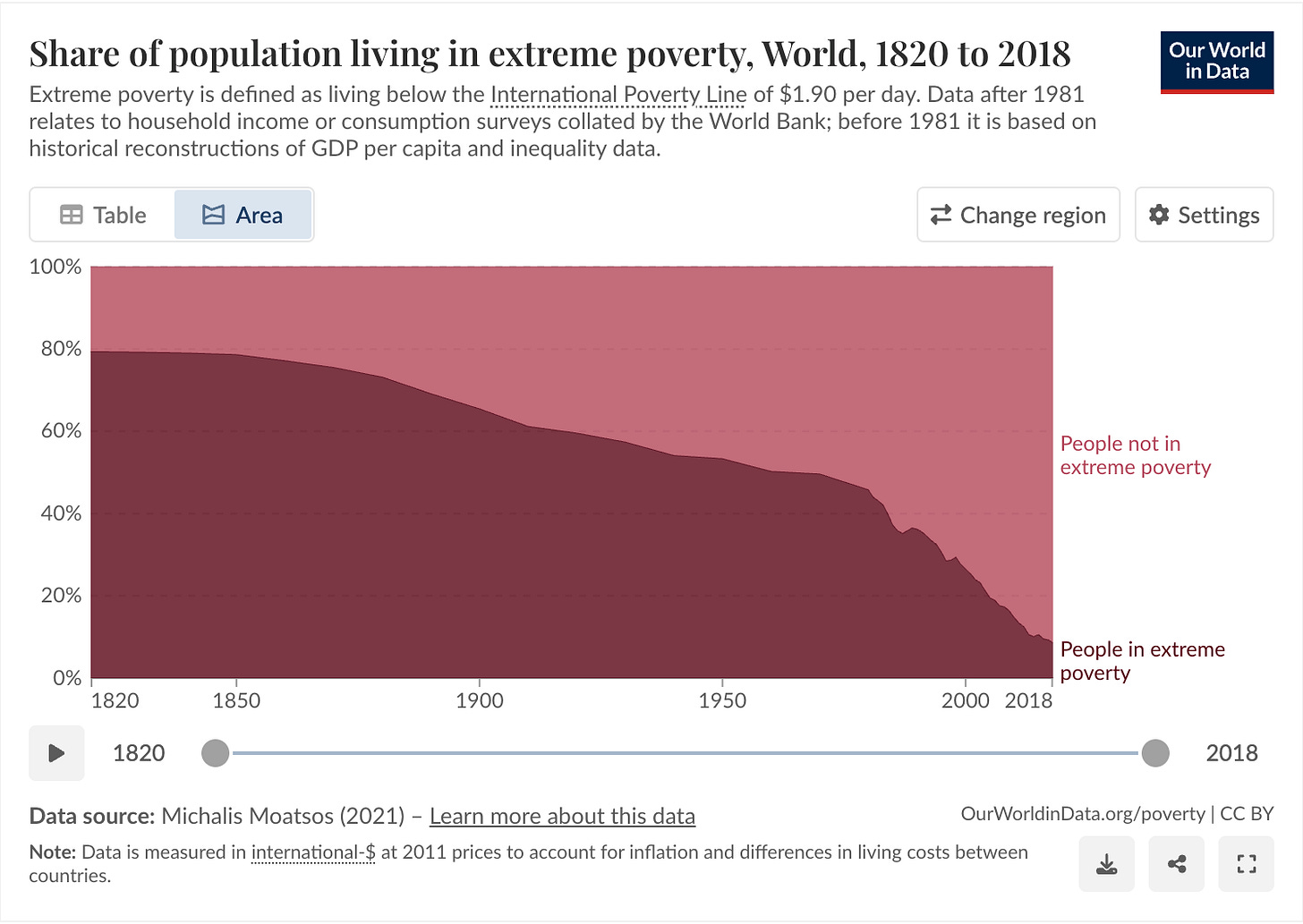
As I say, capitalism’s greatest achievement has not been eliminating inequality entirely. It has been dramatically reducing absolute poverty. According to long-run estimates compiled by economist Michalis Moatsos, the overwhelming majority of humanity lived in extreme poverty in 1820, unable to reliably meet basic needs such as nutrition and shelter. Today, in the developed world, that figure is close to zero, and globally it has fallen to a small fraction of what it once was. The World Bank also notes that two centuries ago most of the world’s population lived in extreme poverty, and that economic growth proved that widespread deprivation was not inevitable.
Please understand that I am not suggesting this means hardship has disappeared. There are still people struggling to pay bills, afford housing, and to get ahead. Those are real problems and relative poverty can still be an awful struggle. But when Green politicians point to inequality as evidence of systemic failure of capitalism, they blur the distinction between people lacking necessities and people having less than others.
Capitalism has succeeded in reducing absolute poverty on a scale unprecedented and now we should find ways to improve it to deliver less inequality, but why hate the system that has brought us thus far? The societies that have done the most to eliminate genuine deprivation have overwhelmingly been market economies that embraced private property, investment, entrepreneurship, and economic growth. The historical story of the last two centuries is not that redistribution conquered poverty. Wealth creation did.
Incidentally, I find it fascinating that acknowledging this has somehow become controversial. We are living through the greatest reduction in human suffering ever achieved and parts of the modern-left talk about capitalism as though it has been an unbroken catastrophe. It’s a bit like looking at modern medicine, noticing some side effects, and concluding antibiotics were a mistake.
So before we let politicians decide how to divide the pie, it is worth remembering how the pie became so large in the first place.
The Green Party’s policy document barely acknowledges any of this. Its worldview is not one of understanding of the crucial role of private wealth creation, but resentment of it. “Corporate greed” is a slogan and used as an explanatory model. Supermarkets, banks, energy companies, landlords, big tech firms, and high-net-worth households are cast as villains hoarding resources from everyone else. The Greens say that when a small group controls “money, property, and business”, everyone else is forced to compete for what is left. That is a zero-sum imagining of the economy that is wrong both in theory and in practice. One person’s success in building a company does not mean another person has had wealth removed from them. A growing economy is the whole point of market capitalism. Value creation.
Politics built on envy produces bad policy and a lot of resentment. The moment a political movement starts trying to make you angry at your neighbour for being more successful than you, it is usually worth stepping back and assessing why. There is a massive difference between asking whether the tax system is efficient and fair, and starting from the premise that the existence of rich people is itself a problem. The Greens repeatedly mix these up. Their language of “fair share” sounds moderate, but the thing actually powering this package is resentment. They convey that the rich have too much and that its why you have too little. The implicit message to voters is that your problems are caused by someone else’s success, and the state can fix things by taking more from them. Once you hate those richer than you, the threshold of how much richer is able to be shrunk as the economy shrinks. We have a number of examples from the 20th century that show why this is not only an awful idea, but one that has resulted in atrocities.
Let’s look at what is being proposed. The Greens’ wealth tax is a proposed 2.5 per cent annual tax on net assets above $10 million and this may sound modest to those of us who do not have businesses or assets. But as a tax on capital, it is severe because it applies regardless of whether the assets generate cash in that year. A founder with a valuable but illiquid company, a shareholder in a growing enterprise, or a person with large unrealised gains could face a tax bill that is wildly at odds with their actual income. In this kind of situation there would be immense pressure to sell assets, restructure holdings, reduce exposure, move capital offshore, or leave New Zealand altogether.
These are the basic mechanics of capital mobility. Wealthy people are not cartoon bad guys who we can throw darts at and expect to remain in the country employing us, injecting capital into businesses, and creating opportunities. They are investors, employers, lenders, donors, company founders, directors, and taxpayers with choices. We are not entitled to their capital and they are not required to keep it here. Their future investments are even more likely to disappear in that if New Zealand tells high-net-worth individuals that success will be taxed annually simply for existing (not its profits), many will not wait around patriotically to be harvested. Some will leave and others will not come in the first place. Others will use their expertise to legally manoeuvre the system to keep assets below thresholds, shift ownership structures, reduce investment, and direct their next venture somewhere more welcoming.
The Green Party attempts to manage these concerns by saying the tax applies only to the richest 0.3 per cent and that avoidance has been accounted for in their modelling. But if a tax affects a small number of people who control a large amount of investment capital (as the Greens say they do), the macroeconomic effect will still be significant. Otherwise they wouldn’t be bothering to do it, right? Modelling “avoidance” is not the same as modelling lost potential. A spreadsheet can estimate how much declared wealth might be taxed, but it cannot fully capture the companies never founded here, the expansions not made, the highly skilled migrants who choose Australia, the entrepreneurs who exit early, or the capital that is raised in Singapore instead of Auckland.
The Greens have understandably leaned heavily on the fact that Infometrics independently reviewed their numbers. Fair enough. If you’re proposing a massive tax overhaul, you’d want someone reputable checking your maths. But even Infometrics’ gentle review contains the important caveat that the costings were reasonable conditional on assumptions, but the behavioural effects of overlapping tax changes are difficult to model. That caveat is doing a lot of heavy lifting because the Green Party is not proposing just one isolated tweak to the system. It is proposing a stack of tax increases on wealth, inheritance, high incomes, large companies, banks, property investors, and multinationals at the same time. Each one of these changes behaviour and has been analysed based on sets of assumptions developed by the Greens. So “the costings are reasonable conditional on assumptions” is like saying the weather forecast is accurate, provided the weather behaves itself or a lion is perfectly safe, conditional on it remaining uninterested in eating you.
The capital acquisitions tax has the same problem with even more sentimentality and resentment. The Greens describe inherited wealth as “unearned” and argue that passing it down entrenches inequality. I find this argument particularly strange because it ignores one of the most universal human motivations. People don’t just work for themselves. They work for their children and so their grandchildren have opportunities they never had. If you asked most New Zealanders why they bother putting money into KiwiSaver, paying down a mortgage, or building a business, “to leave something behind” would be near the top of the list.
This framing contradicts the Greens stated commitment to collectivism and distaste for individualism. It treats wealth as an individual matter that is divorced from the wider collective of family and community. They may run into particular problems when applying this to Māori living in papakāinga environments. This number is estimated to be around 5,000 people currently, but this tax would disincentivise more communities and whānau from setting up these collective living arrangements. Unless the Greens intend to institute a carve out.
The Greens have carved out exemptions for standard family homes and farms. But that creates its own contradictions because if the concern is inherited advantage, why exempt the family home, when it is the single greatest source of untaxed wealth in New Zealand? The exemption makes the policy more politically palatable, but economically it reinforces one of New Zealand’s most challenging distortions in the over-allocation of wealth into housing rather than productive enterprise. If you tax financial assets and business wealth while exempting the family home, you encourage exactly the behaviour New Zealand should want less of: the sheltering of wealth in expensive residential property.
The new 45 per cent top income tax rate over $160,000 is also more aggressive than the Greens pretend. The party frames it as affecting only those who can “contribute a bit more”. But $160,000 is not huge wealth. In Auckland or Wellington, for example, it captures senior professionals, specialists, managers, engineers, doctors, lawyers, small business owners paying themselves through income, and households already facing high housing costs and mortgage pressures. It also doesn’t take into account the families who might live off one larger income so the other parent can stay home. Our demographic decline should mean we are supporting families to have more flexibility in their choices.
A 45 per cent marginal tax rate also doesn’t exist in a vacuum. Add existing drags on income like ACC levies, GST, rates, fuel excise, and inflation, and the effective burden becomes much higher. At some point, high earners reasonably might ask why they should take extra shifts, accept a promotion, grow a business, or even remain in New Zealand when the reward for additional effort is so heavily taxed by the state. New Zealand already struggles with productivity, scale, capital flight, and retaining talent. Raising the top rate sends the wrong signal to exactly the people with the most options to look elsewhere.
The corporate tax proposal repeats the same error at a corporate level. The Greens would raise the corporate tax rate from 28 per cent to 33 per cent for companies with annual turnover over $30 million. This is presented as a tax only on the biggest 0.7 per cent of businesses, especially banks, supermarkets, and energy companies. But turnover is a crude threshold as it does not necessarily indicate profitability. A high-turnover, low-margin business is a very different beast from a high-margin one. Taxing on the basis of size does not make sense.
Corporate taxes are also not primarily paid by faceless bogeymen based overseas, they are ultimately shouldered by New Zealand shareholders through lower returns, workers through lower wage growth, and consumers through higher prices.
One reason many successful economies have spent decades lowering corporate taxes is that investors have passports too. They also have accountants, lawyers, and an internet connection. If one country makes it harder to do business, there is usually another country happy to roll out the welcome mat. Investment flows to places that reward rather than punish business activity. Ireland is perhaps the most dramatic example, with its 12.5 per cent corporate tax rate. Lowering this tax helped transform Ireland from one of Western Europe’s poorer economies into a major hub for global investment, attracting companies such as Apple, Google, Microsoft and Pfizer. Singapore followed a similar path, combining relatively low corporate taxes with a pro-business environment to become one of the wealthiest nations on earth despite having almost no natural resources. Tax rates are not the only thing that matters, but they do matter a great deal. Countries that want more investment, innovation, high-paying jobs and business creation generally, compete to lower barriers. Countries that choose to tax successful firms more heavily because they are successful often discover that investment is far easier to drive away than it is to attract back.
New Zealand’s economic problem is not that we have too many large, successful companies in any case. We have too few. We need more firms that can operate at scale, export, invest in technology, lift productivity, and pay higher wages. So a policy that tells businesses “once you get big enough, your tax rate goes up” is an ambition killer.
The Greens are relying on the emotionally satisfying reflex to punish, because voters harbour dislike for supermarkets and banks, but tax law should not be based on lashing out or emotional reactions. Simply raising the company tax rate on larger firms will not magically produce fairer markets. Tax law should be based on on the cold, hard facts of what makes New Zealand a more attractive place to build large firms and invest.
Similarly, the bank levy is pitched as fairness but likely to be passed on to consumers. Banks are not going to absorb costs out of a kind of moral duty. They pass costs through where market conditions allow via interest, fees, lending criteria, or reduced returns to shareholders.
In New Zealand, where the banking system is dominated by Australian-owned banks, it is easy to weaponise the politics and say “tax the banks”. But it will be borrowers, depositors, and customers who pay a good chunk of it. A policy should be judged by who ultimately bears the cost, not who appears on the original invoice.
The big tech withholding tax proposal has more intuitive appeal because multinational profit shifting is a legitimate issue. There is reasonable public concern when corporations earn significant revenue from New Zealand consumers while booking profits offshore. But even in this space with a legitimate case for change, the Greens are not acting coherently. Though it must be said, there is something wonderfully Kiwi about believing a political party from a country smaller than many cities can simply inform Google, Amazon and Microsoft that the rules have changed and expect them to nod politely.
New Zealand’s small market presents another risk here. We rely heavily on access to global technology, capital, platforms, payment networks, software, cloud services, and investment. A country of five million people should be careful about pretending it can unilaterally rewrite the economics of global commerce without consequences. The better path is coordinated international reform, clear rules, and enforcement of existing laws where breached. Turning big tech taxation into another front in a populist war against “corporate greed” may win applause, but it is likely to see us suffer predictable consequences.
The re-removal of interest deductibility for residential rental properties is a continuation of a manipulative narrative that has been fed to New Zealanders ad nauseam this term of government. They also say they will restore the bright-line test to 10 years. The Greens describe the coalition’s reinstatement of interest deductibility as “landlord tax cuts” and argue that property investors receive special treatment over wage earners. This is frankly deliberate misinformation and the Greens, Labour, and Te Pāti Māori have used it heavily. Interest deductibility is not a tax cut nor any type of special loophole. It is a normal feature of taxing business income because expenses incurred to earn income are generally deductible. Rental owners should be able to deduct interest, as other businesses do, because the government already treats them as a business by taxing income from rentals. So, just as other businesses are entitled, the cost of borrowing to produce that income should logically deductible. Removing deductibility, as Labour did, taxes revenue rather than profit, which is an assault on a fundamental rule of taxation.
And again, increasing costs on businesses results in increased costs for customers, in this case renters. Landlords facing higher tax costs will try to recover those costs through higher rents, where possible, or they will sell up. Some sales may go to first-home buyers, but it will also reduce rental supply. In a housing market already constrained by land-use rules, infrastructure bottlenecks, migration pressures, and slow construction responsiveness, reducing rental supply will hurt the sizeable population who rely on rentals as they cannot afford to buy. Interest deductibility settings are a large reason why, between late 2017 and late 2023, the national median weekly rent increased by roughly $180, rising from about $400 to $580. The Greens call it a “tax on landlords”, but it turns into a tax on renters.
The bright-line extension to 10 years has a different problem. If the Greens believe New Zealand should have a comprehensive capital gains tax, they should argue for one honestly. Despite National’s creative comms and sleight of hand, the bright-line test is a quasi-capital-gains tax on residential investment property. Extending it from two years to 10 years captures more transactions but does not address the underlying incoherence of the policy. It also reduces liquidity, again strangling the housing market, by discouraging sales within the bright-line period.
Now, here comes the sugary sweet political sweetener: the income tax cut. The Greens say 96 per cent of New Zealanders would receive a tax cut, with the first $10,000 of income tax-free. A tax-free threshold is not inherently bad and many countries have one. There are good arguments to be made for reducing tax on low earners in order to improve work incentives at the bottom. But in this package it functions as a redistributive bribe funded by a barrage of new taxes elsewhere so it is hard to view it isolation. Someone earning $40,000 may be $27 a week better off and someone earning $90,000 may be $10 a week better off. But those gains are tiny relative to the potential economic costs of discouraging investment, raising rents, reducing business expansion, and chasing away capital.
What is most sad about this package is how little faith it has in people. In our fellow New Zealanders. It casts every entrepreneur as an exploiter, every large company as greedy, and every landlord as evil. Every successful person is viewed as a potential source of revenue to be tapped by politicians who have generally spent very little time adding to the country’s wealth given they depend on our taxes for their salaries.
If the Greens were proposing just one of these measures, we’d be having a very different debate. But they’re not. They’re proposing a wealth tax, an inheritance tax, a higher top income tax rate, higher corporate taxes, a bank levy, property tax changes, and new taxes on multinational capital all at once. Every road that investment can take into New Zealand seems to have a toll booth being erected on it.
Herein lies the basic problem with redistribution-first politics. It focuses on visible transfers and ignores invisible losses. Voters see the promised weekly tax cut, but not the wage growth that they miss out on because investment falls. They do not see the jobs that are never created, contributing to unemployment. Nor the rental properties not built, the infrastructure cancelled, the specialist who leaves for Sydney, or the investor who decides New Zealand is simply too hostile to success.
Ordinary people depend on the wealth-creating capacity of markets far more than they depend on the state’s ability to redistribute after the fact. Governments cannot redistribute wealth that does not exist. Every hospital bed, teacher’s salary, benefit payment, fixed pothole and public service ultimately depends on somebody somewhere creating value first that can then be taxed. Politicians must remember that government spending is only possible because prosperity exists. Throttling growth will ultimately throttle the amount that can be taxed even if the Greens layer more and more taxes on us. We will all simply be poorer.
The Greens will object that the kind of analysis I have done here is defending the wealthy. It is not. I am a renter and a millennial. If anyone should be receptive to the argument that the system is unfair, it is probably me. I have every incentive to embrace a politics that promises to tax somebody richer and hand me a slice of the proceeds. The reason I don't is because I would rather live in a country that creates wealth than one that spends its time arguing over who gets the last scraps.
I believe we do need to find pro-market ways to improve the ability of younger generations to entry the property ladder and grow their own wealth. What I am defending are the conditions that allow wealth to be created in New Zealand rather than somewhere else. A country, and therefore its people, does not become prosperous by making decisions based on emotionally satisfying people who resent the wealth of others. It becomes prosperous by attracting builders, investors, workers, founders, engineers, exporters, and risk-takers. It becomes prosperous by making itself a place where ambition is welcomed, wealth is created, and productivity is high, not a place where wealth is audited for political purity and often-tried failed policies.
The Green Party says, “The Big Rip-off ends here.” But the real rip-off is convincing voters that prosperity can be redistributed into existence. It can’t. Wealth has to be created before it can be taxed and investment has to happen before wages can rise. Businesses have to grow before public services can be funded and people have to believe success is possible before they will take the risks to build businesses. These are the laws of attraction and basic incentives.
The Greens’ tax plan is not remotely a growth agenda. In fact, to them “growth” is a dirty word. They are on a moral crusade against wealth, dressed as fiscal reform. They are entirely dependent on the fantasy that the state can tax its way to abundance.
Some definitions:
- illiquid: an asset that cannot be quickly converted into cash without taking a significant loss in value. It can also describe an individual or business that lacks the ready cash needed to pay immediate debts, even if they have a high net worth on paper.
- unrealised gains: the potential profits on an investment that has increased in value but has not yet been sold. Because the asset is not sold, the gain exists only on paper and has not been converted into actual cash.
- capital flight: the rapid, sudden outflow of large sums of money from a country. It occurs when investors or citizens rapidly move their assets out of a domestic economy to avoid anticipated financial losses.
- tax avoidance vs tax evasion: avoidance is the legal practice of using existing tax laws to minimise your tax liability. Tax evasion is the illegal practice of not paying taxes, which involves deliberately hiding income, falsifying records, or inflating expenses.
- papakāinga: a Māori term describing communal residential developments built on ancestral, multiple-owned Māori land encompassing intergenerational communities, which can include housing, shared gardens, marae, and commercial spaces.
- withholding tax: an income tax deduction withheld at the source. Instead of a recipient receiving a full payment and paying the tax later, the payer deducts a set portion and sends it directly to the government on the recipient’s behalf.
- bright-line test: a clearly defined, objective legal or tax standard that leaves no room for ambiguity or subjective interpretation. The term is heavily used in New Zealand tax law to determine if the profit from selling residential property is taxable. Under current rules, if you buy and sell a residential property within a two-year window, any profit is generally taxed as income.
- marginal tax rate: the rate of tax paid on the next dollar earned. For example, a person in a 45 per cent tax bracket pays 45 per cent only on income above the relevant threshold.
This article was originally published by Thought Crimes.