Ani O’Brien
Like good faith disagreements and principled people. Dislike disingenuousness and Foucault. Care especially about women’s rights, justice, and democracy.
I have written about social media and children a few times now, but because National has finally announced actual legislation, it seems worth covering once more. I am not opposed to restricting children’s access to social media. I think the evidence of harm is sufficiently serious that governments are justified in acting, and I have little patience left for people who dismiss the whole thing as another moral panic about whatever technology the youth are using this decade. Jonathan Haidt’s The Anxious Generation brought together a substantial body of research on the deterioration in adolescent mental health during the smartphone era, while Freya India’s Girls describes what it is like for girls to grow up carrying an audience around in their pockets. I highly recommend reading both.
The architecture of social media is deliberately addictive, children are particularly susceptible to it, and pretending otherwise in the name of some absolutist conception of liberty is not a position I share. This has resulted in me being called a “luddite” among other things. Funnily enough I find myself more at liberty to discuss this now.
It is my firm belief that primarily parents, but also the state in some circumstances, have a solemn responsibility to protect children and that because of this children do not have the same freedom rights as adults. We do not allow them to drink alcohol, enter into contracts, or drive until a designated age, for example. Parents should be the number one protectors and decision makers for their children, but legislation and the state can take action to support them in this and pick up the slack where absentee parents exist. I want to be clear that I do not think the state should interfere in families as much as it does these days. And yet, I still think parents would be aided by the government making it easier for them to say no to their kids about social media.
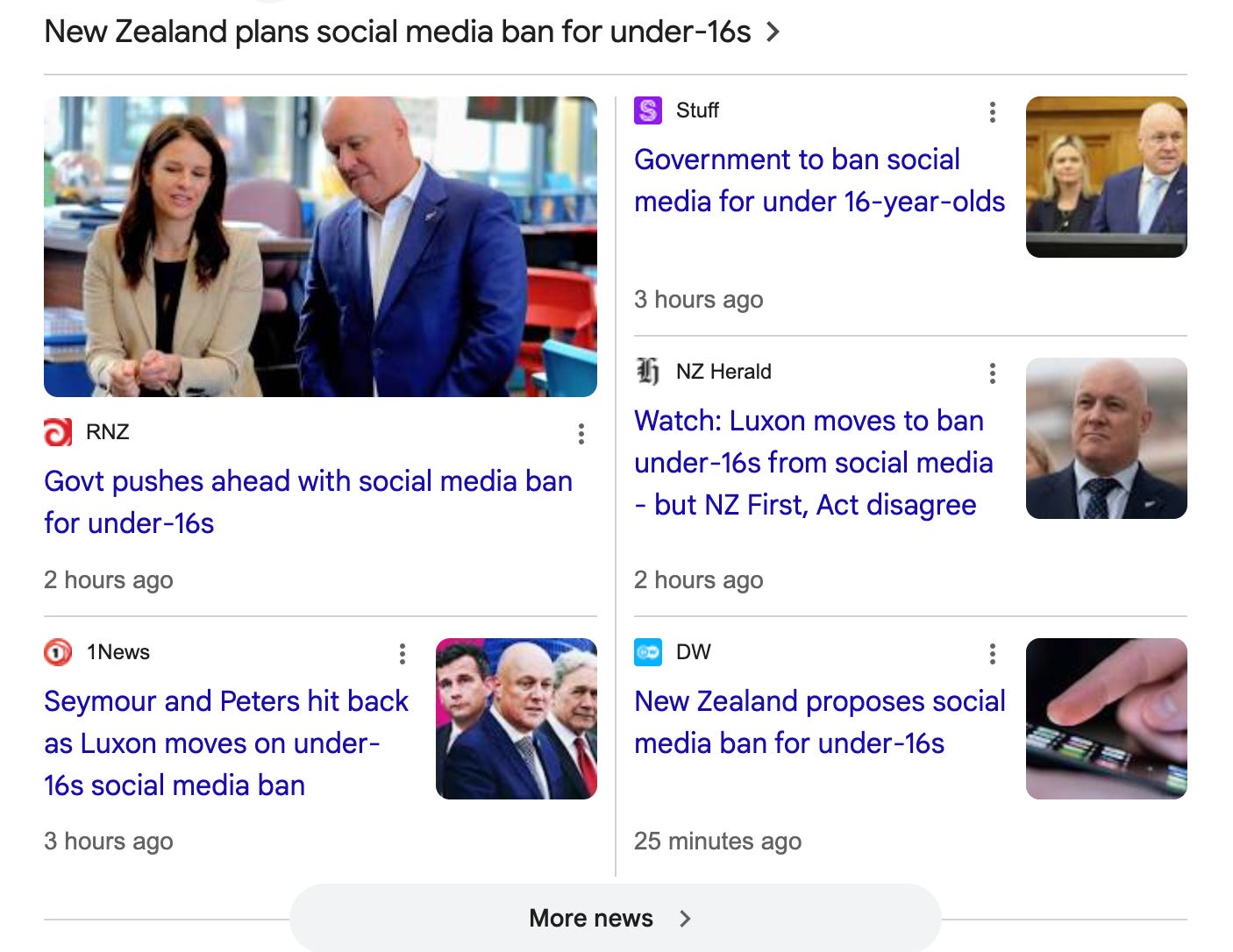
My opposition to National’s proposal has therefore never been about its objective. It is the mechanism that it seems determined to use, despite its failure in Australia. National’s bill would require so-called ‘high risk’ platforms to take “reasonable steps” to establish that users are at least 16. Those steps can include existing account information, facial age estimation, digital ID services, and formal identification. The regime would apply to platforms including Facebook, Instagram, Snapchat, TikTok, YouTube and X, while primarily messaging services, online games, and various other services are excluded. An online safety regulator inside the Department of Internal Affairs would monitor and investigate compliance, with penalties potentially calculated as a percentage of a company’s global revenue.
At their press conference to announce the legislation, Christopher Luxon said the government cannot accept the harm being done to children, while Erica Stanford described the bill as an “enduring framework” that will evolve with technology. Luxon is right about the harm and Stanford is right that technology companies bear some responsibility for products deliberately designed to consume attention. But National has not convinced me that their legislation will actually keep children off social media without substantially changing the relationship every New Zealand adult has with the internet.
This is the problem I keep coming back to. If an internet service must establish that I am an adult before allowing me to use it, the service must have some means of establishing something about who I am. Perhaps that involves formal ID, a third-party digital identity service, or maybe they are hoping that facial age estimation eventually becomes good enough to establish age without establishing identity. I am more open to genuinely privacy-preserving age-assurance technology than I am to universal identification. But the burden of proof should sit very heavily on the people proposing it. The internet is now one of the principal places in which people speak, organise, conduct business, find information, and participate in politics. Anonymous and pseudonymous speech exists for very good reasons, even though I wish fewer people would make use of it, and governments should require an exceptionally good reason before making identification the price of participation.
National’s “reasonable steps” approach also looks like an attempt to avoid confronting the actual problem. A weak age-assurance system is easily circumvented by determined teenagers and therefore does not accomplish what the legislation supposedly exists to accomplish. But, a stronger system would become progressively more intrusive for everyone else. Australia has already demonstrated the obvious difficulty with trying to build a digital fence around teenagers, who possess the combination of technical competence, spare time, and bloody-mindedness that has allowed teenagers to evade adult rules since the beginning of time. And so, failed enforcement inevitably creates political pressure for escalating enforcement. Age verification will fail and so somebody will start talking about banning VPNs. When that fails perhaps device monitoring becomes attractive and eventually we discover that we have rebuilt the internet around proving who is permitted to access it because 14-year-olds kept finding workarounds. Governments do not generally respond to the failure of their flagship regulation schemes by cheerfully dismantling them.
Now, I acknowledge that my position on this bill is not a majority one. I know for a fact my openness to legislation that will actually work has infuriated some of my freedom-loving peers. But we are likely in the minority anyway, because there is a lot of support for government action in this space. That support diminishes as you talk about the methods and impacts of action, but there is a fair bit of support for it nonetheless. National correctly identifies something that is worrying an enormous number of parents. They have committed themselves publicly to doing something about it, and are now trying to construct a regulatory solution capable of fulfilling the promise. Luxon has said he will “die trying” to make the ban happen. That is stirring stuff, I suppose, but determination is not a great substitute for workable policy.
Reporting has referred to this as a “government bill”, but the coalition is split on it. ACT and New Zealand First are both exercising their agree-to-disagree provisions and opposing National, meaning National needs opposition support to get its bill through its first reading. David Seymour’s objection is essentially what I have already outlined in that if they make the system weak the teenagers will circumvent it, but if they make it strong adults will be caught in it. Winston Peters has gone further, warning that enforcing such a regime pushes governments towards digital ID and restrictions on privacy technologies. Both parties acknowledge that there is a problem to be solved but they do not believe this is the solution.
As I argued in a previous Substack, I think we are tackling the wrong end of the problem. We normalised giving children the most sophisticated communications devices human beings have ever possessed then started frantically designing systems to prevent them using the applications those devices were built to deliver. Children do need to be able to call their parents, but they do not need smartphones. A basic phone provides the safety and communication parents want without placing TikTok, Instagram, pornography, algorithmic rabbit holes, and the entire accumulated lunacy of the internet in a child’s pocket 24 hours a day.
Hear me out: Ban the hardware not the softwareAni O’Brien 12 Jul
So I remain much more attracted to the idea of banning the hardware before banning the software. We could restrict the sale and possession of smartphones for under-16s while permitting basic phones. Make it unlawful for under-16s to hold social media accounts, but place the primary responsibility for that rule on parents rather than constructing a system under which every adult internet user must continually demonstrate eligibility to technology companies. That will not achieve perfect compliance because nothing will. Some parents will ignore it and some teenagers will evade it, just as some teenagers obtain alcohol. The purpose is to change the default expectation and support parents who do not want to give their 13-year-old a smartphone, but who are currently forced to fight a culture in which everyone else has one. Law can change that norm without pretending that every breach must be technologically impossible.
There is a genuinely reasonable position available here, although our political debate keeps trying to pretend there is not. We can recognise that children are different from adults and require protection from products designed to exploit immature judgement, while remaining ferociously protective of the privacy and liberty of adults. We should expect parents to exercise responsibility while giving them laws and social norms that make doing so easier. We must also demand that technology companies address genuinely harmful product design without handing a government regulator an ever-expanding mandate over lawful adult communication. I argued in July that protecting children and protecting freedom become competing objectives only if we design policy badly enough to make them so. I have not changed my mind.
I want children off social media and for parents to have considerably more support in keeping them off it, and I am perfectly prepared to support law to help achieve that. But I will not accept that saving childhood requires turning the adult internet into an identification checkpoint, nor will I applaud a policy merely because its architects have attached the words child safety to it.
This article was originally published by Thought Crimes.