
Table of Contents
Anyone who tells you ‘the science is settled’, either doesn’t know what they’re talking about or is trying to sell you something. In the latter case, it’s all too often a case of so-called ‘post-normal science’, which explicitly posits that ‘policy influence’ is more important than ‘rigorous truth-telling’. In other words, it’s propaganda, not science.
When it comes to much ‘settled science’, most lay-people are unaware of just how flimsy the foundations often are. Take, for instance, claims of rates of species loss. As Bjorn Lomborg amply illustrated in his The Skeptical Environmentalist, these claims almost always boil down to an ‘I Just Reckon’ by biologists who are more often than not activists as well.
That goes even more for claims of pre-historic rates of species loss – even the ‘settled science’ of mass extinctions. A small group of palaeontologists are challenging the very idea of mass extinctions. Even the so-called ‘Great Dying’.
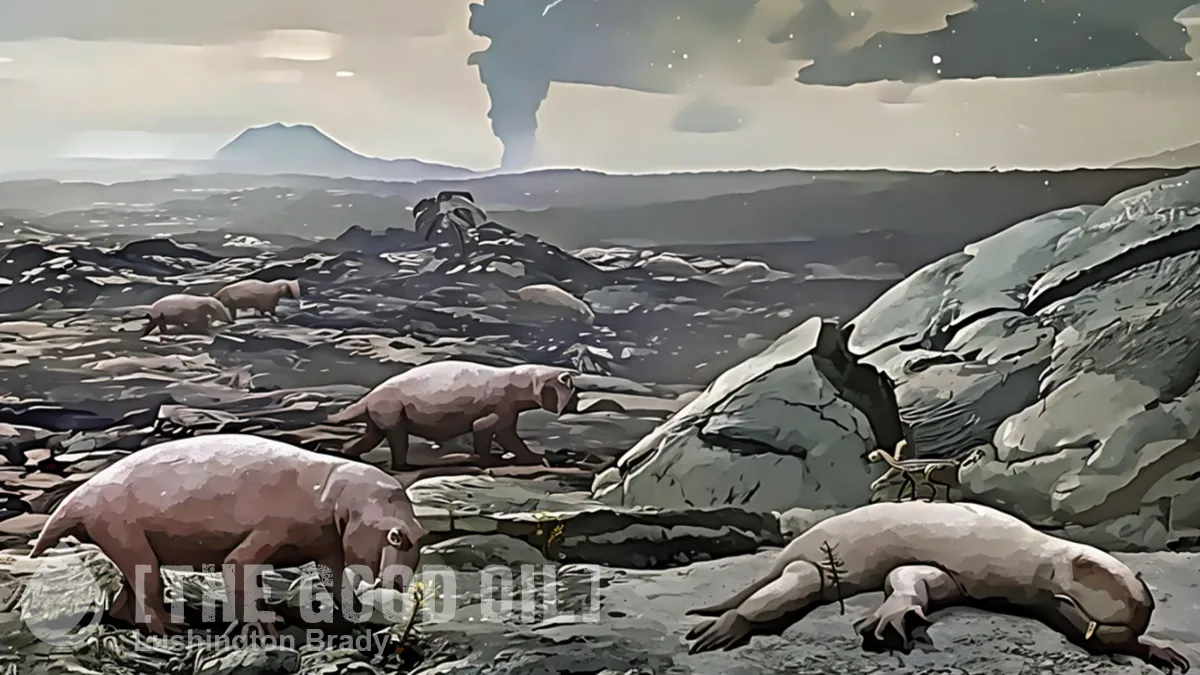
The end-Permian mass extinction was the deadliest event in Earth’s history. Also called the Great Dying, it is thought to have nearly wiped out all life on Earth 252 million years ago.
But was it? A recent discovery at South Taodonggou, in China’s remote Xinjiang province, revealed an ecosystem where plants and animals were thriving just 75,000 years later – the barest fraction of a geological tick of the clock. Meaning that it is almost certain that this spot at least never had any ‘great dying’. Perhaps it was an isolated miracle.
Or, as some scientists are arguing, it’s a textbook case of what Einstein said: it only takes one to prove it wrong.
Palaeontologist Hendrik Nowak at the University of Nottingham, UK […] points to fossil pollen from other sites that also suggests “little or only short-lived disruption” from the end-Permian event. In fact, Nowak argues that the impact was so minimal that – for plants, at least – there simply was no mass extinction then […]
This revolutionary rethink could rewrite the history of life on Earth. It would upend the idea that the continents have witnessed five mass extinctions – and it even has implications for how we frame the current human-induced biodiversity crisis.
The fossil record is like a vast stage shrouded in complete darkness, with only isolated candles shedding patches light on whatever drama was going on in the shadows.
Part of the problem is just how vanishingly unlikely it is that any individual animal or plant gets fossilised. Fossilisation favours certain types of living creatures – those with hard bones or shells, for example – and environments. An excellent book on human palaeontology once likened the fossil record to a vast stage shrouded in complete darkness, with only isolated candles, here and there, shedding light on whatever drama was actually going on.
A particularly favourable environment for fossilisation is the marine environment. Consequently, marine organisms are vastly over-represented in the fossil record.
Indeed, the idea that Earth has experienced five mass extinctions came from a 1982 analysis of the marine fossil record. Two palaeontologists, the late David Raup and Jack Sepkoski, tracked changes in marine biodiversity over the past half a billion years and noticed that the record was punctuated by five crashes. These were at the end of the Ordovician (445 million years ago), the late Devonian (372 million years ago), the end-Permian (252 million years ago), the end-Triassic (201 million years ago) and the end-Cretaceous periods, the latter being when most dinosaurs went extinct. These events came to be known as the big five.
So, it is fairly certain that mass extinctions hit ocean life hard. But that doesn’t tell us much about what was going on on dry land. Indeed, it was initially ‘settled science’ that there was little evidence to support a ‘Great Dying’ of tetrapods on land. (Tetrapods are four-limbed animals, including all reptiles, amphibians, birds, and mammals.) Which was true enough: due to the vastly smaller likelihood of land animals being fossilised than marine ones, the evidence just wasn’t there.
Over the next 30 years, though, a number of sites uncovered evidence that there were large species losses on land, in tandem with the marine holocausts. So, it became ‘settled science’ again that “Mass extinctions happen everywhere, all at once, on land and in the sea,” according to Paul Wignall at the University of Leeds, UK.
Spencer Lucas at the New Mexico Museum of Natural History and Science begs to differ. He points out that fewer than 20 genera, of the hundreds or even thousands in existence at the time, disappeared.
Since then, Lucas has taken a critical look at the rest of the big five. In a review published in 2021, he concluded that land-based tetrapods were barely affected by any of them. “I think that there’s a lot of hyperbole involved in this,” he says. “It’s a big deal that the non-avian dinosaurs go extinct at the end of the Cretaceous. That said, I don’t think it’s really a mass extinction.” He points out that plenty of other large, land-living tetrapods, including the crocodilians, survived. And, of course, we now know that one group of dinosaurs – the birds – didn’t go extinct, nor did the mammals. Lucas argues that tetrapods on land are in a better position to avoid extinction because air has a lower viscosity than water, which makes migrating to new regions following the deterioration of the local environment energetically less costly for land animals than for their marine counterparts.
Another often overlooked land animal are the insects.
In 2021, Sandra Schachat, now at the University of Hawaiʻi at Mānoa and Conrad Labandeira at the National Museum of Natural History in Washington DC assessed the fossil record of insects and concluded that the tiny animals seem never to have suffered a mass extinction.
Certainly, once-flourishing groups such as the dragonfly-like Palaeodictyoptera disappeared, but others rose to take their place. More importantly, the insect fossil record is extremely patchy. There’s a notable gap of around 20 million years near the end-Permian.
Twenty million years is a geologically long time for the insect corner of the stage to be shrouded in darkness. Who can say what was happening?
Over such a long period, insect communities can change gradually, but drastically, through evolution by natural selection alone. “When the fossil record is so incomplete that your best snapshots of a group of organisms come tens of millions of years apart, you’re going to expect to see big changes, with or without a mass extinction,” says Schachat.
As anyone who did high school biology in the ’70s or ’80s will remember, Nils Hellstrom showed just how well-equipped insects are to survive even the toughest of times.
Plants are another thorn in the side of the ‘Big Five Mass Extinctions’ narrative. Plant mass extinctions are vanishingly rare. Even in the ‘Great Dying’. While some genera, such as Glossopteris, vanished, others chugged along fine. Conifers appear to have flourished.
Half the species on Earth could vanish over the next 3,000 years, and it would still not meet the threshold of a mass extinction event.
If there were no Big Five mass extinctions, where does that leave the supposed Sixth? Is it really the First, or is it, like the others, a relic of incomplete (or biased) science?
Even the definition of ‘mass extinction’ is not ‘settled science’. Still, most agree that it requires the loss of at least 75 per cent of species over the course of several thousand years to around two million years. In today’s alleged ‘biodiversity crisis’, less than 0.1 per cent of known species have become extinct over the past 500 years. As one scientist puts it, half the species on Earth could vanish over the next 3,000 years and it would still not meet the threshold of a mass extinction event.





![[The Good Oil] April 2026 Political Poll](https://images.unsplash.com/photo-1540910419892-4a36d2c3266c?crop=entropy&cs=tinysrgb&fit=max&fm=webp&ixid=M3wxMTc3M3wwfDF8c2VhcmNofDk1fHx2b3Rpbmd8ZW58MHx8fHwxNzIyMzkxNTI4fDA&ixlib=rb-4.0.3&q=80&w=1304)

