Ani O’Brien
Like good faith disagreements and principled people. Dislike disingenuousness and Foucault. Care especially about women’s rights, justice, and democracy.
The public debate over New Zealand’s Free Trade Agreement with India has been waging since New Zealand First announced they would not be supporting it. Depending on who you listen to, it is either a significant breakthrough that opens New Zealand up to one of the world’s most important emerging markets, or a rushed, low-quality deal that gives away too much while delivering too little in return. Both sides are telling a version of the truth. But neither, on its own, is sufficient to understand what has actually been agreed.
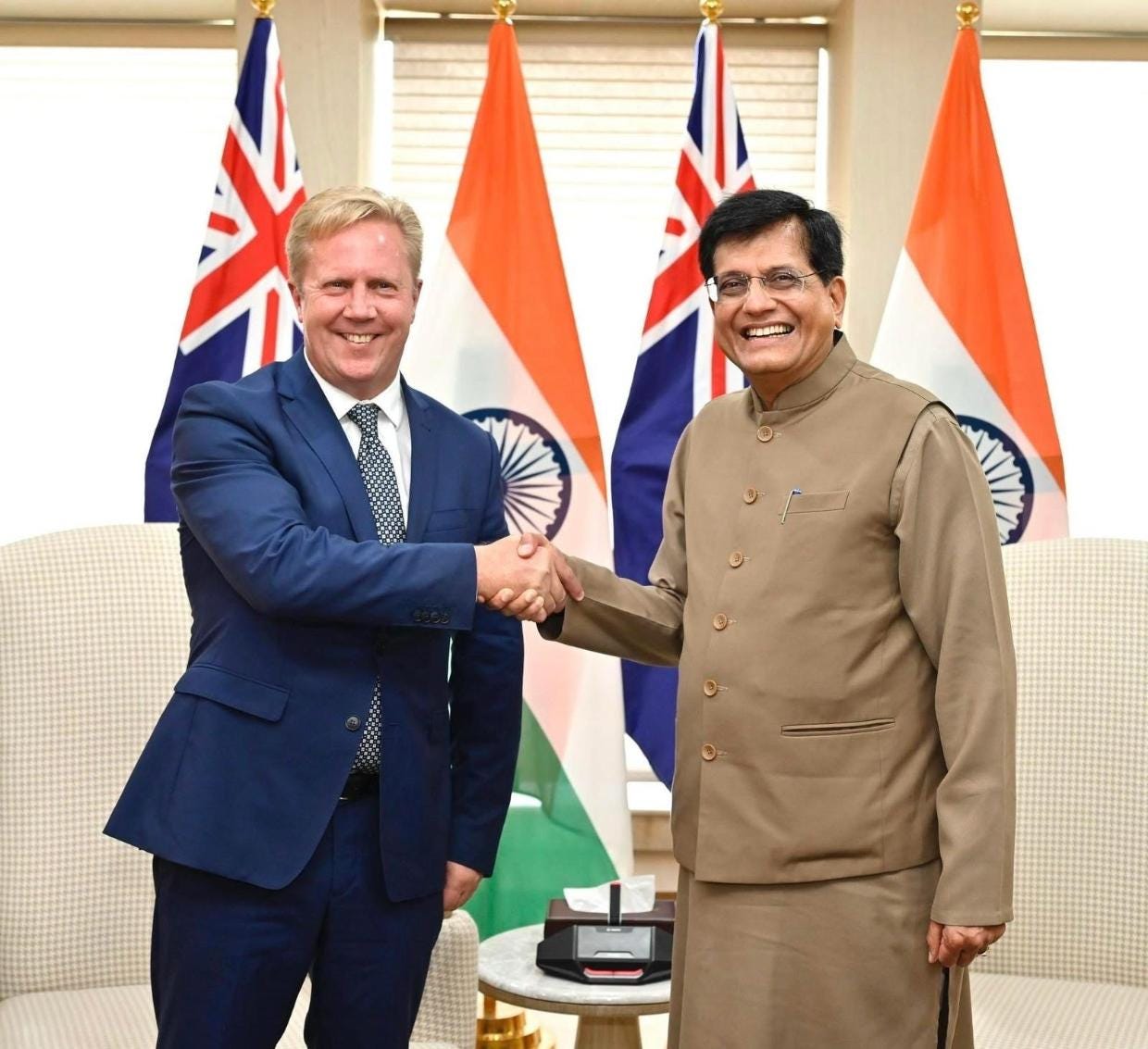
To make sense of the deal, it helps to start by stepping back from the rhetoric and mapping out the competing positions.
The government’s case (note: I will refer to the National/ACT position as the government as it is a government bill) for the deal rests on a strategic argument rather than an immediate economic one. India is the world’s most populated country and one of the fastest-growing economies. It is widely expected to become the third-largest economy in the world in the coming years. For successive New Zealand governments, gaining preferential access to that market has been a goal, and one that has proven stubbornly difficult to achieve.
From the government perspective, the agreement is a necessary step forward and a massive achievement. It reduces or eliminates tariffs on the vast majority of New Zealand’s exports, lowers barriers that have historically made trade with India prohibitively expensive, and gives exporters a more predictable framework in which to operate. Business groups have largely reinforced this view, pointing to sectors such as forestry, sheep meat, horticulture, seafood, and wine as clear beneficiaries. For them, the deal is less about immediate gains and more about positioning New Zealand in a market that is expanding in terms of size but also relative wealth.
There is also the wider geopolitical argument that in an increasingly uncertain global trading environment, diversification must be a strategic priority. New Zealand’s heavy reliance on a small number of markets, particularly China, is a vulnerability and even incremental gains in a market like India are viewed as mitigations. Their argument is not that this agreement transforms the economy overnight, but that it lays the groundwork for a deeper and more resilient trading relationship over time.
Even within this pro-FTA side there is a more sceptical view, however, particularly from within the rural sector and parts of the business community that feel the agreement has been oversold. This is not an anti-trade position and many of these sceptics are strong supporters of free-trade agreements in principle. Their concern is that this particular agreement does not live up to the standard implied by the government’s rhetoric.
The most obvious point of tension is dairy. New Zealand’s largest export sector, accounting for a significant share of our country’s goods exports, has secured only limited gains in the India FTA. Core products such as milk, cheese, and butter remain largely outside the agreement, reflecting India’s longstanding protection of its domestic dairy industry which is predominantly made up of very, very small herds and collectives that service local communities.
What has been included is relatively narrow and technical. The agreement provides some access for niche dairy products such as milk proteins and bulk infant formula ingredients, often subject to quotas or partial tariff reductions, and in some cases geared toward processing and re-export rather than direct sale into the Indian consumer market.
While industry groups acknowledge that these provisions are not meaningless, they argue the deal does little to shift the overall picture. The reality is that the agreement opens the door slightly at the margins of the dairy sector, but leaves the main structure firmly in place, which is why many in the industry don’t see it as a true breakthrough.
This scepticism extends to the overall economic impact of the deal. Official modelling suggests modest gains of around a 0.07 per cent to Gross Domestic Product (GDP) over a decade – nothing that could reasonably be described as transformative. That does not make the agreement worthless, but it does challenge the idea that it represents a major economic transformation. For critics in this camp, the issue is not that the deal is bad, but that it is being framed as something it is not.
A more forceful critique comes from New Zealand First, whose opposition is both broader and more emphatically stated. Their argument is that the agreement is not simply an imperfect trade deal, but one that gives away too much in areas that go beyond trade itself. Immigration sits at the centre of this critique. New Zealand First argues that the agreement creates new pathways for Indian workers and students, which in turn could increase migration pressures at a time when the domestic labour market is already under strain. They point to provisions for temporary work visas, student mobility, and post-study work rights as evidence that the agreement is as much about the movement of people as it is about the movement of goods.
Immigration-adjacent provisions are not new in FTAs. They are usually called “temporary movement of natural persons” and appear in many trade agreements, including New Zealand’s past deals. What is more unusual is the scale and political salience of the country-specific India mobility package, alongside a large investment-promotion target.
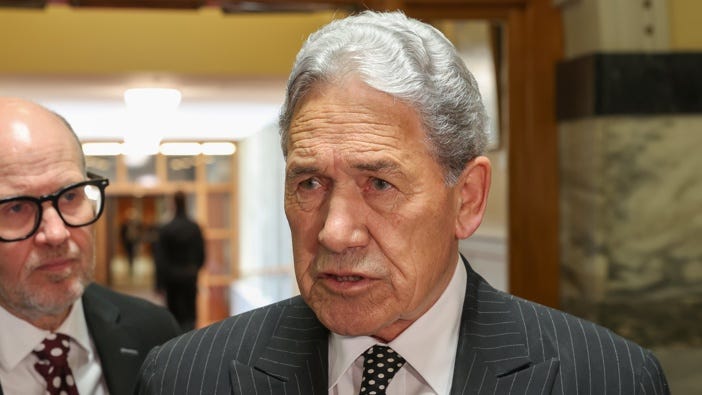
However, New Zealand First’s concern goes further than simply noting that mobility provisions exist in the agreement. Their argument is that the FTA actively changes the incentives around migration in a way that could materially increase migration flows from India, even if it does not legally mandate them. They see the combination of factors as creating a package that makes New Zealand a more attractive destination at scale. In their view, this is not just a technical extension of existing policy settings, but a targeted opening that is likely to be promoted aggressively in India itself, amplifying demand.
They highlight the 5,000 temporary worker cap and argue that, once family members are factored in, the actual number of people entering our country to stay long term could be significantly higher. They have cited figures of up to 20,000 people. The government counters that this is a hypothetical scenario, as family reunification remains subject to existing immigration rules rather than being guaranteed under the agreement. Nonetheless, those existing rules do allow many work visa holders to support applications for their partners and dependent children, meaning family members can often accompany them in practice, which increases the number of migrants significantly.
Thematically, New Zealand First’s concerns are about timing, burden on already under pressure resources, and labour market conditions. They argue that introducing new pathways, even controlled ones, risks adding pressure in a labour market where some New Zealanders are already struggling to find work, and that trade agreements should not be used as a vehicle to indirectly expand migration settings.
The (rest of the) government has pushed back strongly on this, insisting that the agreement does not create any automatic right to migrate to New Zealand and does not constrain the ability of current or future governments to set immigration policy. On the narrow legal point, that is correct. The agreement does not override domestic immigration settings, but New Zealand First’s criticism is not without foundation. The agreement does include structured pathways for temporary entry and student mobility, and these are likely to be promoted in India as part of the broader package. The reality is that both sides are talking about different aspects of the same issue. The government is focused on legal rights and constraints and New Zealand First are focused on behavioural effects and incentives. Neither perspective is wrong.
The second major concern raised by New Zealand First relates to the investment provisions. The agreement includes a commitment for New Zealand to “promote” a significant level of private sector investment into India over a 15-year period. That is around US$20 billion, which is approximately NZ$30–33 billion. Ministers have described this as an “aspirational” target rather than a binding obligation, emphasising that the government cannot compel private businesses to invest overseas.
Critics, however, point to language from the Indian side that suggests the commitment carries weight, including references to review mechanisms and potential remedial measures if expectations are not met. The commitment is not a straightforward legal requirement that can be enforced in the way tariffs can be, but it is also not meaningless. It creates a framework within which future pressure or negotiation could occur. The uncertainty lies in how these clauses might be interpreted over time.
A third area of contention is more political than economic. The agreement includes references to the United Nations Declaration on the Rights of Indigenous Peoples (UNDRIP) and preserves New Zealand’s ability to provide more favourable treatment to Māori under the Treaty of Waitangi. In practice, the reference to UNDRIP does not create new binding obligations in New Zealand law. The language makes clear that both parties recognise the declaration “as it applies within their respective legal systems”. It means UNDRIP is not being elevated above New Zealand law or given independent legal force through the agreement. It is meant to reflect existing positions not create new ones.
The Treaty clause similarly preserves policy flexibility rather than expanding it. Even so, this raises concerns about the incorporation of contested constitutional or ideological elements into trade agreements. It also sits uneasily alongside the government’s stated mandate to remove co-governance and race-based policies from the law and public service. However, the legal significance of these provisions in the agreement does appear to be limited. Their importance lies in how they are perceived politically, particularly in the context of ongoing domestic debates about Treaty principles and co-governance.
Labour’s position mostly aligns with the government on the India FTA although it reflects a more cautious support. The party recognises the long-term strategic value of the relationship, but naturally, in an election year, they do not want to give too much props to the government for anything. Labour has raised concerns about specific aspects of the deal, particularly around migrant worker protections and the potential for exploitation. Hipkins has also expressed unease about the process by which the agreement was developed, noting that Labour were brought into the discussion relatively late despite the government needing their support to pass the bill.
A number of commenters online have expressed frustration that the full text was not made public before being agreed to, but publishing the fine print after signing is not unprecedented. In New Zealand’s Treaty process, cabinet approves the final text and authorises signing, then the Treaty text and National Interest Analysis are presented to parliament. It is common for concluded texts to go through legal verification before release too. The NZ-EU process, for example, involved draft text, legal verification, signature, and then final text/NIA release. That said, it is understandable people are uneasy when a deal is being argued about publicly before we can read the full text. Not unprecedented, but not ideal for trust either.
When the political arguments are set aside and the agreement itself is examined, most positions reflect reasonable concerns viewed from different angles. The deal does deliver meaningful tariff reductions across a wide range of sectors, particularly those that have faced high barriers in the Indian market. It provides greater certainty for exporters and creates a framework for future engagement. But it also contains significant limitations. The exclusion of dairy is the most obvious, but not the only example. Many of the gains are phased in over time or subject to conditions, and the overall economic impact is modest in the short term.
On immigration, the agreement does include provisions for the temporary movement of people, but these are capped and conditional. They do not remove the government’s ability to control immigration policy. However, critics are quite right to point out that it is often the unintended consequences of deals and laws that cause the most bother in the long term. How the deal and its various parts are interpreted matters more than what the drafters intended at the end of the day.
On investment, the commitments are real but ambiguous. There are questions to be answered about what our legal and enforceable obligations are. What are the actual consequences for our private sector not delivering on the expected investment? Calling it “aspirational” is all very well, so long as there are not real consequences.
On constitutional issues, the provisions are politically sensitive and will get up the noses of many coalition voters, but its is legally constrained in practice. To be honest, the embedding of UNDRIP is symptomatic of the continuing tension that exists throughout New Zealand government where the Treaty of Waitangi and co-governance continue to be centred in policy and law despite promises from the government to address this. New Zealand First and ACT have both pointed fingers at National for the feet dragging.
When all of this is considered together, it is fair to conclude that the agreement is neither the triumph its strongest supporters claim nor the disaster its most vocal critics describe. It is something more typical of modern trade policy that acknowledges a negotiated compromise between two countries with very different economic structures and priorities. It opens doors, but sometimes only partially. It creates opportunities, but does not guarantee outcomes.
The most honest way to understand the India FTA is as a foothold. It gets New Zealand into a market that has long been difficult to access. It gives exporters a platform from which to build. But it does not resolve the fundamental challenges of trading with India, nor does it deliver the kind of sweeping gains that characterised earlier agreements, such as the one with China.
That may still make it worthwhile. But it also means that the public deserves a clearer account of what has actually been agreed. This is one issue in which New Zealanders can find useful information in the talking points of all parties contributing to the discussion. It hits on some of our most challenging hot button topics including our economy, over-reliance on the Chinese market, immigration, and stagnant productivity. The mere act of disagreeing and discussing the pros and cons of this deal has, in my view, been a positive example of how divergent views can exist even among those committed to similar outcomes. It is a reminder that disagreement in itself is not bad, nor is prioritising different aspects of governance. Ultimately the New Zealand people, when they are sufficiently informed of the various perspectives, can come to their own conclusions about whether this deal is a net positive or negative for our country. I will not be making that decision for them.
This article was originally published by Thought Crimes.