Table of Contents
The long-term physical effects of space travel on humans have been a theme in science fiction since at least the 1950s. In Cordwainer Smith’s Scanners Live in Vain (1950), deep space has such a profound and negative effect on the human psyche that spaceships are piloted by “scanners”: volunteers who have had their sensory nerves surgically disconnected. Passengers travel in hibernation. In several of his short stories of the same period, Arthur C Clarke (accurately) predicted that children born and raised on the Moon or other low-gravity planets would be forever exiled from Earth: their bodies would simply never be able to endure Earth gravity.
Indeed, ‘gravity torture’ is briefly shown in the excellent hard SF books and TV series The Expanse. “Belters”, born and raised in low-gravity environments, are tall and painfully thin, and can only even briefly visit Earth suspended in water tanks. Mars-born humans can endure Earth’s near-double gravity to some extent, but can only endure Earth’s sunlight with the aid of welding goggles. Historically, Mars was colonised by a mix of Texans and Indians, creating the memorable pilot, Alex Kamal (Cas Anvar), an ethnic Indian who talks like John Wayne.
At the other end of the spectrum, the “Jinxians”, in Larry Niven’s Known Space universe, grow up in a nearly two-g environment in the Sirius star system. As a result, they are very dark-skinned, and squat and muscular. They are also prone to heart failure. Perhaps as a consequence of their harsh lives, Jinxians are known for their sense of humour, which leans heavily to puns.
As these examples show, science fiction writers have long taken for granted that prolonged living in space, especially over generations, will profoundly alter humans. Not just physiologically, but psychologically and culturally. Many of these writers had relevant backgrounds and expertise (Clarke was a mathematician, physicist and technician and Smith a military expert in psychological warfare), but what, exactly, does science suggest will be the real-world effects? Evolution, after all, has not stopped short at Homo sapiens – and environmental pressures are the primary driver of evolution.
How will a Homo spatialis likely evolve?
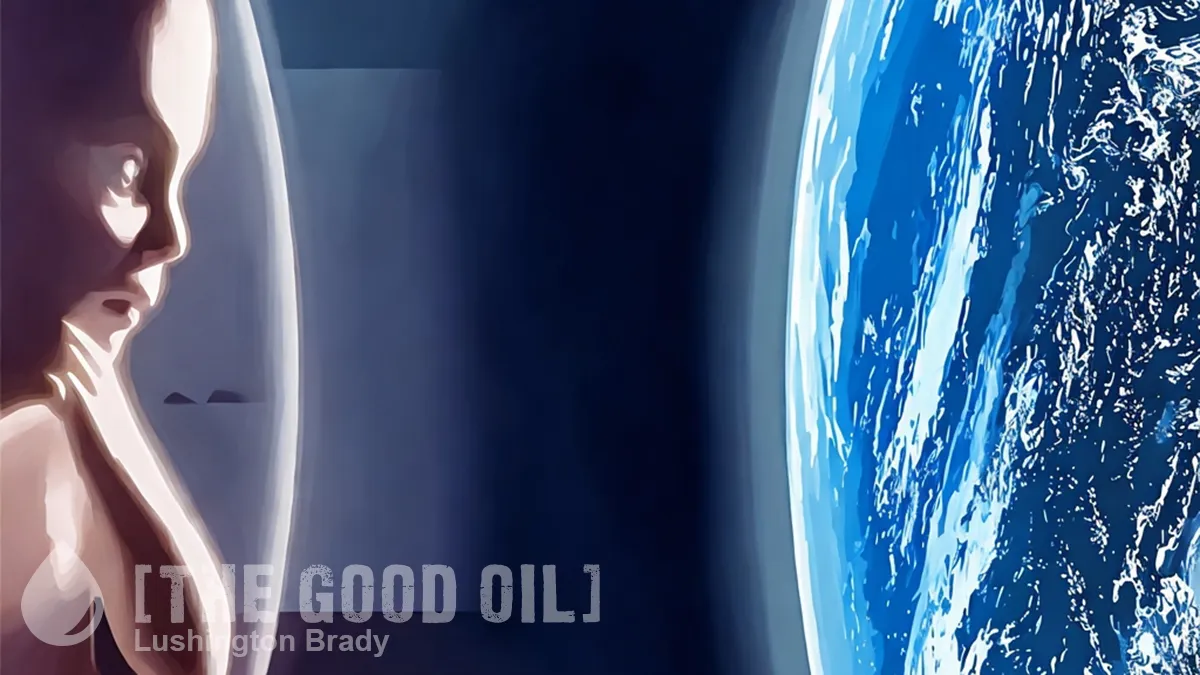
Evolutionary biologist Scott Solomon, in his new book Becoming Martian: How Living in Space Will Change Our Bodies and Minds (MIT Press), argues that “The colonization of other worlds will alter the very definition of what it means to be human.”
We already know that space changes adult bodies. “We know from astronaut studies that muscles get weaker, bones get more brittle because they’re not working as hard against gravity,” Solomon said. “We also know about vision changes. The eye has structural changes documented for astronauts like Scott Kelly who spent prolonged time in lower gravity.”
(After Kelly spent almost a year on the International Space Station, from March 2015 to March 2016, scientists found that the shape of his eyeball had changed, including developing a thicker retinal nerve and folds in the choroid layer that surrounds the eye, affecting visual acuity.)
The cardiovascular system weakens as well, because the heart no longer has to pump blood uphill in the same way. Fluids shift upward in the body. The human form, shaped by millions of years under Earth’s gravity, begins to subtly come apart.
But those were healthy adults who’d grown up in our native environment – Earth – and only spent relatively short times in space. What about potential future generations born and living their lives on other planets or in space itself? A minor subplot of The Expanse is that all Belter women go through pregnancy and birth on the Jovian moon Ganymede, where its natural magnetosphere shields the developing foetuses from the much higher radiation levels of space. But the Belters – derisively called ‘Skinnies’ by other humans – can never escape the effects of growing up in low gravity.
Bones, for example, do not simply thin in low gravity. They grow differently.
“As a child’s body is growing and developing in lower gravity,” Solomon said, “their bones might not form in the same way.”
The problem is not just weakness, but structure. Certain microscopic connections inside bone may never form without Earth’s constant downward pull.
“There’s this possibility,” he said, “that a child born in lower gravity wouldn’t form a skeleton strong enough to support being able to come back to Earth.”
Like the Martians of H G Wells’ The War of the Worlds, real-life Martian humans would likely find Earth to be a toxic soup of microorganisms.
The immune system presents an even deeper problem. On Earth, it’s trained from infancy by constant exposure to a vast and chaotic ecosystem of microbes. Every breath, every touch, every meal helps teach the body what is dangerous and what’s not. “But most microbes on Earth won’t be on Mars,” Solomon said. “We’ll take some by accident or on purpose, but it’ll be a tiny slice.”
It’s quite possible a child born and raised on Mars “would get sick if they come back to Earth,” he added, “because they’d have no prior exposure to the vast majority of microbes we breathe in every day.”
In theory, vaccines could help. In practice, the challenge is overwhelming.
“We have so many different kinds of microorganisms on Earth,” Solomon said. “We haven’t even discovered all of them, much less developed vaccines for the wide range a person would encounter when they take their first deep breath of Earth air.
And The Expanse’s Ganymede as a space-based maternity hospital?
“We know very little about pregnancy and childbirth in lower gravity,” Solomon said. “We do know bone density decreases in lower gravity.” Over a lifetime, that includes the pelvis. Solomon suggests that C-sections could become the norm for many Martian pregnancies.
Once that happens, evolution takes an unexpected turn. Natural selection no longer favors bodies shaped for unassisted birth. Over generations, larger heads and narrower birth canals become easier, not harder, to pass on. A population can slowly back itself into permanent dependence on surgery just to reproduce.
It’s the kind of feedback loop that rarely appears in glossy visions of space colonization, but sits squarely in the wheelhouse of evolutionary biology.
As Darwin realised, members of the same species, split into isolated populations, in different environments, quickly diverged. Similarly, human populations that settled remote islands developed distinct physical and cultural differences within mere centuries. Tasmanian Aboriginals were notably different to their Mainland counterparts. The Moriori, to their ultimate downfall, developed a rigorously pacifist culture, in stark contrast to their ancestral cousins, the hyper-warlike Māori.
Taken together, these changes point toward a future in which people born on Mars are not just culturally different from Earthlings, but biologically distinct. Solomon estimates that after 10 or more generations, spanning roughly 250 years, the accumulated effects of isolation, selection and immune divergence could make the two populations effectively incompatible. Not through deliberate genetic engineering, but through the same slow, inevitable mechanisms that have shaped life on Earth for billions of years.
Those are just the physiological changes. The cultural and psychological changes will likely arrive far sooner. In The Expanse, Earth, Mars and the Belt live in an uneasy state of mutual dislike, which breaks into open warfare. Belters speak an impenetrable (to outsiders) patois. In Known Space, non-Earth humans condescendingly despise ‘Flatlanders’. In both SF universes, Belters are conditioned by the precarious environment of space to be hyper-cautious and able to don a spacesuit as unthinkingly as we tie our shoelaces.
Colonies in the New World on Earth rapidly developed, culturally and linguistically, from their root stock – and that was just on the familiar environment of Earth.