Table of Contents
Nigel
Nigel is the founder, editor-in-chief, and lead writer at Pavlova Post, a New Zealand satire publication covering national news, local chaos, weather drama, politics, transport mishaps, and everyday Kiwi life – usually with a generous layer of exaggeration.
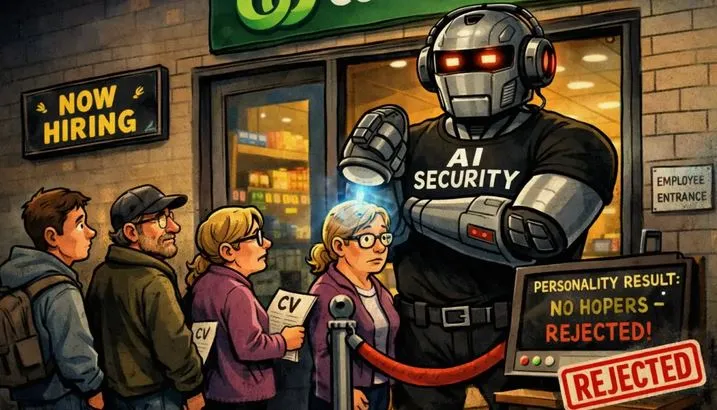
New Zealand’s entry-level job market has finally completed its transformation into a sci-fi side quest, with Woolworths applicants now discovering that before they can refill the milk, stack the chips, or politely point at aisle six, they may first need to survive what one applicant has already described as the AI bouncer. The real story is straightforward enough: more applicants have come forward describing bizarre personality feedback and apparent rejections from AI-run interviews tied to Woolworths’ recruitment process, while broader reporting today shows growing concern about AI screening in New Zealand hiring.
Which is grimly efficient, if you think about it.
Why waste a local manager’s time meeting a real teenager from Kapiti, or a warehouse worker, or a semi-retired customer-service veteran, when a machine can look at a few typed answers and conclude they are spiritually unfit to stand near the avocados?
What is actually happening with Woolworths AI job interviews?
The current backlash centres on applicants saying Woolworths’ AI interview process made strange assumptions about their personality and suitability for fairly ordinary retail roles. One Herald report says more people have now come forward, including applicants who felt the system was unfair to young people or blocked them before they ever spoke to a human. Woolworths told RNZ it uses AI tools in the initial stages for some roles, says hiring decisions are made by human leaders, and says non-AI alternatives are available if requested.
In other words, the official position is basically:
‘Don’t worry, the robot only guards the gate. A human still gets to approve who enters the kingdom.’
Very comforting stuff.
This is the workplace version of being told the nightclub doesn’t judge you on looks, because a real person inside still decides whether your shoes are too weird.
Why does this feel especially cooked for a supermarket job?
Because most New Zealanders still think a supermarket job should involve some version of: turn up, speak normally, seem reasonably awake, and demonstrate that you are unlikely to fistfight the trolleys.
Instead, applicants are now being filtered through a system that reportedly comments on things like self-belief, distractibility, emotional energy, and openness to new things. In one reported case, a 16-year-old received feedback suggesting his self-belief could alienate people. In another, an applicant said he had been rejected repeatedly without ever getting to speak to an actual person.
That is an astonishing amount of psychoanalysis for a role that may ultimately involve facing up the biscuits and asking someone whether they want their receipt.
Pavlova Post would like to stress that New Zealand has now reached a deeply modern point where a shelf-stacking job can apparently require the kind of personality scrutiny once reserved for reality TV casting, police psych screening, or becoming deputy principal at a school with ‘dynamic leadership opportunities’.
Why are people so uneasy about AI screening?
Because even people who like technology start getting twitchy when the machine moves from checking hard facts to making fuzzy calls about character.
RNZ’s reporting quotes Unite Union’s Gerard Hehir saying AI systems are effectively black boxes and can reinforce bias rather than remove it. The same story also includes concerns from Project Employ that people who are neurodiverse or simply a bit outside the expected mould may be disadvantaged by systems that seem to reward extroversion, eye contact, or polished communication. Victoria University AI lecturer Andrew Lensen said the country is drifting into a “slightly perverse situation” where AI-written applications are being read by AI screeners.
That last part may be the most New Zealand 2026 sentence imaginable.
We have somehow built a labour market where one robot helps write the application, another robot reads it, and then somewhere in the middle a human being with rent due is told their ‘energy profile’ may not align with frozen foods.
If you’re in Temuka, Timaru, Invercargill, or any other place where people still believe jobs should involve at least one actual conversation, the whole thing feels less like innovation and more like being politely ghosted by a vending machine.
The true genius of the AI bouncer system
What really elevates this into pure workplace drama is that it combines every Kiwi workplace irritation into one neat package.
There is the corporate insistence that the process is fair.
There is the low-level dread that no one local actually controls it.
There is the suspicion that somebody at head office described it as ‘streamlined’, which is corporate for ‘nobody can argue with the software because the software doesn’t attend meetings’.
And there is the especially bleak energy of watching entry-level workers get assessed like they are applying to become Air New Zealand chief pilot rather than trying to secure a roster that includes one Saturday shift and maybe the odd Thursday night.
If the current hiring ladder continues, applicants will soon be required to:
- submit a CV
- answer a chatbot
- pass a personality scan
- provide a five-year strategic vision for aisle recovery
- and reassure an algorithm that they won’t bring emotionally disruptive levels of enthusiasm to canned tomatoes
Will this become normal across NZ hiring?
It already appears to be broader than just Woolworths. RNZ reports companies such as McDonald’s and Woolworths are using AI to process applications at scale, and the wider concern now is not whether AI is present, but how much judgement employers are handing over to it in practice.
That is what makes this such a good story. It is not only about one supermarket chain. It is about the quiet national shift from ‘hand in your CV’ to ‘please convince a machine you have the correct emotional texture for part-time retail’.
New Zealanders are generally pretty tolerant people. We’ll put up with self-checkouts yelling at us. We’ll tolerate QR-code menus. We’ll even accept that every second service now comes with an app for no reason.
But there is something especially offensive about being told by a bot that your vibe is wrong for stacking mince.
At some point, a country has to draw a line.
And ideally that line is somewhere before the yoghurt fridge.
Grown-up links
1News/RNZ: Jobseekers disturbed as companies screen applications with AI
NZ Herald: More complaints arise about Woolworths’ use of AI personality analysis in job interviews
NZ Herald: Teenager bewildered at “pretty stupid” AI personality feedback after Woolworths interview
This article was originally published by Pavlova Post.