This is edition 2026/117 of the Ten@10 newsletter.
Hi all,
This is the Ten@10, where I collate and summarise ten news items you generally won't see in the mainstream media.
Enjoy!
1. TOP Is a Trojan Horse for the Left
Ashley Church — ashleychurch.com
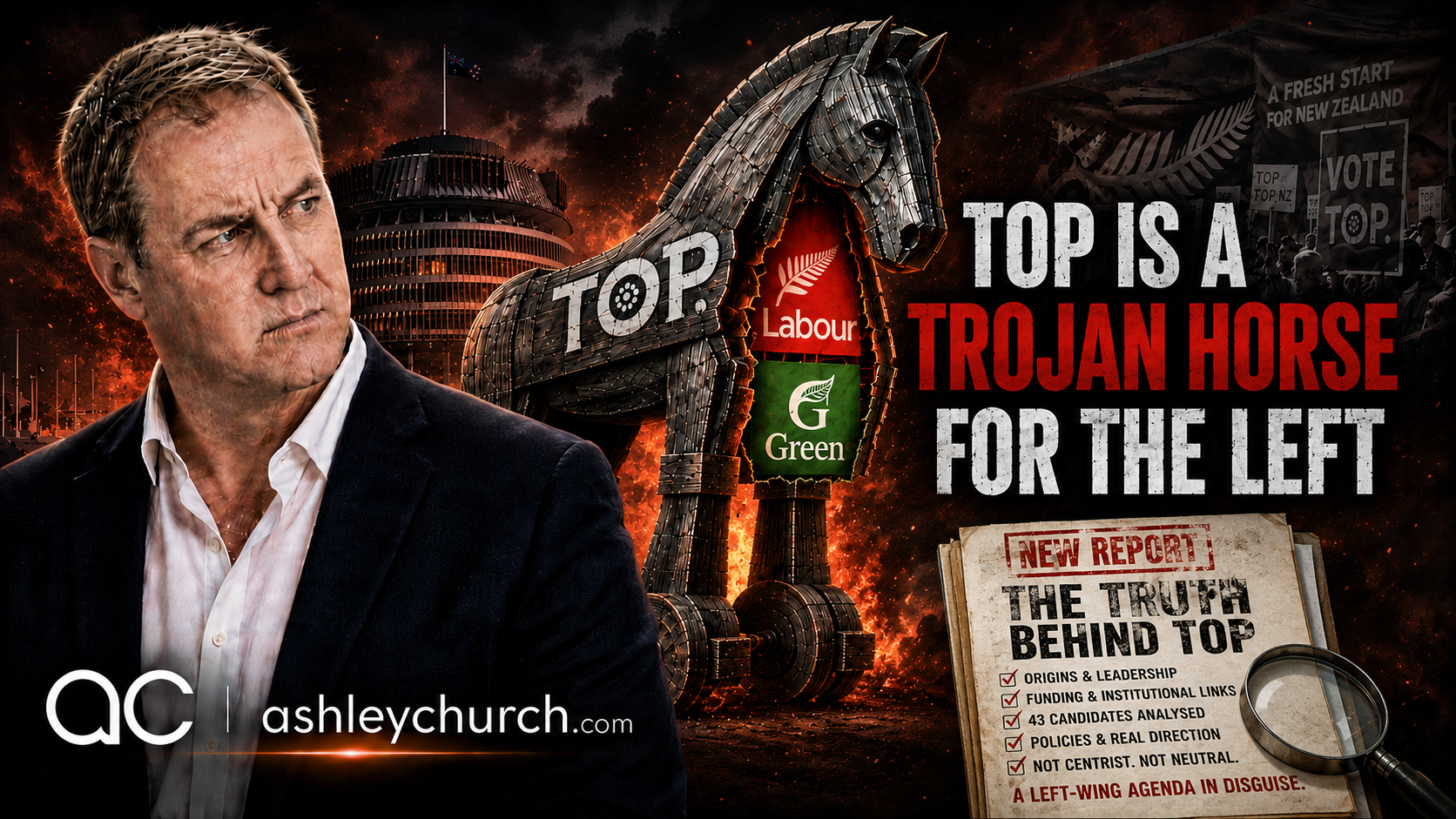
- 🐎 Church argues The Opportunities Party markets itself as a centrist “blue-green” option but is in fact a left-wing institution in centrist clothing — a “Trojan horse designed to deliver centrist votes to the left.”
- 📊 TOP was founded by Gareth Morgan in 2016, won 2.4% in 2017, fell to 1.5% in 2020, recovered to 2.2% in 2023, and now sits at 4.6% under leader Qiulae Wong.
- 📋 Citing an independent Taranaki-based researcher’s report on all 43 announced candidates, Church claims roughly 38 of 43 come from overlapping left-wing professional networks.
- 🌿 Identified sectors include environmental/conservation organisations, climate activism, Treaty and indigenous-rights policy, central and local government, trade unions, publicly funded science, and harm-reduction advocacy.
- 👤 Notable candidates named: WWF NZ CEO Kayla Kingdon-Bebb (He Puapua co-author), Te Puni Kōkiri policy adviser Jessica Hammond, School Strike for Climate alumnus Finn Liley, former Green candidate Bianca Beebe, PSA delegate Ben Wylie-van Eerd, and union delegate Blair Smith.
- 🧑💼 General manager Iain Lees-Galloway is a former union organiser, Labour MP and Cabinet minister under Jacinda Ardern.
- 💰 Church says environmental groups that boycotted National’s Blue-Greens forum attended TOP’s Teal Hui — evidence of true institutional alignment.
- 🛡️ TOP’s use of former National MP Dame Jackie Blue is dismissed: she left National over pay equity, which Church calls “a staple of extreme left-wing ideology.”
- 🎯 Takeaway: TOP’s centrist branding is, on this reading, a packaging strategy for a slate, staff, and donor base overwhelmingly anchored on the progressive left.
- 🗳️ If correct, a vote for TOP is functionally a vote that strengthens Labour/Greens/Māori Party coalition arithmetic.
2. The Pakeha Guilt Conspiracy
Chris Trotter — Substack
- 🎭 Trotter’s polemic identifies a “Pakeha Guilt Conspiracy” allegedly founded in the 1970s by frustrated Marxists and now numbering tens of thousands across schools, universities, courts, and the public service.
- 📖 His target is Richard Shaw’s book *The Good Settler: Essays from other people’s lands*, published by Massey University Press, which sketches a “real New Zealander” who uses Māori place names, shares the stage and story, and weaves a collective “us and ours” narrative.
- 🎤 Trotter mocks the description as a kind of liberal utopian caricature: “I’m betting these ‘real’ New Zealanders also know all the words to *Kumbaya* — and can sing it in Te Reo, too!”
- 🐑 The core question: are these displays of guilt sincere belief, or “Judas sheep leading the Pakeha flock to cultural slaughter”?
- 📜 Trotter frames the decolonisation project as a political strategy to politically disarm inheritors of the colonial project and hasten its destruction.
- 🎯 Takeaway: the essay is a sharp-tongued critique of elite Pākehā complicity in decolonisation, treating it as ideology rather than reconciliation.
- ⚠️ Note: the full article is paywalled; the free excerpt is a provocation, not a policy analysis.
- 🗳️ Trotter’s framing aligns with a wider right-wing narrative that the 2026 election will be fought over whether New Zealand retains one-law-for-all citizenship or continues a “quiet constitutional revolution.”
- 📉 The piece treats “Pakeha guilt” as the emotional engine behind co-governance, treaty-principles litigation, and the elevation of tikanga into common law.
- 🎯 Takeaway: expect this argument to intensify as the election approaches, with TOP’s Treaty/devolution stance likely to be a key target.
3. Deciding Election 2026
Dr Muriel Newman — NZCPR / Brash & Mitchell
- 🏛️ Newman frames the 2026 election as a referendum on a “quiet constitutional revolution” driven by co-governance, Treaty-principles litigation, and the elevation of tikanga into common law.
- ⚓ Case study 1 — Port of Tauranga: Ngāti Kuku blocked expansion, demanding $19 million per year for 35 years (present value $335–475 million), including $11 million/year as “fair revenue sharing.” Newman calls it “cultural ransom.”
- 🚫 The coalition was elected on a promise to “end race based policies,” yet Minister Chris Bishop’s Fast-track law and its planned successors allegedly preserve iwi-council cultural arrangements.
- 🗳️ Case study 2 — Auckland Māori Statutory Board: an amendment to the Local Government (System Improvements) Bill would restrict voting rights on council committees to elected councillors, but exemptions preserve the unelected Board’s voting power.
- ⚖️ ACT proposed removing the Board’s voting rights in committee; NZ First introduced a bill to abolish it entirely.
- 📜 Case study 3 — Treaty references in legislation: Justice Minister Paul Goldsmith’s preferred wording references both “Treaty of Waitangi” and “te Tiriti o Waitangi,” which Newman says entrenches separate meanings.
- 🎯 Newman argues Article 1 ceded sovereignty, Article 2 protected property, Article 3 granted equal rights — and modern “Treaty principles” invented since 1975 have no basis in the original text.
- 🗳️ The article calls on voters to demand parties commit to one law for all and to dismantle co-governance and race-based legislative privileges.
- ⚠️ Newman’s historical and legal interpretations are contestable; the value here is documenting the argument that will be central to the right’s 2026 campaign.
- 🎯 Takeaway: the election is being framed by conservative critics as a last chance to halt a constitutional transformation they say has proceeded without public mandate.
4. Te Arawhiti Issues the Policy Templates
Ivan Barnett — Brash & Mitchell
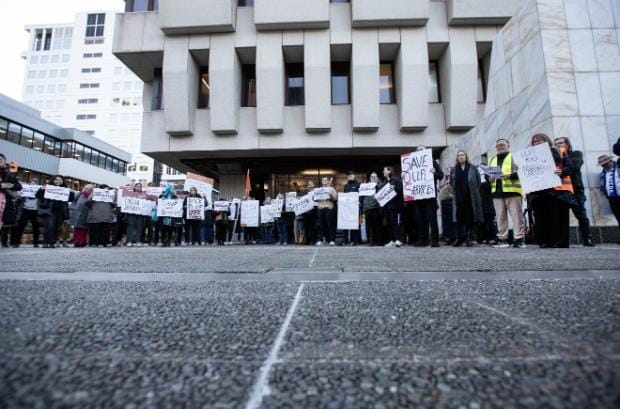
- 🏛️ Te Arawhiti — the Māori Crown relations agency — is described as the body that issues the policy templates, Treaty-principles definitions, and partnership expectations now shaping the entire public service.
- 📑 Barnett says these frameworks are already embedded across government departments, councils, and regulatory agencies; they influence RMA interpretation, council consultation, and infrastructure assessment.
- ⚠️ He argues they operate quietly, without public mandate, and without meaningful parliamentary oversight.
- 🚧 Consequences listed: ports held to ransom, energy providers forced into massive settlements, councils pressured into agreements delivering no public return, and essential infrastructure slowed or stalled because officials will not enforce equal treatment.
- ⚖️ Barnett’s central question: should any group be able to demand vast sums from public-benefit infrastructure solely because of ancestry?
- 📜 He says the answer is no — not because of who the group is, but because the law does not permit financial leverage based on ancestry, and democratic systems cannot function when such leverage is tolerated.
- 🗳️ The 2026 election will not by itself resolve the issue; changing governing parties has not dismantled entrenched frameworks, and Te Arawhiti’s templates will remain unless Parliament directly confronts them.
- ✅ The author asserts equal citizenship must be restored through clear legislative action, not political slogans.
- 💰 The One Country Fund is cited as existing precisely because this embedded machinery cannot be ignored.
- 🎯 Takeaway: Barnett’s argument is that a bureaucratic architecture now overrides elected government, and the election must produce a legislative cleanout, not just a change of ministers.

5. Australia’s Teen Social Media Ban Failed
Cam Wakefield — Reclaim The Net
- 📱 Australia’s world-first under-16 social media ban is being widely bypassed six months after launch; the government’s response is to double fines and expand surveillance powers.
- 📊 A British Medical Journal study of 408 Australian teens aged 12–15 found that three months after the ban, **85% were still logging on**.
- 🧒 Evasion methods include drawing mustaches on faces for selfies, borrowing logins from older siblings or parents, and simply claiming to be over 16.
- 💰 Maximum fines for tech firms doubled from A$49.5 million to **A$99 million**.
- 🕵️ The eSafety Commissioner can now compel platforms, digital-ID vendors, and app stores to hand over documentation proving under-16s are blocked.
- 📉 The author argues the real effect is not reduced teen platform use but the normalisation of handing faces and identity data to automated scanners.
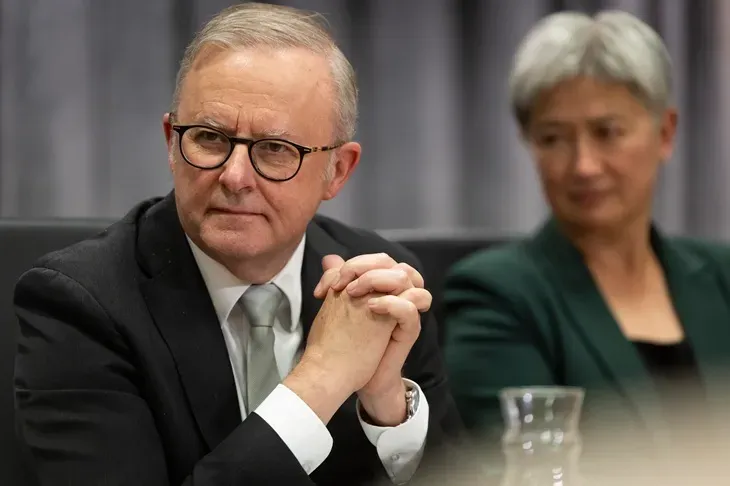
- 🗣️ Prime Minister Anthony Albanese: “It is clear Big Tech are not doing enough to comply with the law — there are still too many children on social media.”
- ⚠️ The author calls the ban a “comprehensive failure” whose remedy builds surveillance infrastructure while teenagers evade it with markers.
- 🌍 Britain is reportedly going further, potentially pulling gaming and live-streaming platforms into the same regime.
- 🎯 Takeaway: the policy is failing at its stated goal and succeeding at expanding the surveillance state.
6. What the AirCon Debate Says About Britain’s Climate Insanity
Konstantin Kisin — Substack
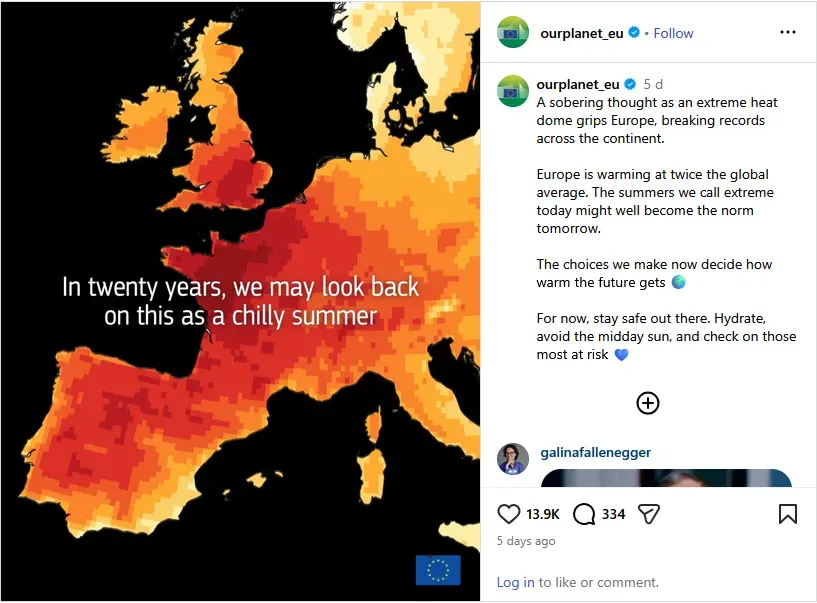
- 🌡️ Kisin argues Britain’s annual summer heat panic has escalated into “insanity,” with some councils forcing residents to remove air-conditioning units.
- 🤝 He identifies as a “climate accepter,” not a denier: he accepts recent warming and is willing to accept human activity as a significant contributor for argument’s sake.
- ❌ What he rejects is the claim that current temperatures and rates of change are historically unprecedented.
- 📜 Historical context: Britain was under ice sheets or tundra for ~280,000 of the last 300,000 years; hippos once lived in the Thames; Vikings farmed Greenland during the Medieval Warm Period; the Thames froze for Frost Fairs during the Little Ice Age.
- ⚡ Around 11,700 years ago, global temperatures rose by roughly 10°C in decades — “not centuries, decades” — entirely without human activity.
- 📊 Kisin says standard graphs terrify because they omit long-term context; the “inconvenient” record demolishes the claim that temperature stability is the natural order.
- 🏛️ The policy implication: if the current temperature and rate of change are not unprecedented, climate policy should be proportionate and adaptive rather than emergency-based.
- ⚠️ The full article is paywalled; the free excerpt develops the historical-context argument and promises a second point about policy.
- 🎯 Takeaway: Kisin is making the “history matters” case against climate catastrophism, not against the existence of warming.
- 🗣️ The piece fits a growing conservative critique that climate policy has become a pretext for restrictions ordinary voters would never otherwise accept.
7. Britain’s Heatwave Response Was Straight From the Covid Playbook
Jennie Bristow — spiked
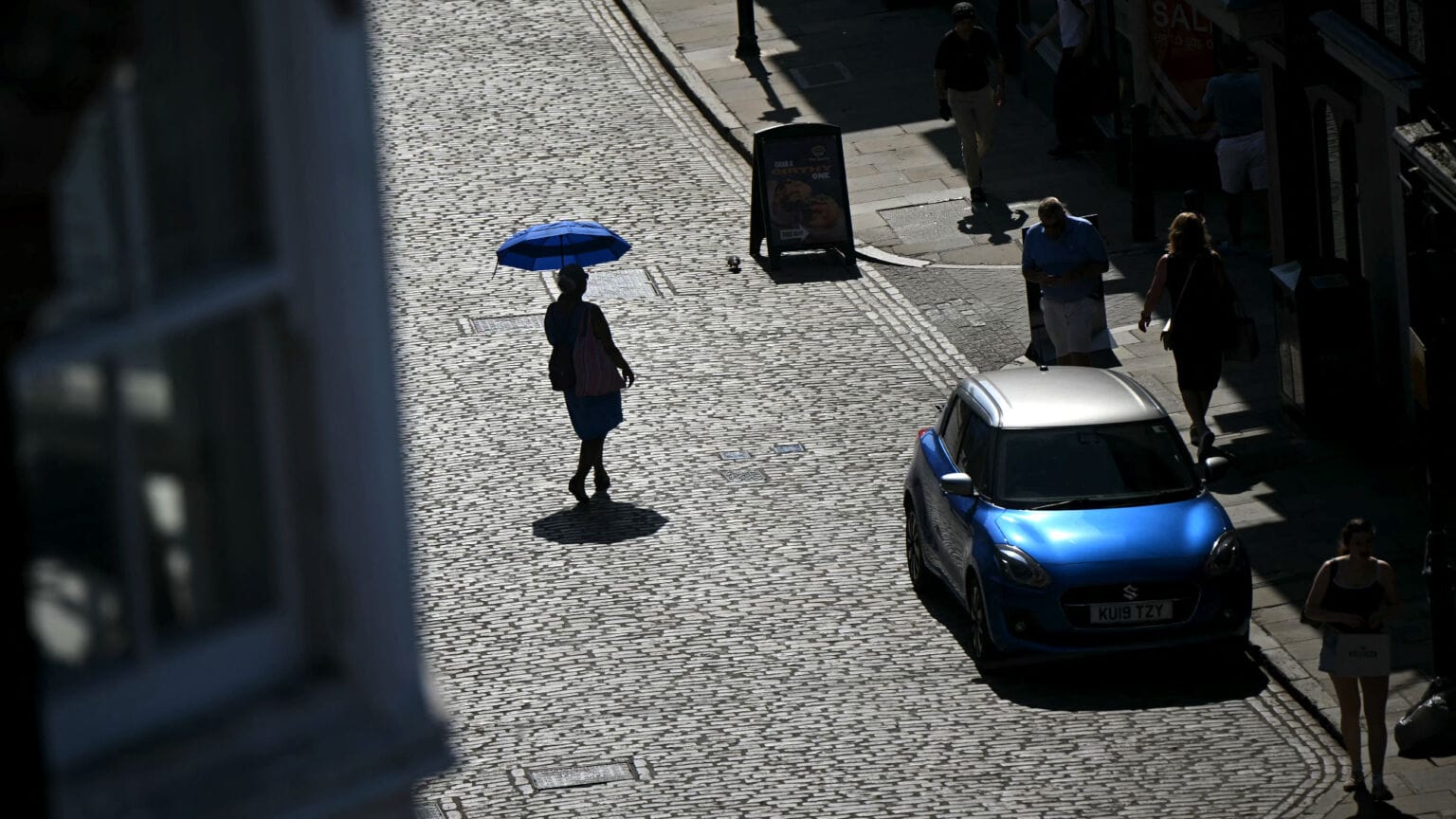
- 🌡️ Bristow argues Britain’s response to a summer heatwave — hundreds of school closures, train companies advising against travel, and firms telling staff to work from home — is the “Covid playbook” applied to weather.
- 📺 The pattern: exaggerate novelty, invent new severity metrics, escalate through breathless media coverage, impose anti-social measures, then blame the public for trying to get on with life.
- 📊 The Met Office’s “extreme heat warning” was only introduced in July 2021 and was issued as recently as 2022 — making it a new metric, not proof of unprecedented heat.
- 🏠 Working from home suits the comfortable; for families in stuffy city flats with limited technology, it is much harder. Meanwhile air-conditioned trains, offices and cafes sit half empty.
- 📉 The author says the real story is an inability to cope baked into infrastructure and institutions; rather than fix resilience, officials shut society down.
- 📰 Mainstream media, especially “trusted” outlets like the BBC, are accused of manufacturing a cycle of competitive escalation with live blogs and danger narratives.
- 🚰 Contrast: Paris residents cool off by jumping into the canal; London has a “cool map” directing people to shaded/air-conditioned public spaces. These practical social solutions are treated as afterthoughts.
- ⚠️ The deeper critique: ordinary people are not trusted to make sensible decisions, and social institutions withdraw from collective responsibility at the first sign of difficulty.
- 🎯 Takeaway: the heatwave is a test of institutional competence, and Bristow says Britain is failing by defaulting to shutdown rather than adaptation.
- 📉 The article connects this to a post-Covid culture in which disruption is normalised and elite institutions prefer remote, atomised responses.
8. Cricket Won’t Be the Same Without Ben Stokes
Hugo Timms — spiked
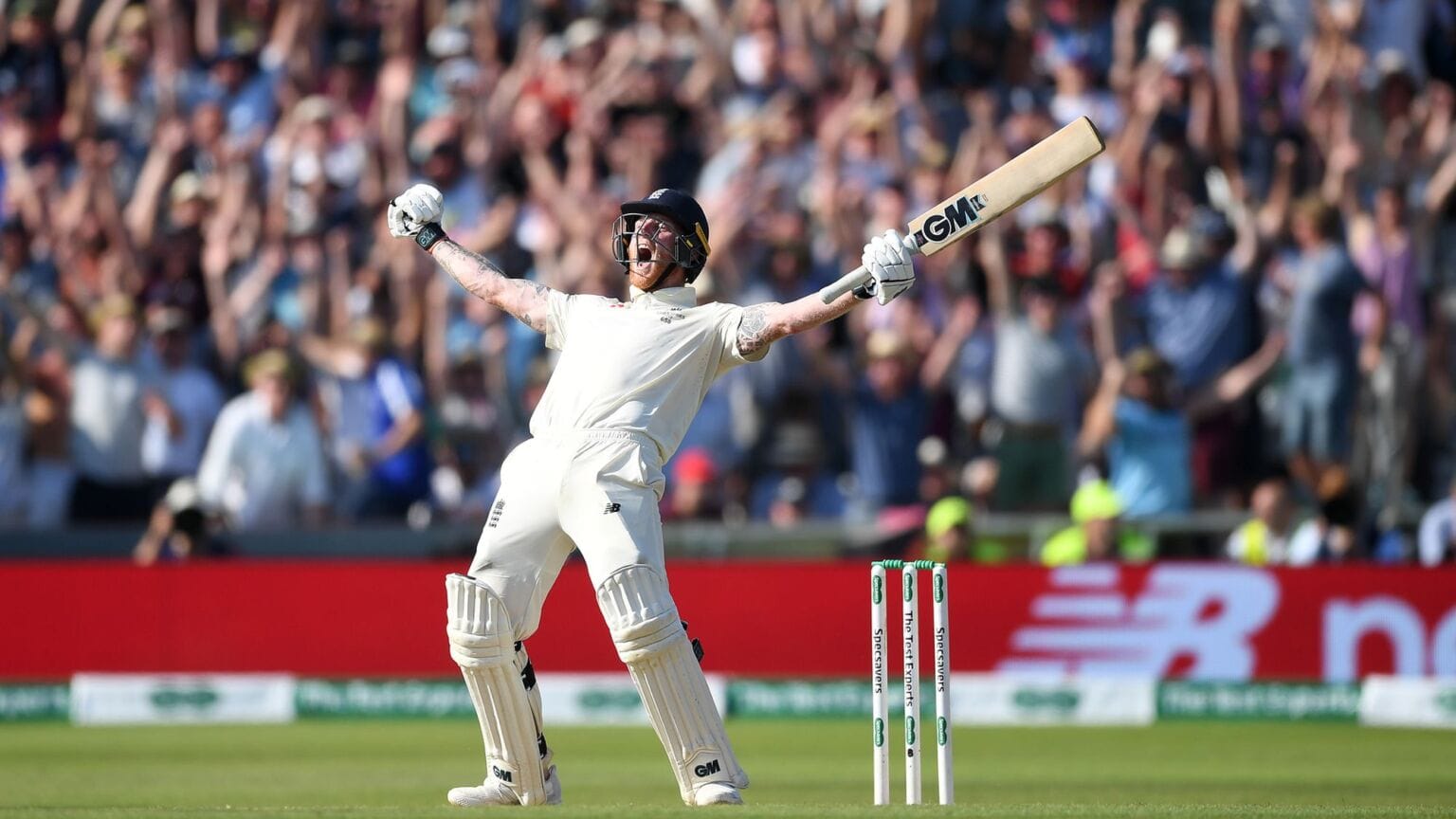
- 🏏 Ben Stokes announced his retirement during England’s Test against New Zealand at Trent Bridge, leaving English cricket less competitive and the sport “far less interesting.”
- 🌟 Stokes is described as the most entertaining, loveable player of his generation — a rare figure whose presence elevated the game, alongside Shane Warne and Virat Kohli.
- 🏆 Career-defining innings: Headingley 2019, when England chased a record 379 against Australia; Stokes scored 84 of the last 72 runs after the final-wicket partner, Jack Leach, joined him.
- 📉 Records: only the second player after Jacques Kallis to take 250+ Test wickets and score 7,000+ Test runs.
- 🥊 Off-field controversies: 2017 Bristol nightclub acquittal followed by an ECB fine and ban; a 2021 mental-health break; and a June 2026 Chelsea nightclub fight involving teammate Gus Atkinson, after which Stokes was banned from the second Test and forced to apologise despite appearing to play no direct role.
- ⚠️ The 2026 incident appears to have been the last straw, ending a strained relationship with coach Brendan McCullum and the ECB dating back to 2017.
- 🎯 The article criticises the ECB as “managerialist, incompetent and overly sensitive to criticism,” and says McCullum and the board failed to stand up for Stokes.
- 🏴 England’s Ashes chances next summer are described as having “vanished,” and fans are denied a final showdown between Test greats.
- 🎯 Takeaway: Stokes leaves a gaping hole in English cricket, and his forced exit is seen as emblematic of a board that mishandled its greatest player.
- 🗣️ “This was not the way Ben Stokes was supposed to bow out.”
9. The Truth About White Guilt
Katharine Birbalsingh — The Spectator Australia
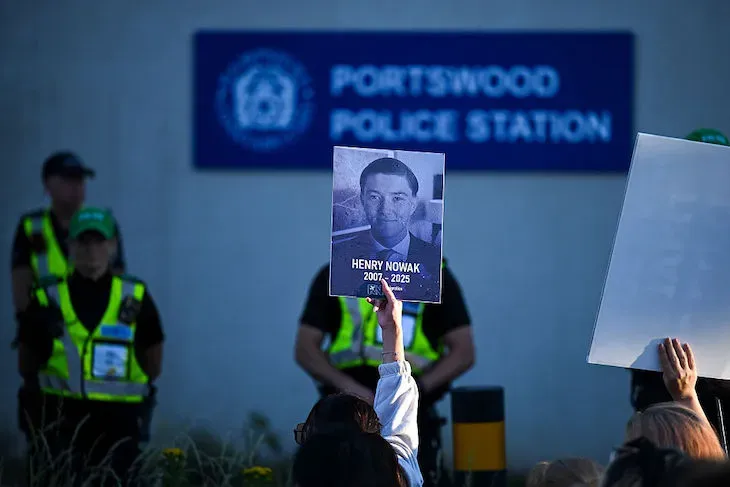
- 🧠 Birbalsingh argues a moral shift has left many young Westerners unable to judge situations by right and wrong, because they have been trained to divide the world into oppressors and oppressed.
- 🚔 She cites the Henry Nowak case, claiming officers were “terrified of being seen as racist” and therefore failed to protect a dying handcuffed victim because his attacker was a brown man.
- 💔 She also cites the Charlie Kirk shooting, saying young people celebrated online because they viewed Kirk as an oppressor.
- 👨👩👧 Boomers, Gen Xers and older Millennials are blamed for failing to transmit traditional values, treating school as purely academic and underestimating social media’s influence.
- 🏫 Schools allegedly reduce history to Hitler, slavery, and American civil rights, framing it as one long struggle of oppressed groups against the “dead white man.”
- 🏛️ Museums and galleries are accused of flattening human achievement into the oppressor/oppressed narrative — for example, the Science Museum’s aviation display highlighting exclusion of women and black people rather than celebrating flight.
- 📱 Social media reinforces victimhood narratives and white guilt, leaving young people unable to recognise complexity or nuance.
- 🗳️ Birbalsingh links the cultural formation to youth support for politicians she describes as Marxist, such as Mamdani in New York and Zack Polanski in the UK Greens.
- ⚠️ The piece is a sweeping cultural diagnosis rather than a data-driven study; its examples are contested and presented without independent verification.
- 🎯 Takeaway: Birbalsingh’s argument is that “white guilt” has created a generation unable to apply ordinary moral judgement, with dangerous real-world consequences.
10. The Coming Crash of Intellectuals
Samuel Thawley — The Spectator Australia
- 📉 Thawley argues the West’s longest boom has not been in mining, energy, manufacturing, or finance, but in the production of people who work with symbols: graduates, managers, officials. He calls it the “symbolic economy.”
- 🎓 Pressure 1 — Overproduction: degrees were sold as a “lounge pass” to the symbolic economy, but when everyone holds one it becomes the new minimum. Peter Turchin calls the result elite overproduction.
- 📊 US undergraduates in 2026 expected $80,000 in their first year; jobs offered about $56,000. They expected $145,000 a decade on; the real mid-career figure is closer to $95,000. More than two in five recent graduates now work in jobs that never required a degree.
- 🏢 Pressure 2 — The stalled pyramid: organisations merge, flatten, and delayer; a management career only lifts everyone if new layers keep being created. A May 2026 study of 1.3 million mid-career professionals found a quarter hit a ceiling early; public administration was the most stall-prone field.
- 🏛️ Pressure 3 — Politics: the public wing of the symbolic economy is seen by a growing part of the right as a self-interested “swamp” that votes for its own expansion.
- 🤖 Pressure 4 — AI: unlike previous pressures, AI attacks the demand for human mental work, not just the supply of workers. Rules-based information processing is exactly what AI learns first.
- 🇺🇸 Washington’s DOGE cut close to a tenth of the federal workforce inside a year, but federal spending kept rising because the work remained. AI, Thawley argues, is the variable that could actually keep tasks cut.
- 🎯 The crash will fall hardest on the public servant: least disciplined by markets, most swollen by debt, most resented by one side of politics, and most exposed to automation.
- 🗳️ The centre-left is the flagship party of the symbolic economy; its decline dissolves the world that made modern Labour/Labor parties what they are.
- 🎯 Takeaway: a 50-year expansion in cognitive labour is ending, and the political fallout will be large, credentialed, downwardly mobile elites looking for a new banner.
What our members are saying about Ten@10
Elizabeth
These articles are compulsory reading for me and the perfect addition to the usual list of Goodoil items!
Lynne
Absolutely brilliant to receive these current and thought provoking articles.
Jonathan
Just wanted to let you know that I’m loving this new 10@10. Much appreciated from someone who chooses to read/watch almost NO mainstream media.
Murray
Cam, relish your output as the newspaper in Christchurch is so intent on non news. Thankyou
Fred
Thanks for Ten @ Ten, really enjoy reading it.Keep it up. All the best, keep healthy.
Jocko
Wonderful info not otherwise available in NZ. More power to your elbow! Thanks.