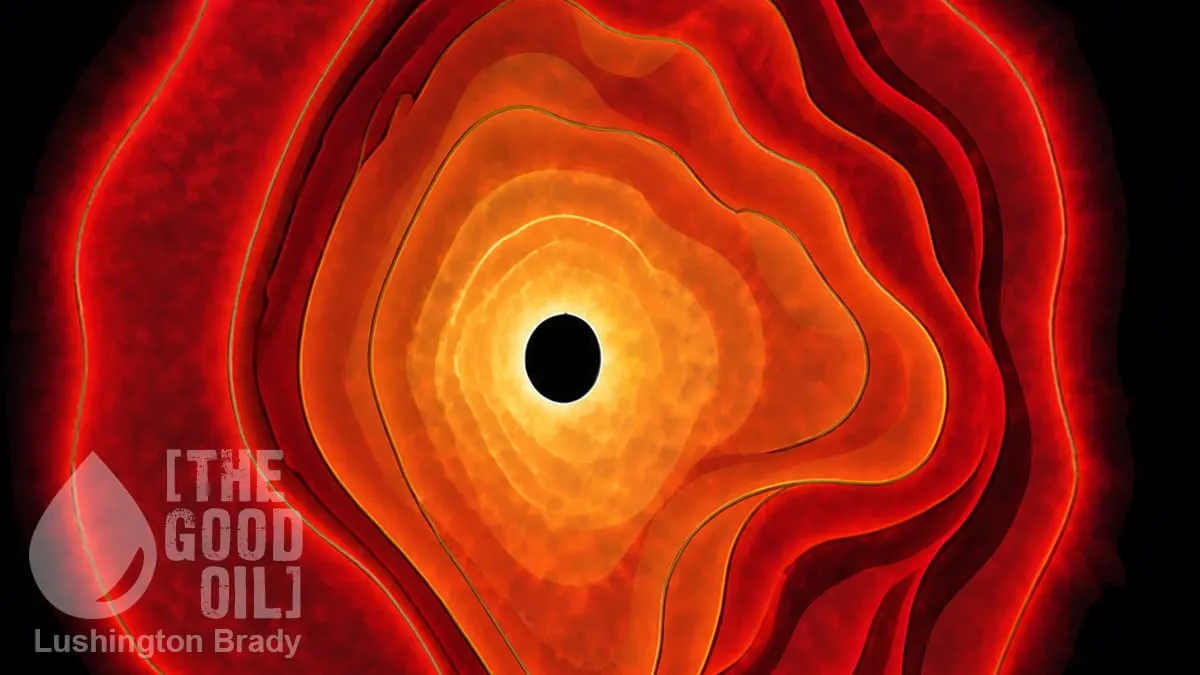
Black holes are some of the weirdest Damned Things in existence. While their conceptual possibility was suggested as far back as 1783, it wasn’t until 1915 that Karl Schwarzschild extrapolated the maths of Einstein’s recently published Theory of General Relativity and found a hard theoretical basis, which, incidentally, peeved Einstein so much that in 1939 he tried to prove that they were impossible. But, like all Damned Things, they refused to go away: by the 1970s, the first probable black holes were inferred (starting with Cygnus X-1). But it wasn’t until 2019 that a black hole was directly observed.
Compounding their weirdness is the fact that black holes can actually be very bright. The brightness is not actually the black hole itself (by definition it’s black because its gravity is so strong not even light can escape), but the matter swirling around like a cosmic drain hole. As matter like gas swirls around the black hole, it moves very fast and rubs against itself, which, like rubbing your hands together, creates heat: only at temperatures reaching millions of degrees.
It’s not just the stuff swirling around the cosmic plughole that’s moving fast: black holes themselves spin. Very fast. So fast that a star recently discovered orbiting Sagittarius A* (the * denotes it as a black hole), the supermassive black hole at the heart of our galaxy, has recently been estimated to be the fastest moving star in the galaxy.
Dubbed S301, the star reaches about 15,500 miles (25,000 kilometers) per second at its fastest – more than eight per cent the speed of light.
“What is special about this star is that it’s orbiting Sagittarius A* on a very tight orbit, taking just 8.7 years to complete it, and is approaching the black hole at a mere 12 times the distance of Earth to the sun. That is unprecedented,” study author Felix Mang, a PhD student at the Max Planck Institute for Extraterrestrial Physics in Germany, said in a statement.
Astronomers spotted it with the GRAVITY instrument on the (imaginatively named) Very Large Telescope and have already traced it back through earlier observations. The elongated path suggests it once belonged to a binary system that strayed too near the black hole; one star was captured, the other flung away at blistering speed.
Because S301 gets so close, the subtle dragging of spacetime caused by the black hole’s spin – frame-dragging, or Lense-Thirring precession – should gradually twist its orbit. Track it through the next close approach in 2031 and two full circuits and we may finally measure the spin of our galaxy’s central black hole directly. That would be a clean, observational test of general relativity in one of the most extreme environments known.
Just to prove how imaginative astronomers are, future observations are planned with GRAVITY+ and the Extremely Large Telescope.
Astronomers are also apparently Soundgarden fans.
Astronomers claim to have discovered a new kind of cosmic object, a black hole “star”, which is the size of the entire solar system and glows with a brilliant red light.
It was found as an intensely red spot in James Webb images of the early universe. Very early: object MoM-BH*-1 (there’s a ‘yo momma’ joke in there, somewhere), as it’s called, formed only 660 million years after the Big Bang. And it’s weird, even for a black hole.
It pours out a hundred billion times more energy than any conventional star. Yet its spectrum shows features classically associated with stars. Computer models resolve the paradox: it is not a giant fusion-powered star at all. It is a black hole so thoroughly wrapped in dense, swirling gas that the envelope radiates like a stellar atmosphere.
If the interpretation holds, many of the mysterious Little Red Dots scattered across Webb’s deep fields are the same class of object. Because they are so far away, with far away being the same thing as long ago, in the universe, these black hole stars may be the swaddled infancy of the supermassive black holes that now sit at the centres of nearly every large galaxy. They would be the seeds that grew, over billions of years, into monsters like Sagittarius A*.
In that sense the two discoveries book-end the same phenomenon: one shows us a mature, spinning black hole sculpting the path of a star in the present-day Milky Way; the other shows us what those black holes may have looked like when the universe was still in its turbulent youth.
The universe, it turns out, keeps inventing new ways to be both dark and obscure, and blindingly bright at the same time.