Yvonne van Dongen
Veteran NZ journo incredulous gender ideology escaped the lab. Won’t rest until reality makes a comeback.
Progress on the road back to reality.
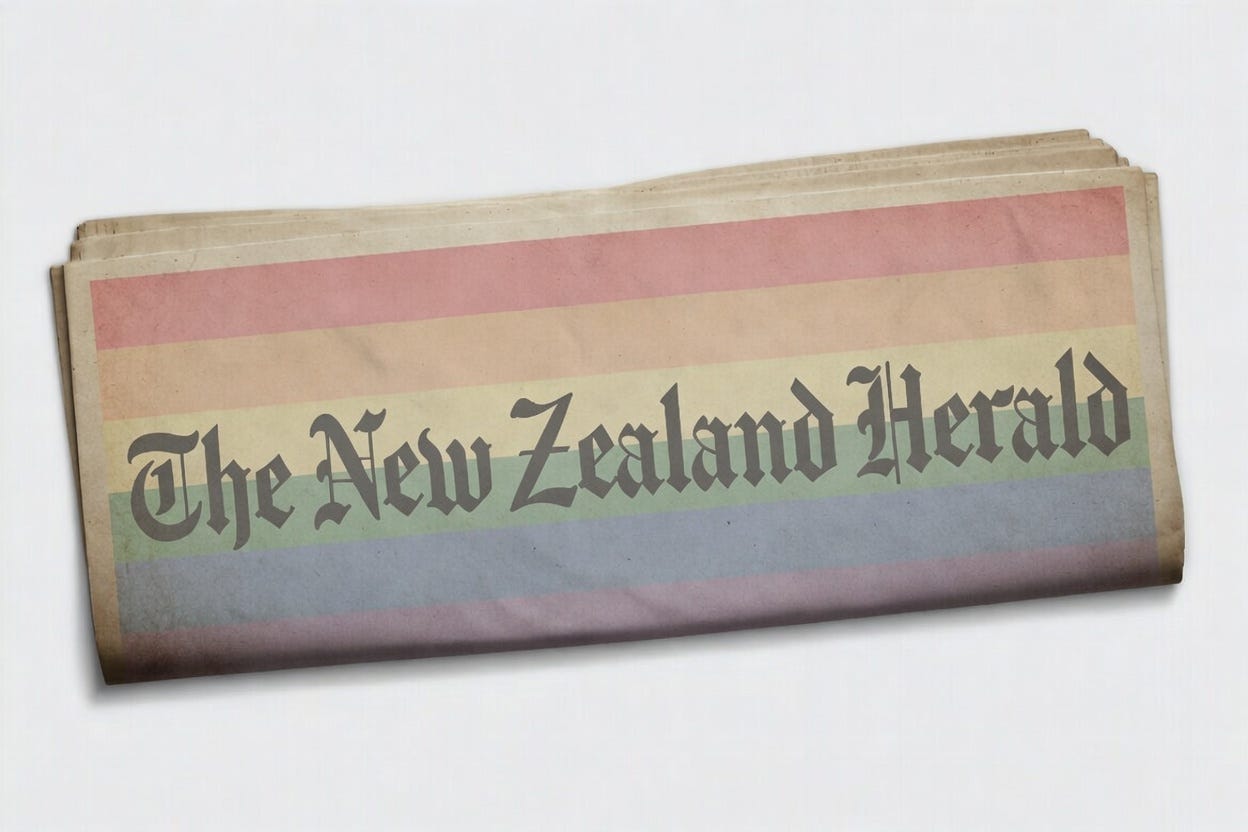
As of this month, NZME, publisher of the NZ Herald, has dropped the Rainbow Tick. They have held this badge of approval since 2017. The day the NZ Herald got their first tick, they were so chuffed, they applied rainbow colours to their masthead.
NZME’s other mastheads and brands – including Newstalk ZB, the Northern Advocate, Bay of Plenty Times, Daily Post, Hawke’s Bay Today, Wanganui Chronicle, ZM, The Hits, Coast, Mix, Hauraki, Hokonui, Flava and GrabOne – also featured rainbows that magical unicorn day.
Frankly, it was an easy win. All it required was the incantation of a few all-powerful words (diversity, inclusion, feeling safe), a willingness to submit to gender woo, plus the payment of indulgences (ranging from $10,000 to $12,000 annually), and the transmogrification was complete. Rainbow Ticked up the wazoo.
At the time Michael Stevens, programme director at the Rainbow Tick, said this:
We are a population that is largely invisible, and any signs that acknowledge we exist and give us a chance to see ourselves represented in the wider world are not just welcome, but also immensely powerful and supportive.
Invisible? They have to be the most over-hyped, over-exposed, celebrated minority that ever walked God’s green earth. Every year these shy wallflowers get a day, then a month, a parade, rainbow-stickered police cars, street flags, window displays and bucketloads of merch shouting their fabulousness from the rooftops.
Businesses around the country have followed suit. These days you can barely escape the happy happy joy joy candy colours of inclusion. A rainbow-coloured croissant is still painted on the window of my local bread shop and Ponsonby Woolworths has permanently rainbow-ised its logo, signalling its queer cred to credulous locals.
Are you cringing already? Do you see how quickly this kind of woke genuflection gets old? Less than a decade from first-day rainbow congratulations until now. That’s all it took. Less than a decade for this fruity fad to become old and tawdry and, yes, downright embarrassing. A fluoro reminder of how easily duped the media, among others, were. But doubly appalling that it was the media, since the fourth estate is supposed to maintain neutrality. Ha – rainbow vom – ha.
But here’s the good news. Since NZME was the first media firm in New Zealand to earn the Rainbow Tick, it may be that their decision to drop the ick tick will also prompt a copy-cat cascade of rejection. It’s not news to anyone that the media are as independent and free-thinking as a skittish school of reef fish.
So far, already Vodafone, Sky and Auckland University of Technology have said goodbye to the tick.
The question we should all ask now is – does it matter? What difference does dropping the tick really make? It may be a coincidence but the same month the Herald quietly ditched the rainbow tick (no fanfare now), they also published a lengthy column by Lady Deborah Chambers, KC, on the judicial review of puberty blockers. This is notable since the NZH and other NZME outlets have generally given the issue a wide berth.
The article is timely since in July a high court hearing brought by the Professional Association for Transgender Health Aotearoa (PATHA) takes place. Chambers warned that PATHA’s case raises deeper issues about the judicialisation of politics and says it underscores why the boundary between judicial oversight and democratic decision-making must be carefully guarded.
Democracy functions best when elected politicians are permitted to make the difficult calls they were elected to make, and when courts reserve intervention for genuine excesses of power rather than disagreements over evidence or ideology. Judicial review remains essential. But it must not become a veto power for the unelected.
Could both milestones be part of the Jim Grenon effect? In 2025 the Canadian billionaire became a significant shareholder of NZME. He also funds the news aggregate service the Centrist. In June 2025 Grenon was appointed a director of NZME and he has since increased his stake to around 19.9 per cent. His public rationale is that he sees New Zealand’s mainstream media as ideologically skewed and wants to inject more balance.
Ditching the Rainbow Tick and publishing the Chambers’ column may be a sign that management has got the memo that biology is back. Sadly, further down the food chain, the folk who actually write the stories have not. In the same week the Chambers’ column was aired, the NZ Herald published a story about a they/them allegedly prevented from wearing the Palestinian keffiyeh at the University of Canterbury graduation ceremony. This faux victimhood and willingness to cast the keffiyeh-wearing woman as non-binary screams institutional capture.
A few days earlier (April 27) a man who went missing was described as a woman by the NZ Herald since he identifies as such and has given himself a woman’s name under our self-sex ID laws. He was found 24 hours later, but the inaccurate framing by the media and police call into question public safety and tells us where both institutions sit right now. Obedient followers of the rainbow cult.
The PATHA legal case may be significant in many ways: the outcome, of course, but also whether and how it is reported by mainstream media.
This article was originally published on the author’s Substack.