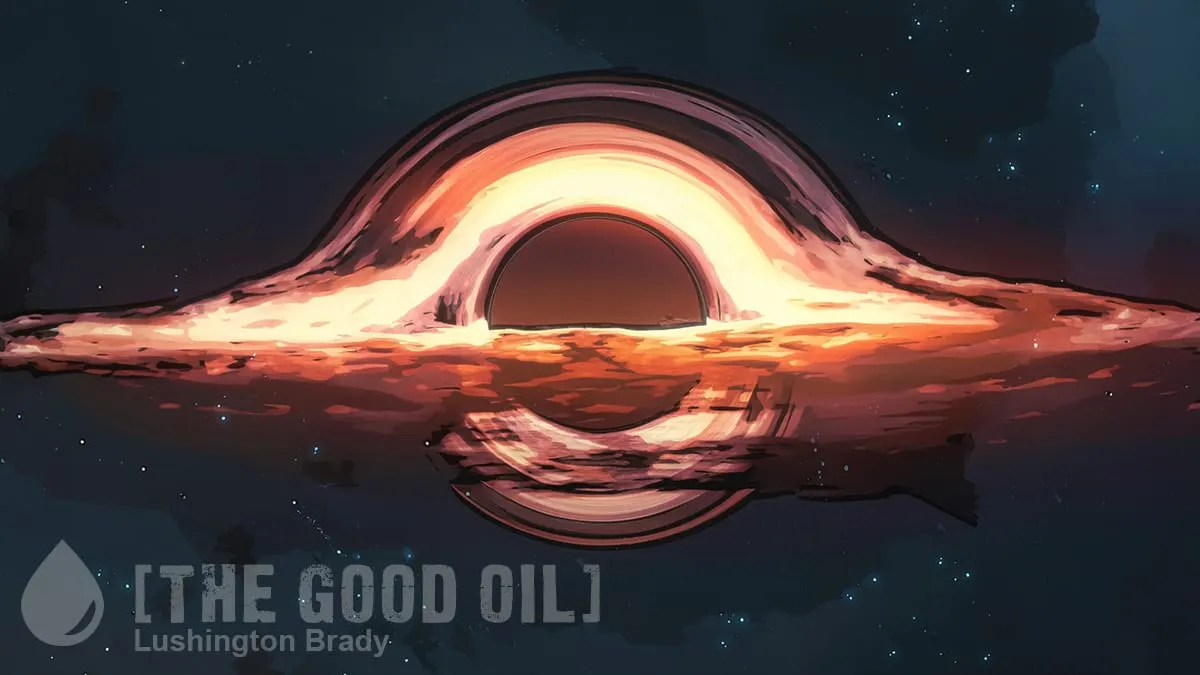
For over a century, black holes have been sold to us as cosmic dustbins with a point of infinite density at their centre. Drop anything in and it supposedly falls forever into a mathematical nightmare where density becomes infinite and the equations of general relativity explode. New papers published in 2026 are quietly suggesting the whole picture may be wrong.
The old story began in 1916 when Karl Schwarzschild found an exact solution to Albert Einstein’s equations for a spherical mass. Einstein reconceived space and time as spacetime: not separate entities, but inextricable strands of the warp and weft of the fabric of the cosmos. In Einstein’s cosmology, the curvature of spacetime is what we experience as gravity.
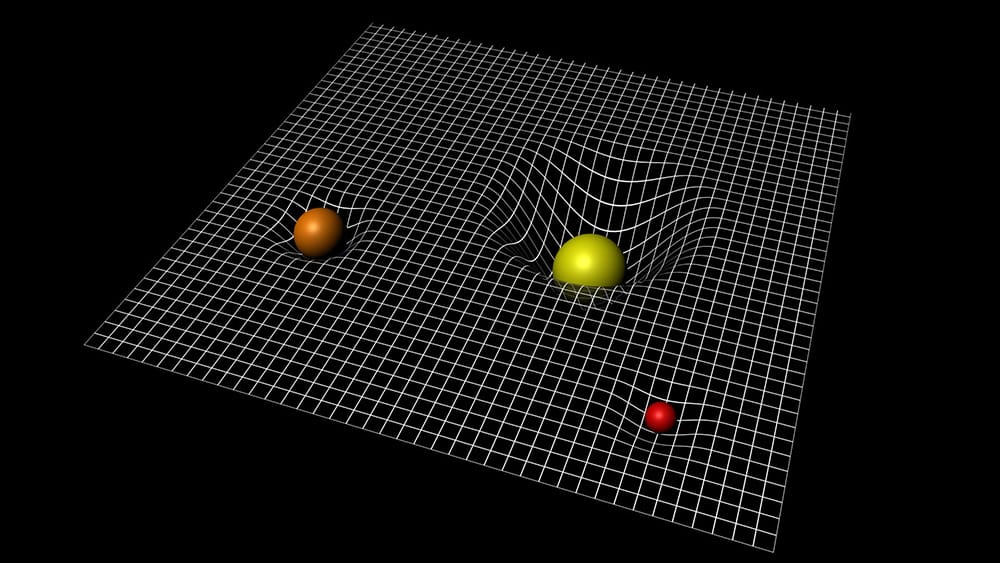
Think of spacetime as a stretchy fabric. Massive objects create dents in that fabric and smaller objects roll toward the deepest part of the dent. Near a black hole the dent becomes extremely steep. The old view said the fabric gets crushed into a single mathematical point of infinite steepness: a black hole dents spacetime so much that it becomes an infinitely deep well. Schwarzschild’s calculations posited the event horizon: the boundary of the warped sheet of spacetime when something falls down the infinite well. Beyond the event horizon, nothing escapes. Not even light.
Later work by Roger Penrose and Stephen Hawking turned this into the claim that collapsing matter must form a singularity: a true point of infinite density where spacetime itself ceases to make sense.
[Physics has], for some reason, largely ignored the elephant in the room and hasn’t yet stopped to question the singularity. Until now, at least. The problem is the singularity itself, this idea that a black hole is just infinity and that's the end of it. But if a collapsing star creates an infinity, that calls the whole picture into question. Is it really geometry folding neatly into an infinite point? Look at the word we use often. Collapse. Einstein used that word. So did Penrose and Hawking. But they were describing matter contracting to a singularity, not a full geometric failure of spacetime itself. Matter falls inward, geodesics run out, and they called that the end. What they did not say is that the geometry carrying all of it has a breaking point of its own. Geometry does not fold into a point. It fails. It breaks apart. And what is left in its wake, the empty void we call a black hole, is what remains after the break.
The new research says this ‘singularity’ is not a feature of nature. It is an artefact of the equations. When a star collapses, the geometry of spacetime does not fold neatly into an infinite point. It reaches a breaking point and fails. What we call a black hole is the region left after the geometry has failed.
One paper, Black hole singularities and the limits of the spacetime continuum, treats the curvature of spacetime like a physical load on a structure. There is a calculable radius where that load becomes too great and the geometry can no longer hold together. The event horizon becomes a phase boundary: the surface where one description of spacetime ends and something else begins. No new physics is required. The same equations of general relativity already in use simply show their own limit.
The event horizon stops being a gateway to an infinite interior and becomes a phase boundary, the surface where one description of spacetime ends. The paper also unifies the field, pulling the scattered approaches – the limiting-curvature models, the emergent and thermodynamic pictures, the elastic analogies, the phase-transition descriptions – into a single principle. Spacetime has a breaking point, and everything the theory predicts outside the black hole stays exactly the same.
A second paper, published in Physical Review D, reached the same conclusion from another direction. As a star collapses, the geometry cannot remain smooth all the way to the centre. It develops a discontinuity the authors call “Minkowski breaking”. The structure of spacetime tears before a true singularity can form.
In plain language, general relativity has always described gravity as the curvature of spacetime.
The event horizon stops being a gateway to an infinite interior and becomes a phase boundary, the surface where one description of spacetime ends.
This matters far beyond black holes. Einstein’s theories are the best theory of gravity we currently have – at least for anything larger than an atom. At the atomic and sub-atomic level, Einstein fails and quantum physics takes over. This is a huge problem in physics: both relativity and quantum physics are the two most successful theories in physics. They have passed every experimental test with flying colours.
The only problem is that both are fundamentally incompatible. Relativity works spectacularly well for the macro world; quantum physics for the extremely micro world: but neither works for both.
Singularities are the places where Einstein’s theory of gravity stops working. Singularities appear at the centre of black holes and at the beginning of the universe in the Big Bang model.
But if singularities are not real, but are instead signs that the geometric description of spacetime has broken down, then the path to a quantum theory of gravity becomes clearer.
A successful theory of quantum gravity would need to describe what happens when spacetime curvature becomes extreme and when distances become tiny: exactly the conditions inside a black hole or at the birth of the universe. Removing the infinite singularity removes one of the biggest obstacles to building such a theory. It suggests that spacetime itself may have a fundamental limit, a smallest scale or a breaking strength, beyond which a different description is required. That limit could be the bridge between Einstein’s smooth geometry and the probabilistic and granular world of quantum mechanics.
For more than a hundred years, the singularity has been treated as an unavoidable feature of the universe. These new papers treat it as a warning sign that the current description has reached its edge. If they hold up, black holes will no longer be viewed as gateways to mathematical oblivion but as the places where our understanding of spacetime itself runs out and where the next theory must begin.
Which brings us to Isaac Asimov’s famous (but apocryphal) statement that, The most exciting phrase to hear in science, the one that heralds new discoveries, is not “Eureka!” (I found it!) but “That’s funny…”