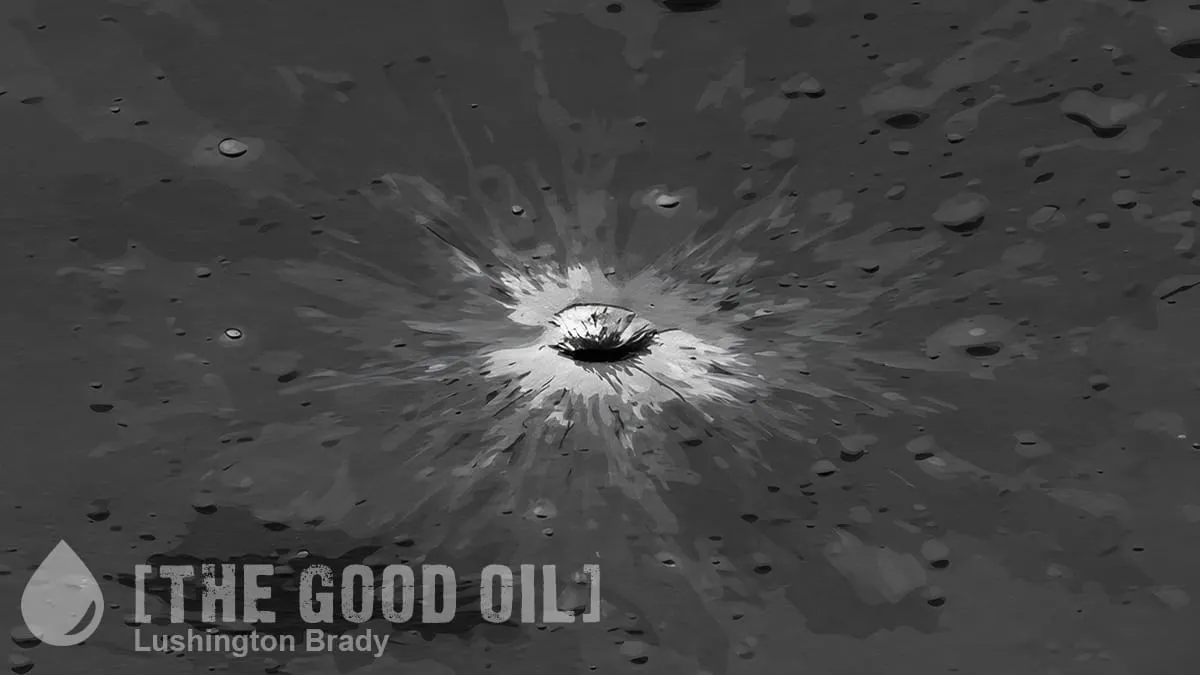
We often think of the Moon as a ‘dead’ world where virtually nothing has changed for billions of years. But that’s not entirely accurate: it may not have, so far as we’re aware, any internally active geology, but that doesn’t mean the Moon is completely unchanging.
That’s because of the same forces that gave the Moon its distinctive appearance. The great dark ‘seas’ and endless vistas of craters all owe their existence to billions of years of impacts from space. Indeed, the Moon has functioned in large part as a ‘cosmic vacuum cleaner’, hoovering up inbound rocks that might otherwise devastate the Earth even more often than they have.
Fortunately for us, it’s still doing it.
Last year a NASA scientist scrolling routine maps from the Lunar Reconnaissance Orbiter (LRO) stopped dead. Robert Wagner had spotted “an unusually large bright spot circled by a dark halo”. It was a paradigm case of the saying, apocryphally attributed to Isaac Asimov, that the most exciting phrase in science is not ‘Eureka!’, but ‘…that’s funny…’
When Mr Wagner spotted “an unusually large bright spot circled by a dark halo”, he said he immediately knew it needed further analysis.
“I just stopped, dropped everything, and started looking into what that spot was,” he said.
What it was is now called the McGetchin crater, after an old lunar hand. The crater is 222 metres across and 43 metres deep – wider and about as deep as the Colosseum. It was punched into the regolith sometime between 11 April and 22 May 2024 by a comet or asteroid the size of a three- to six-storey building. The previous LRO record-holder, found a decade ago, was a third the size. Events like this, NASA reckons, come around every 132 years. Wagner’s team call it a once-in-a-lifetime observation. For the Moon it’s a Tuesday.
The LRO has been circling since 2009, taking before-and-after pictures like a particularly obsessive landlord. It has logged landslides, landers, seismic faults and hints of lava tubes. About 140 new craters turn up each year – most are pinpricks from microscopic gravel. The camera can still resolve a hole nine metres across, made by a rock barely bigger than a metre. McGetchin is in another league. Ejecta flew more than a hundred kilometres, at a steeper angle than the models liked. The top two centimetres of lunar soil, it now seems, get overturned every 80,000 years: faster than the textbooks had it.
Night-time temperature maps showed a 6.5-kilometre patch around the new hole sitting slightly cooler than the neighbourhood. Disturbed bedrock and dust are fluffier, so they cannot hold heat. NASA noted, with the dry understatement of people who plan to park vehicles there:
“The large extent of this ‘cold spot’ is striking, because it shows that impacts can modify the Moon’s surface far beyond the crater itself.”
Not everything crashing on the Moon comes from deep in, or even from outside of the Solar System, though.
A month earlier the vacuum cleaner collected something we threw. On 5 August the upper stage of a SpaceX Falcon, having drifted for more than a year, hit at 8,700 kilometres an hour and left an 18-metre crater less than three metres deep. Humanity’s contribution to the bombardment: a used bottle tossed over the fence.
The romance of a changeless satellite is a poet’s convenience. The thing is a shooting gallery that regularly saves Earth’s arse. Every dark sea is a frozen splash from something that did not obliterate the very earliest sparks of life on Earth. Every new bright halo is something that might not have wiped us out, but would have been decidedly inconvenient.
The Moon is still hoovering. We should be grateful it is.