Table of Contents
The worst fate that can befall a subculture is that it gets adopted by the mainstream. In the ’50s, the small group of brilliant artists and writers who called themselves “Beats” became famous and the media engendered the Bowdlerised caricature of the finger-snapping, beret-and-shades-clad ‘like, groooovy’ hipster. A decade later, Hunter S Thompson wrote that “San Francisco in the middle ’60s was a very special time and place to be a part of.” Then Scott McKenzie’s “San Francisco (Be Sure To Wear Flowers In Your Hair)” made it a phenomenon – and six months later, a funeral, “Hippie, Son of Media” was announced by San Francisco’s original bohemians. A decade after that punk quickly morphed from an explosion of creativity on multiple continents, into yet another uniformed, regimented subculture.
Around the same time, another subculture began to coalesce around self-published comic books and stories, and fledgling conventions: the furry fandom. Seven years ago, long-time stand-up comic and furry elder Matthew “2Gryphon” Davis announced that the fandom was not dying – it was dead. And it was killed by the left and transgenderism.
To understand the death – murder, really – of the furry fandom, you first have to understand what it is. Or was.
You probably think the furry fandom is ‘weirdos who think they’re animals’ and ‘perverts who dress as animals and have sex with each other’. Both notions are wrong. Or at least were.
What the fandom was, was a gathering-point for fans of anthropomorphic art, literature and cinema. Disney and Bugs Bunny cartoons, the Narnia and Redwall novels, Bambi and Watership Down. Anything that featured humanoid animals, or animals talking and acting in humanised ways.
In a way, the furry fandom, as in anthropomorphism, is as old as humanity itself. The oldest known human figurative art is the 40,000 year-old, small ivory statue of the ‘lion-man’ from Germany. From the gods of Ancient Egypt, to the fables of Aesop, Lewis Carroll, Walt Disney and Hanna-Barbera, humans have always enjoyed anthropomorphic characters. The furry fandom made anthropomorphism their subcultural touchstone.
The arrival of the internet in the late ’80s and early ’90s spurred the fandom on, as fans across the world began to discover each other and their mutual interest. Comics like Steve Gallacci’s Albedo science fiction military series, set in a sector of space populated by sapient and predominantly humanoid versions of mammal and avian species, began to appear. Stan Sakai’s Usagi Yojimbo, Jim Groat’s Red Shetland (a parody of Red Sonja) and more soon followed.
According to “Online Furry Expert” Roy Calbeck:
Furry comics were the driving force in the fandom’s first decade and because of that we kept it clean... Pinups like you’d see on Bettie Page calendars was about as racy as it got. We were about science fiction, fantasy, novels, animation and, of course, swapping art in big black sketchbooks, just for the fun of creating.
Coinciding as it did with the advent of role-playing games, adopting ‘fursonas’ within the fandom became popular. This was not that furries thought they were animals ‘trapped in a human body’. A ‘fursona’ was no different than a nom-de-plume like, well, ‘Lushington Brady’. A different subculture, ‘otherkin’, do believe they are ‘animals trapped in a human body’: furries long regarded them as fringe weirdos who lurked at the fringes of the fandom. Not any more.
“We were first to fall. I’m sorry, #CharlieKirk”
– Roy Calbeck
As the fandom grew and conventions became more popular, something began to change. “It was going well for a good long time,” says Davis. “But eventually we started having a problem… I’m gonna call him Bo Peep because… a 50-something man – male pattern baldness and a geek beard – wearing a Little Bo Peep outfit.”
At first the furries would politely explain to people like Bo Peep that, ‘You know, maybe you’re looking for another con down the street or something, because this isn’t what we are.’ But Bo Peep objects that, ‘How dare you tell me I don’t belong in your group, because I identify as Little Bo Peep.’ And so, just as happened to the lesbians and gays when they let the ‘T’s in, ‘inclusion’ and misplaced altruism became a death-knell.
“The furry fandom kind of went, well, what’s the harm? … and besides that, furry fandoms were very used to rejection and they didn’t want to see other people be rejected. But the foot was in the door – and the problem only got worse,” as Calbeck relates.
“Then we had sexual lifestyle activists enter the fandom… No one batted an eye because no one cared who you banged in the privacy of your own bedroom.” Then the transgenders decided that, besides being women trapped in men’s bodies, they were animals trapped in human bodies.
Just as American punk was subsumed by what were derided as “Quincy Punx”, named for an episode of the medical drama Quincy ME, which sensationalised supposed violence in the punk subculture – and became a self-fulfilling prophecy as young men with an itch for violence decided ‘punk’ was where they wanted to be.
In the case of the furry fandom, it was an episode of CSI: Las Vegas, which featured a ridiculously fictionalised episode with a ‘furry sex party’. Long-time participants in the fandom laughed it off, until it, too, became a self-fulfilling prophecy.
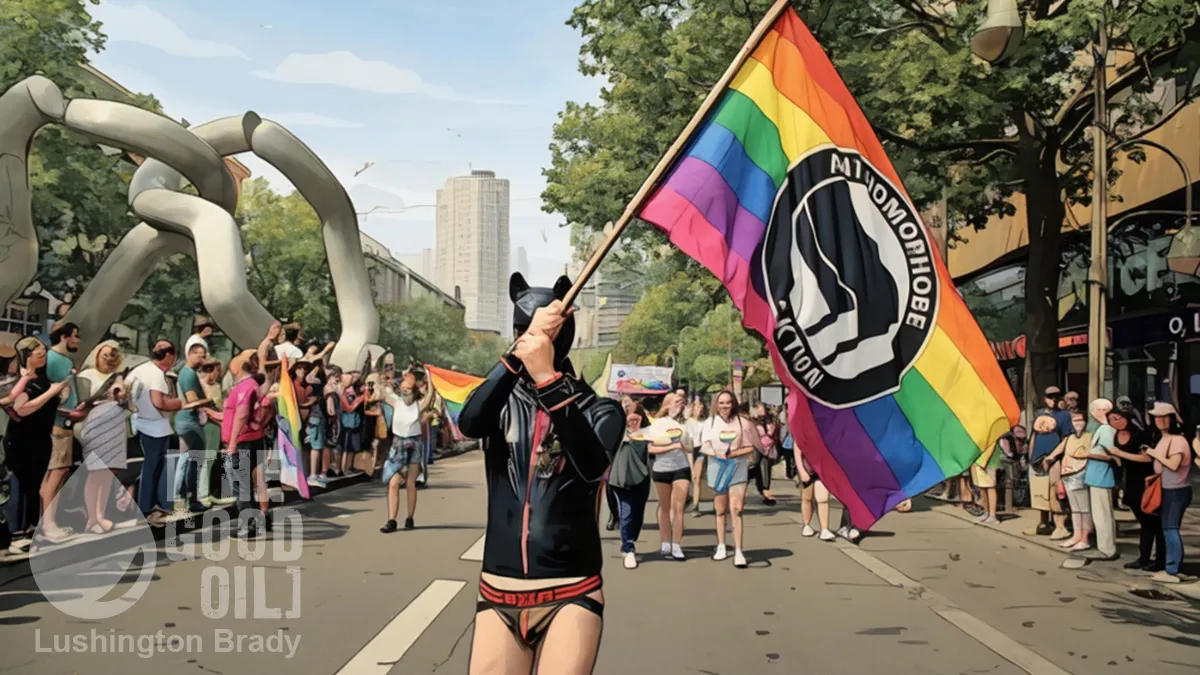
Within a few years, people started showing up to the convention who openly complained that that had no idea what a ‘furry’ was and no interest in it either; they were under the impression that it was some kind of Gay Pride event, so they showed up in drag-queen outfits and leather bondage with leashes attached.
Because people were used to bringing their kids, and because some of these events and incidents were at family venues such as the Knott’s Berry Farm Hotel, a schism formed whereby one side demanded the pervs at least keep it to themselves and the other called them – us – Nazis.
The furry fandom got targeted, just as feminists and gays are now. “If you weren’t on board with wearing bondage gear in public, you were a literal fascist,” says Calbeck. Not just wearing bondage gear in public: in the last decade, furry message boards have been increasingly flooded with outright paedophilic content and users.
The same routine was played out there as would be elsewhere: smear, isolate and run out anyone opposed to anything because if you didn’t they were going to ABSOLUTELY murder you, don’t you know some of them are gasp CHRISTIANS?!…
That’s when furry Antifa cells began to show up at furry conventions with baseball bats, slapping “NAZIFUR” stickers on hotel room doors. Some of these began advising people on Twitter how to face off with cops in the streets.
Stating the obvious fell on deaf ears. They were, and mostly still are, in total control of the fandom. Discord leaks talking about how to poison the coffee of “Nazifurs” circulated along with lines like ‘shoot some fascists and use centrists for target practice’. It became laudable to tell everyone how violent you were prepared to be to battle [insert made-up insane conspiracy theory here].
And now here’s the chicken, roosting on a corpse… we were first to fall. I’m sorry, #CharlieKirk.”