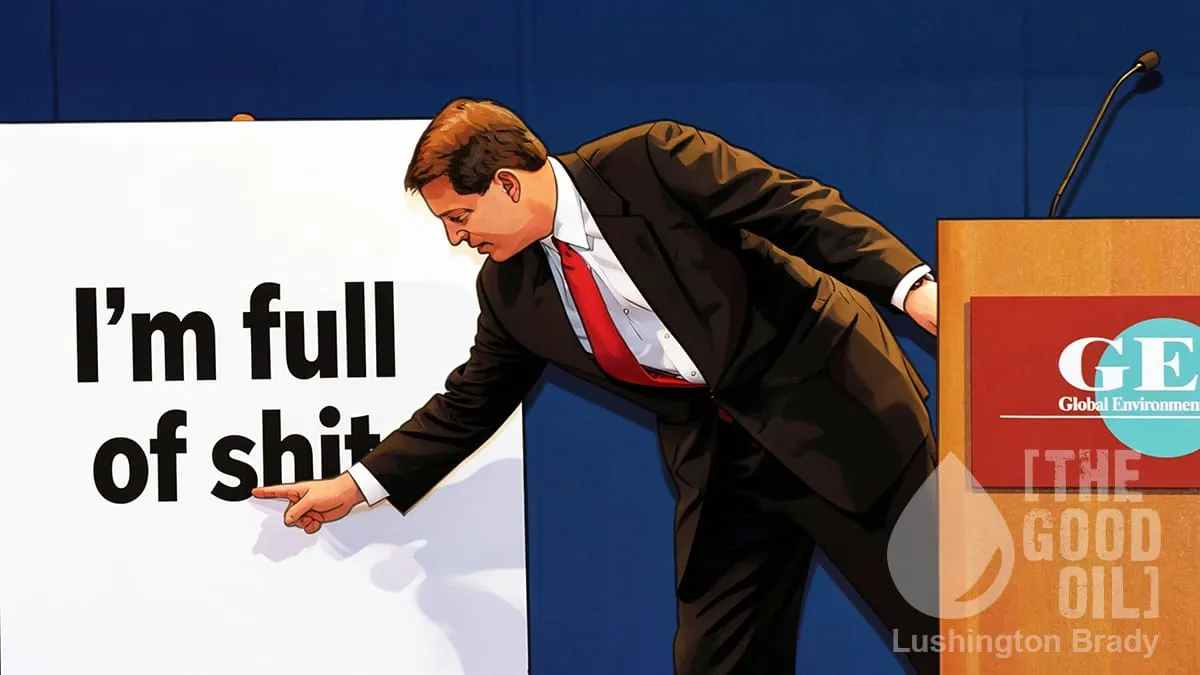
To paraphrase A Few Good Men, you want the inconvenient truth? You can’t handle the inconvenient truth! At least, not if you’re one of the legions of Climate Cultists who swallowed Al Gore’s death-by-PowerPoint agitprop as the New Green Gospel. Like the late Paul Ehrlich’s The Population Bomb, the years have not been kind to Gore’s jeremiad.
Two decades have elapsed since the erstwhile vice president rolled out his glossy, cinematic scare-mongering, successfully shifting climate anxiety from the dry cloisters of academia straight into the fevered imaginations of the chattering classes.
More than any other single work, this glossy, visually dramatic production translated the abstractions of climate modeling into a compelling narrative – one that struck fear into the hearts of tens of millions.
Naturally, the empirical ledger tells a rather different tale. The foundational warming metrics rely heavily on the tail end of the Little Ice Age as a convenient baseline, inflating normal climatic ebb and flow into an unprecedented planetary emergency. Yet, despite the apocalyptic forecasts of drowned island nations, boiling rainforests, and millions of climate refugees, none of whom deigned to materialise, our sanctimonious high priests of Net Zero doubled down. Trillions upon trillions of dollars have since been immolated on the altar of the grand energy transition.
Annual global expenditure on the so-called energy transition now exceeds $2 trillion – more than two per cent of world GDP – with cumulative spending since the release of An Inconvenient Truth reaching $10–15 trillion.
And to what end? While Bjørn Lomborg and the Copenhagen Consensus repeatedly point out that genuine human miseries – malnutrition, malaria, clean water deficits – could be comprehensively alleviated for a mere fraction of this fiscal profligacy, our Davos-dwelling betters prefer grand gestures. Every dollar directed toward this green leviathan is a pound ripped away from real human flourishing, sacrificed to appease the Gaia-obsessed deities of central planning.
The sheer gall of the enterprise, however, reaches its zenith when confronted with what can only be described as an ‘anti-truth’: a falsehood so thoroughly upside-down that reality itself has rudely intervened to mock it. We were promised relentless desertification, withered crops, and a scorched, barren earth. Instead, satellite data reveals something entirely inconvenient to the doom-mongering fraternity.
The Earth had not only failed to become more drought-prone and desert-like, but had instead been transformed – and stunningly so – into a much greener planet, with up to half of the world’s land surface showing clear increases in vegetation density.
Praise be to carbon dioxide! Back when I was still drinking the Klimate Kool-Aid, the fossil fuel industry ran an ad praising CO₂, with the tagline, ‘They call it pollution: we call it life.’ At the time, I dutifully regarded it as outrageous. The planet has since slapped my unquestioning belief right in the face. Far from being the apocalyptic demon gas of progressive nightmares, CO₂ has acted as an elixir for the botanical world. Staple crops are thriving, agricultural yields are up by double digits, and an expanse of greenery roughly equivalent to two continents has bloomed across the globe. If flora possessed suffrage, they would undoubtedly ballot for even higher atmospheric concentrations, having narrowly survived a historical CO₂ drought during the glacial epochs.
Yet, do our professional catastrophists thank the heavens, or the fossil fuel industry, for an abundant harvest and a greener Earth? They’d sooner drink cask wine. Their ideological commitment is impervious to mere facts. For the radical left, climate panic has never been about atmospheric chemistry: it is a Trojan horse for the dismantling of free-market capitalism. As Naomi Klein and her fellow travellers so candidly admit, the crisis is simply too jolly an opportunity to waste if one wishes to impose totalising state control, egalitarian redistribution and de-growth upon the West.
It all brings to mind George Orwell’s biting observations regarding the psychological architecture of the professional socialist: less animated by a genuine affection for the downtrodden than by an ascetic, snobbish resentment of the productive and successful, not to mention the awful proles. As satirical magazine Viz so accurately summed it: Ordinary people are just ruining the planet for celebrities.
Solar and wind installations, touted as redemptive by the same activists warning of CO₂ catastrophe, require backup generation of equal capacity for periods of calm or cloud – inevitably fossil-fired, often coal.
It is magnificent theatre, of course. Western taxpayers burn trillions to shutter reliable baseload energy, banish domestic hydrocarbons and cripple manufacturing, all whilst China and India commission coal-fired power stations with cheerful abandon. A grand exercise in performative penance that achieves precisely zero for the global climate whilst immiserating the working man.
Had a fraction of these squandered trillions been applied sensibly, say, toward an expansive fleet of modern nuclear reactors and advanced desalination infrastructure, we could have solved global energy poverty, irrigated the Sahara, banished drought forever and maybe finally have got those flying cars.
But redemption through abundance holds zero appeal for a movement whose very lifeblood is grievance, austerity and control. They do not wish to save the planet – they merely wish to run it.